Read · 2 min

+2 contributors


Definition of complex numbers
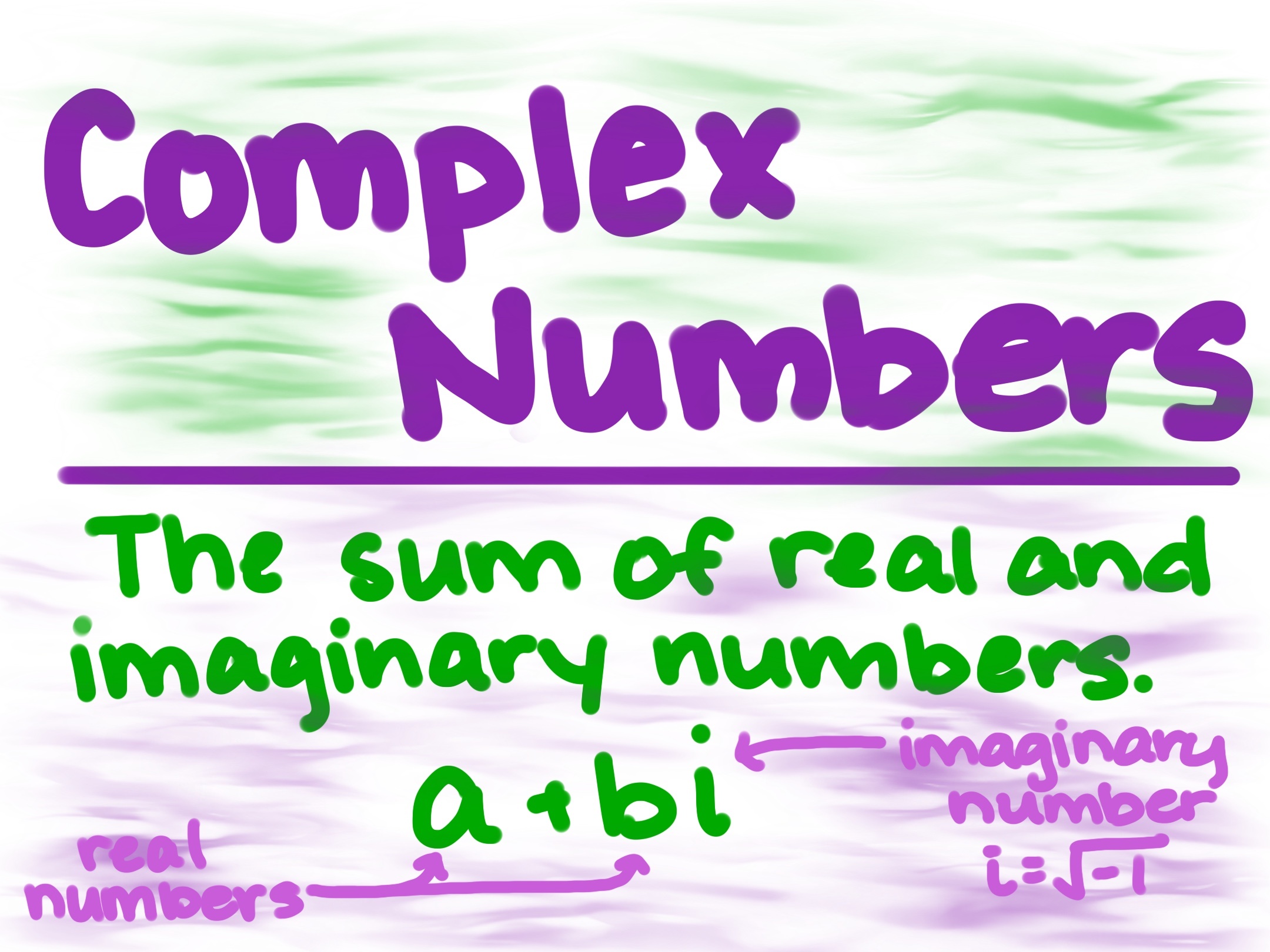
Complex numbers are the sum of real and imaginary numbers (and you thought it ended at combining numbers and letters). A complex number will take the standard polar form: Where and are real numbers and on the complex plane. It's a slightly different number system.
Here are some examples of complex numbers:
Now, there is one interesting fact about complex numbers. That fact is that integers are also complex numbers! For example, is a complex number because it can be written as . You can also have negative complex numbers!
Purely Imaginary vs. Real Numbers
We have become acquainted with real numbers, these are numbers that exist on the real number line. For example, , , and are all real numbers because they show up on the real number line.
A purely imaginary number is a multiple of . So, , and are all purely imaginary numbers, which are also known as non-real numbers.
Now, real and purely imaginary numbers combine to form complex numbers. So, this means that all imaginary numbers are also complex numbers. This also means that all real numbers are complex numbers!
For example: is equal to , but it is also a complex number because it has an imaginary part. Granted, the imaginary part is equal to , but it is still there. Conversely, is a complex number that is equal to . The real part is equal to , but it is still there.
Break It Down Now
We now know that complex numbers can be written as . We know what and are, let's think about what they represent.
is the real part of the complex number, . We can also write this as is the imaginary part of the complex number, . We can also write this as
Note: Both parts of the complex number are real numbers. So if someone asks for the imaginary part of complex number , they are asking for the real number , NOT . However, is an imaginary number, but it is not the imaginary part of the complex number.
Simplifying complex numbers often requires understanding powers of imaginary numbers. Non-real roots of polynomials occur in conjugate pairs, as described by the conjugate root theorem.