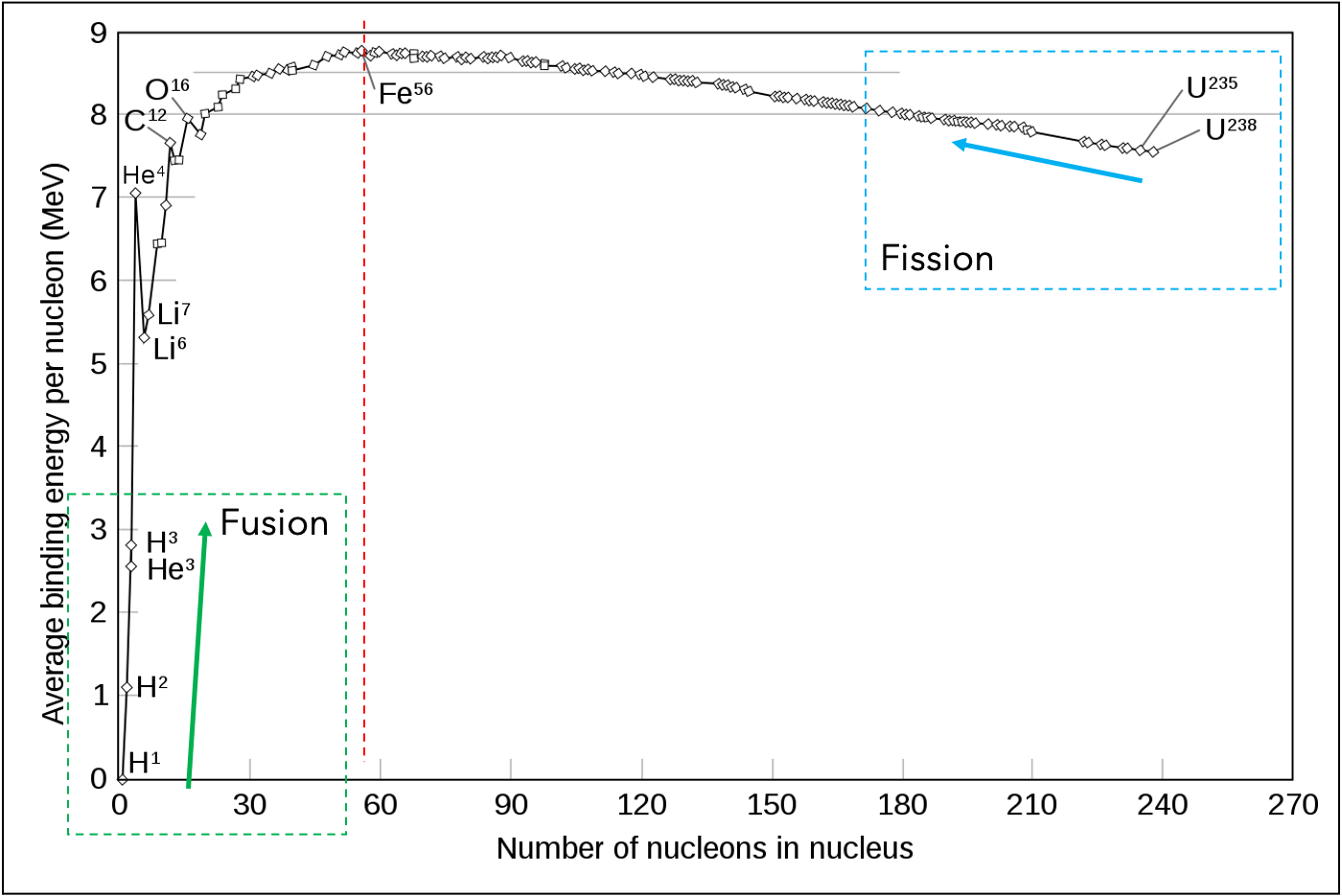
As we've been studying radioactivity, we only examined individual elements and atoms. We started by talking about nuclear stability. On the periodic table, the binding energy declined beyond the metal lead. So, we knew that electrostatic repulsion was overcoming the strong nuclear force. We also examined a strange phenomenon called the mass defect. There was a difference between an element's theoretical and calculated mass. Why? Because some of the mass is energy! That's Einstein's famous relativity equation.
Next, we learned that a nucleus becomes more stable by releasing radiation. But, each type was unique. Alpha decay ejects a helium nucleus. Its goal is to reduce the mass. Beta expels an electron to convert a neutron to a proton. The conversion helps to balance the electrostatic and strong forces. Gamma decay emits a photon to relax to a lower energy. The weirdest was electron capture. The nucleus sucks up an electron from the 1s-orbital. What's the result? A proton becomes a neutron! It's also an attempt to balance the forces.
So far, we've done a lot of work. But, we still haven't looked at any nuclear reactions. Let's fix that!
What is a Nuclear Reaction?
Let's start by defining a nuclear reaction. A nuclear reaction is a chemical reaction that involves atomic nuclei instead of electrons. There are two methods. The first is slamming two atomic nuclei together. The other is to hit an atom's nucleus with a subatomic particle. Most often, we're using neutrons. In both cases, one or more new nuclides forms.
There are two categories of nuclear reactions.
-
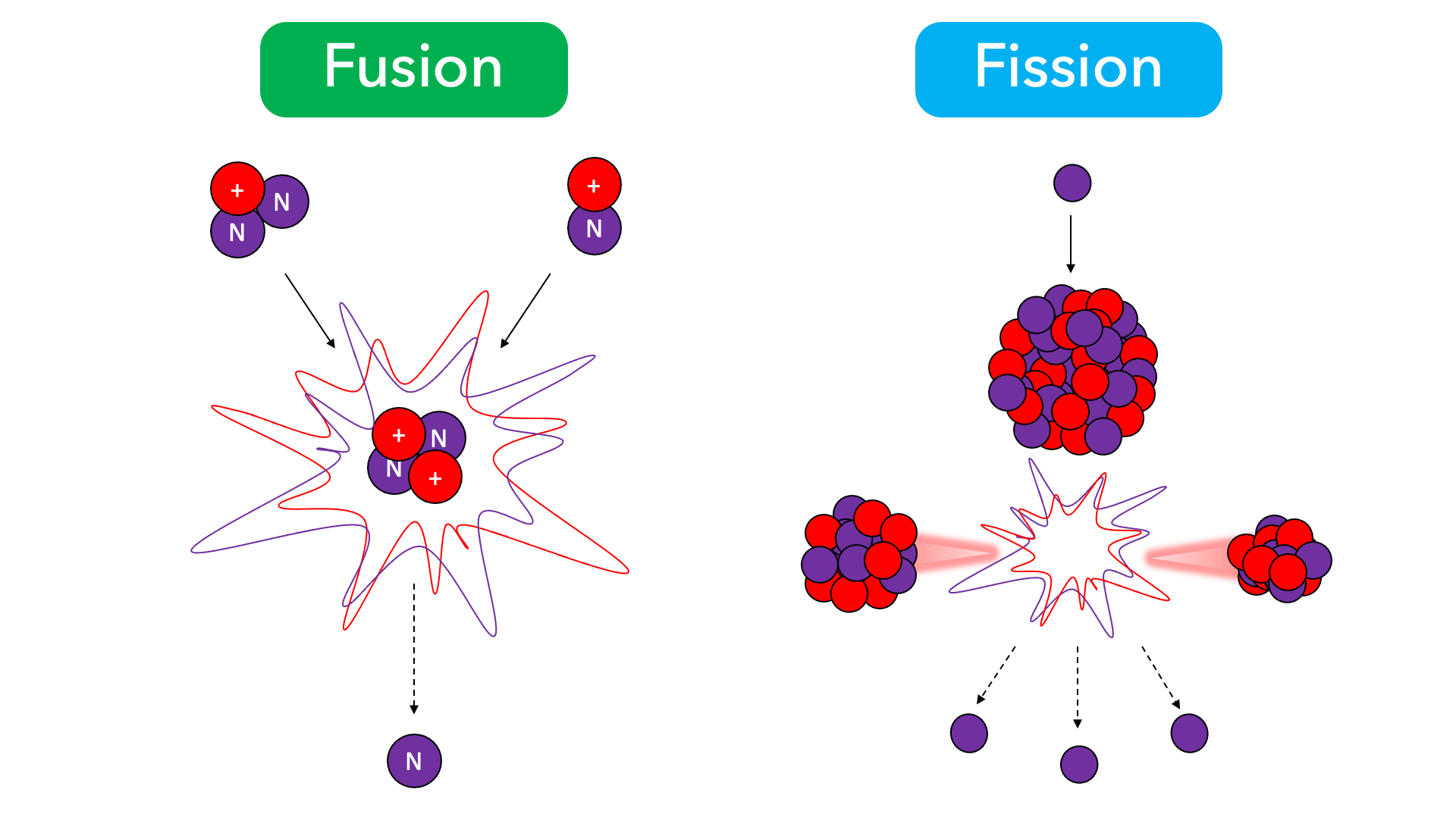
Fission Reactions: A large nucleus is hit by and absorbs a smaller nucleus or subatomic particle. The absorbed particle causes the nucleus to become unstable. So, it shatters into multiple smaller nuclei.
-
Fusion Reactions: Two nuclei collide and combine. The result is a new stable nucleus. Sometimes, the collision ejects other smaller particles.
Collisions in Nuclear Reactions
How do nuclear reactions work? They're amazingly similar to the chemical reactions we already know. Do you remember collision theory? For a chemical reaction to happen, molecules must collide. But, they have to hit with the correct energy and orientation. Remember, atoms and molecules are whizzing around very fast. So, only a tiny fraction undergoes a reaction. But, the sheer volume of collisions ensures it proceeds.
How does all this translate to nuclear reactions? It happens when two nuclides strike with the correct energy. Thankfully, we assume that nuclei are spheres. So, we don't have to worry about orientation. But, we still need to consider probability. That's why a nuclear reaction is only between two nuclides. The chance of three nuclides hitting each other is low. Even more, the odds that they have the correct energy are low. So, rarely see a reaction between three nuclides.
There is one example that comes close to a three-particle collision. The noble gas helium tends to collect at the center of old stars. Our sun is currently undergoing hydrogen fusion. So hydrogen converts to helium in a three-step process. But, old stars run out of hydrogen. So, they begin to fuse helium. Remember, the pressures and temperatures in a star's core are astronomical! So, they have a lot of energy. Sometimes, two helium-4 nuclei collide and form beryllium-8. Beryllium-8 is a very unstable isotope. How do we know? Its half-life is 8.9×10⁻¹⁷ seconds. That's 89 attoseconds! It decays so fast that it's incomprehensible. But sometimes, another helium nucleus will strike. What's generated? Carbon-12! It's the primary source of carbon in our universe! Technically, it's a two-step mechanism. But, it transpires so quickly that we could consider it a single collision.
Writing and Balancing Nuclear Reactions
Just like chemical reactions, we can write and balance nuclear reactions. A chemical equation tells us that bonds are breaking and reforming. But, the number of atoms is constant. So we balance the moles. In a nuclear reaction, nucleons get rearranged. But, their total number is unchanged. So, instead of balancing moles, we balance the mass number and atomic number. So how do we write balanced nuclear equations?
- We write each nuclide with its isotope notation. That tells us the mass number and the protons.
- The total of the reactant's mass numbers must always equal the product's.
- The total atomic number must also be conserved. We write electrons as −10e and neutrons as 00n.
- Sometimes, we have ions. So, our third step is to balance the charges.
Let's study an example. We'll use the helium reaction between the three helium atoms discussed before.
So, we know that two helium atoms are reacting. How do we write heliums isotope notation?
24He
So, the reactants' side of our equation contains two helium atoms.
24He+24He
Next, we need to balance the mass numbers and the protons. In this case, we know there is only one product. So, our product's mass number is 8, and the proton number is 4. If we look at our periodic table, that's beryllium. So, what is our balanced equation?
24He+24He→48Be
What about the second reaction? Beryllium-8 reacts with helium to produce carbon-12.
48Be+24He→612C
Let's look at another example. The alkali metal potassium-40 undergoes electron capture. Write its nuclear reaction.
Let's start by writing the isotope notation.
Potassium-40 is 1940K.
An electron is −10e.
Let's write the reactant side of our equation.
1940K+−10e→
Our total mass number is conserved. So, we only need to balance the proton atomic number. So, we have element number 18. That's the noble gas Argon.
1940K+−10e→1840Ag
Let's look at a final example from the actinide elements. When we studied decay series, we looked at Uranium-238. Its first step is alpha decay. What is the nuclear equation?
First, let's write the isotope notation for Uranium-238 and an alpha particle.
We can write alpha particles in two ways: 24He or 24α.
92238U
Let's write our chemical equation. We'll write "X" for the unknown element.
92238U→24He+X
We need to balance the mass number and protons.
238=4+X→X=234
92=2+X→X=90.
So our new element is Thorium-234! Let's write our balanced equation.
92238U→24He+90234Th
Conservation of Energy
When we studied thermodynamics, we looked at a reaction's energy. The first law was the conservation of energy in a closed system. We had to end with the same amount as we started. We only transformed the system's energy. That's also true for nuclear reactions, but it takes on a new twist!
In nuclear reactions, relativistic energy is conserved. Let's consider a nuclear reaction that releases energy. We still call it an exothermic reaction. Why? The discharged energy is kinetic energy. The nuclei are moving faster. So, the temperature increased. Where did we get that energy? Before the reaction, it was the reactant's binding energy. So there was an energy transfer. We can also have endothermic reactions. Some amount of energy is absorbed to allow the reaction.
But, how do we calculate the energy released or absorbed? We use the same procedure as summing the mass defect. Let's consider a simple nuclear reaction. Let's slam two hydrogen atoms together to make helium. We'll need the isotope of hydrogen named deuterium.
Let's write the balanced nuclear equation.
12H+12H→24He
Now let's add the masses of the reactants and products.
Reactants: 12H+12H=2.014amu+2.014amu=4.028amu
Products: 24He=4.003amu
Now we can subtract the reactants and products.
4.028amu−4.003amu=0.025amu
We know that 1amu=931.49MeV. So, we can calculate our energy.
−0.025amu×931.49amuMeV=23.3MeV
So, we released 23.3MeV of energy. Wait a minute, why isn't it negative? Unfortunately, this happens when there is overlap with physics. Nuclear physicists and chemists use the opposite sign conventions. So, a positive sign indicates an exothermic reaction.