Illustrated · 1 min

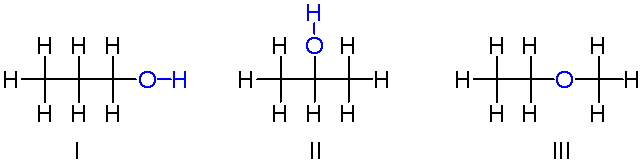
Three isomers of . Each cross between lines represents a C atom.
When discussing the covalent bonds in , we automatically assumed that one carbon and four hydrogens will form four C-H bonds because each H can only form one bond, and therefore they couldn't bond to both each other and carbon. When you have more complicated molecular formulas, though, how do you know which atoms are bonded with which?
The truth is, you don't. Many chemical formulas, or lists of the amount of each atom in a molecule, such as , actually describe multiple different molecules with different bonds between atoms. The different bonds and structures result in dramatically different properties. These molecules are called isomers of each other. They are particularly common among organic molecules, because carbon can form 4 bonds, and is therefore able to get rearranged in many different structures.