Illustrated · 1 min

Lemniscates
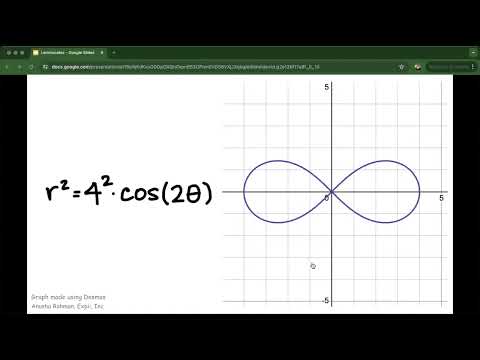
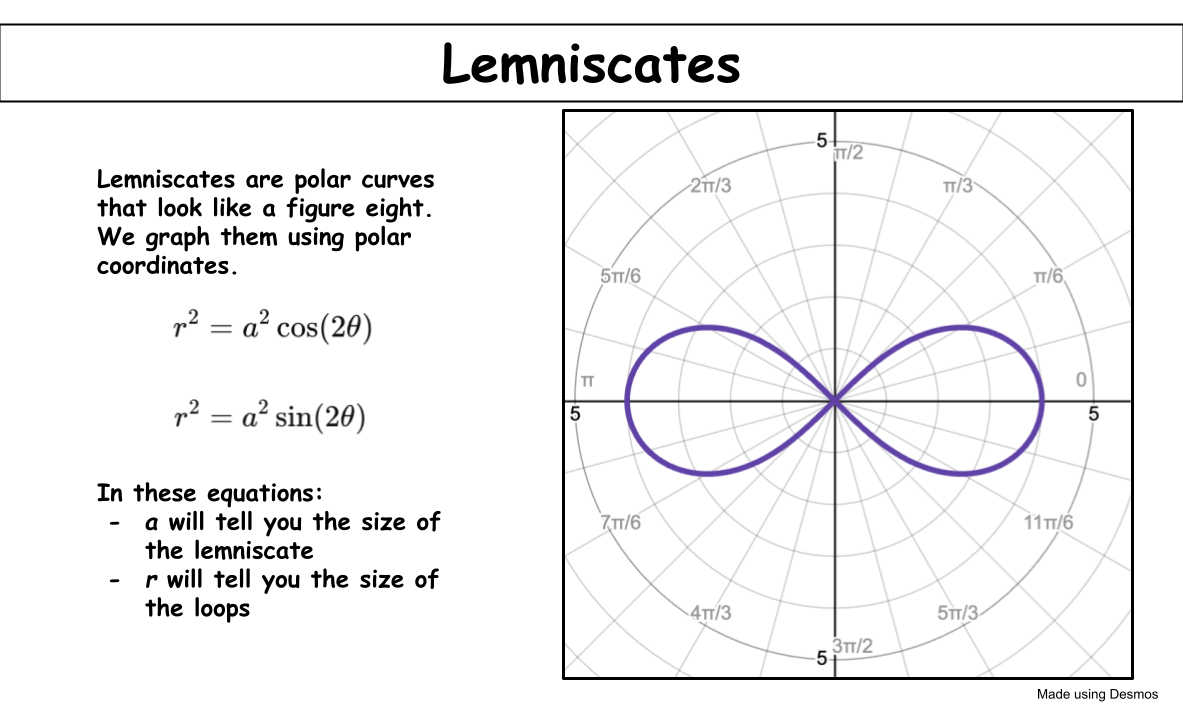
In this lesson, we will learn about lemniscates, particularly the Lemniscate of Bernoulli, a special case of a lemniscate! Lemniscates of Bernoulli are mathematical curves that look like a figure eight, or an infinity sign:
Here's a short history lesson: the term "lemniscate" comes from the Latin word, "lemniscatus", which means "decorated with ribbons" or "in the form of a ribbon". Jakob Bernoulli first studied lemniscates in the 17th century.
The polar equation of a lemniscate is:
, where is the distance from the origin to a point on the curve, is the angle that the line from the origin to that point makes with the -axis, and is a constant term.
If you ever encounter a situation where the coordinates aren't in the form you need, don't sweat! Remember that you know how to [convert from polar to rectangular and from rectangular to polar!
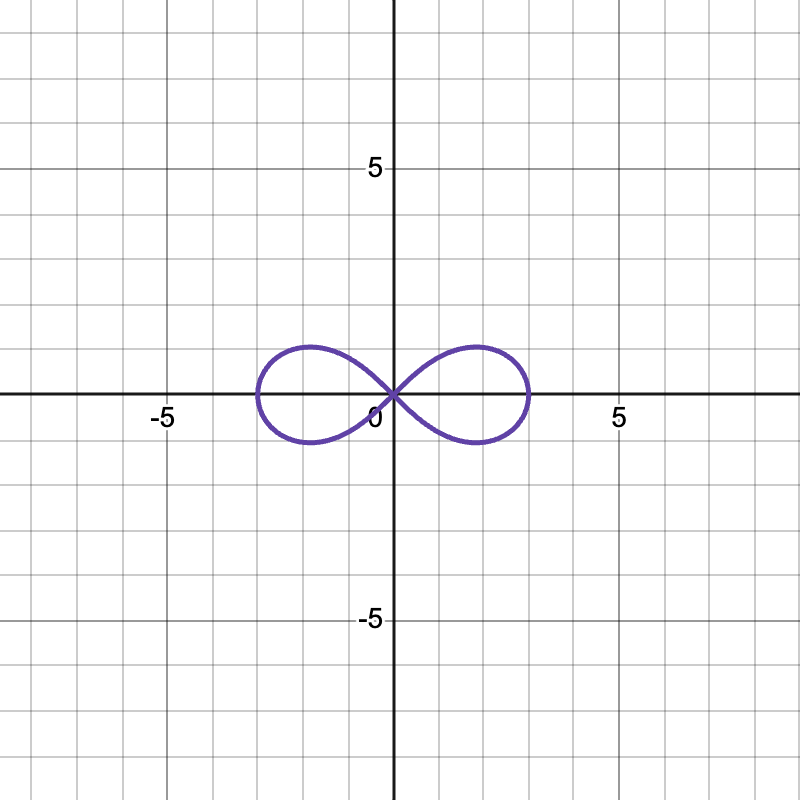
Consider the following equation: over . Here is a graph of this equation:
Made using Desmos
This looks cool! It looks like a figure eight.
Some properties to keep in mind:
- Lemniscates are symmetrical about both the - and - axes.
- The length of a lemniscate curve can be calculated using elliptical integrals.
- The area enclosed by a lemniscate can be calculated using elliptical integrals.
- Lemniscates are often expressed in polar coordinates, which makes them easier to work with.
There are many cool applications for lemniscates! For example, lemniscates can describe the motion of a particle in a gravitational field when the particle's orbit has a specific shape. It's even been used as inspiration in the arts, since the shape is so elegant.