Illustrated · 1 min

Lemniscates

In this lesson, we will learn about lemniscates, particularly the Lemniscate of Bernoulli, a special case of a lemniscate! Lemniscates of Bernoulli are mathematical curves that look like a figure eight, or an infinity sign: ∞\infty

Here's a short history lesson: the term "lemniscate" comes from the Latin word, "lemniscatus", which means "decorated with ribbons" or "in the form of a ribbon". Jakob Bernoulli first studied lemniscates in the 17th century.

The polar equation of a lemniscate is: r2=a2⋅cos⁡(2θ)r^2 = a^2 \cdot \cos(2\theta)

, where rr is the distance from the origin to a point on the curve, θ\theta is the angle that the line from the origin to that point makes with the xx-axis, and aa is a constant term.

If you ever encounter a situation where the coordinates aren't in the form you need, don't sweat! Remember that you know how to [convert from polar to rectangular and from rectangular to polar!

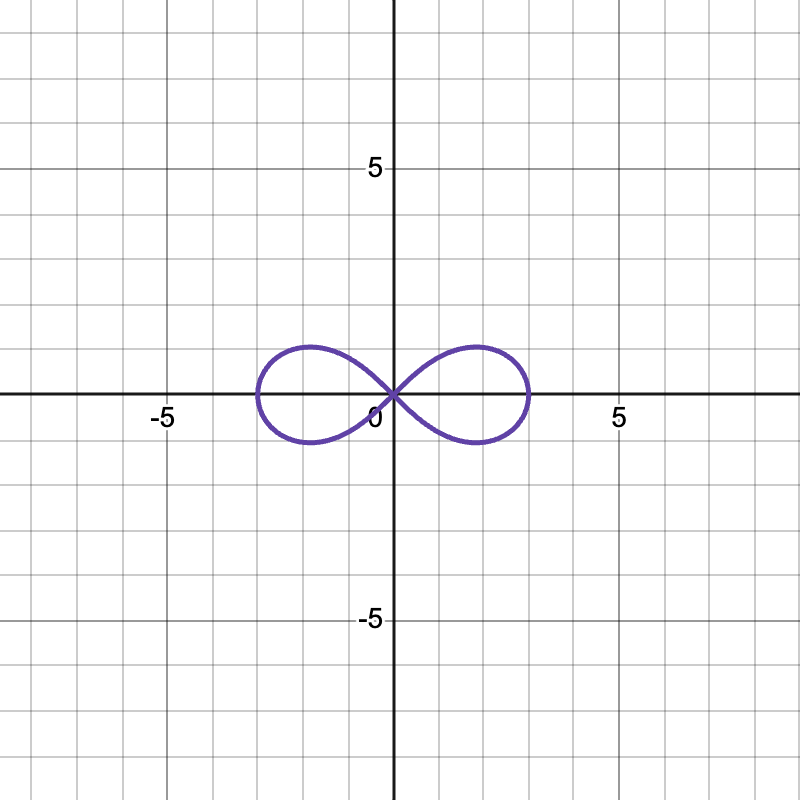
Consider the following equation: r2=32⋅cos⁡(2θ)r^2 = 3^2 \cdot \cos(2\theta) over 0≤θ≤2π0 \leq \theta \leq 2\pi. Here is a graph of this equation:

Graph of a lemniscate

Made using Desmos

This looks cool! It looks like a figure eight.

Some properties to keep in mind:

  • Lemniscates are symmetrical about both the xx- and yy- axes.
  • The length of a lemniscate curve can be calculated using elliptical integrals.
  • The area enclosed by a lemniscate can be calculated using elliptical integrals.
  • Lemniscates are often expressed in polar coordinates, which makes them easier to work with.

There are many cool applications for lemniscates! For example, lemniscates can describe the motion of a particle in a gravitational field when the particle's orbit has a specific shape. It's even been used as inspiration in the arts, since the shape is so elegant.
Video

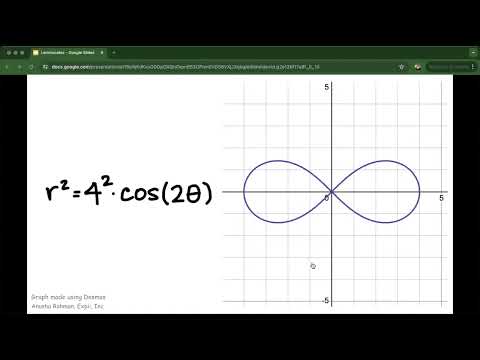
(Video) Lemniscates

by Anusha Rahman

In this short lesson by Anusha Rahman, you will learn about the basics of lemniscates.

Summary

Lemniscates is a fascinating mathematical curve that resembles a figure-eight. Here is the equation of a lemniscate:

r2=a2⋅cos⁡(2θ)r^2 = a^2 \cdot \cos(2\theta)

Lemniscates will typically exhibit symmetry along the xx-axis and yy-axis. Occasionally, they will also resemble symmetry along the origin.

Some cool tricks:

  • aa will tell us the distance from the center to one end of the lemniscate.
  • If we swap cosine with sine, the loops of the lemniscate will shift closer to the yy-axis. It looks like it's rotating!

Illustrated · 1 min

Lemniscates

A lemniscate is a polar curve that looks like a figure eight or infinity symbol. It's one of the coolest looking curves you can graph using polar coordinates!

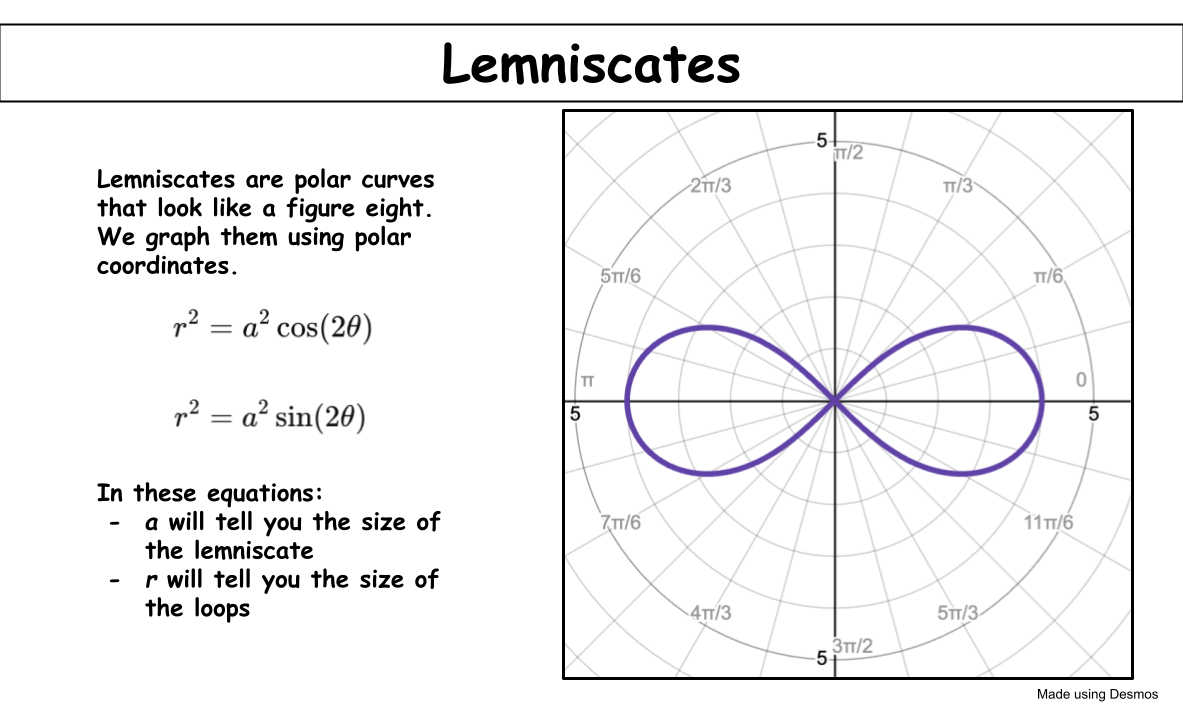
Lemniscates are polar curves that look like a figure eight. We graph them using polar coordinates.

Made using Desmos

The general form of a lemniscate is:

r2=a2cos⁡(2θ)r^2 = a^2 \cos(2\theta) r2=a2sin⁡(2θ)r^2 = a^2 \sin(2\theta)

In these equations,

  • aa tells you the size of the lemniscate
  • rr will give you both sides of the loop

Since the general form of the equation involves r2r^2, we will need to take the square root of both sides to find rr. This means we will often get both positive and negative values for rr - which is how we get both sides of the loop.

The graph of a lemniscate has two symmetrical lobes: one on each side of the origin. If the equation uses cos⁡(2θ)\cos(2\theta), the lobes lie along the xx-axis (horizontal). If it uses sin⁡(2θ)\sin(2\theta), the lobes are tilted at a 45∘45^{\circ} angle (diagonal).

Just like rose curves, lemniscates are symmetrical and repeat every π\pi radians. They pass through the origin, because when θ=0\theta = 0, r=0r=0. Lemniscates are special because they combine polar symmetry with double-angle trig functions.

Type a concept, like “slope” or “photosynthesis”.

↑ ↓ to choose · Enter to openSearch explanations and problems