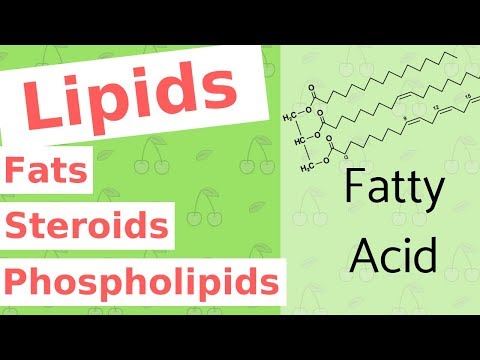
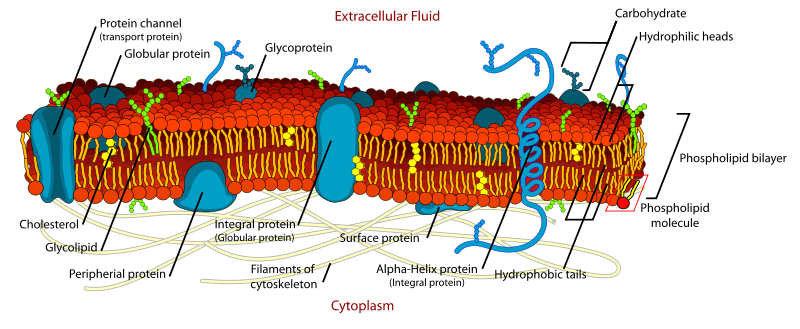
Lipids include fats, oils, waxes, and steroids. They are insoluble in water, which allows our bodies to use them as waterproof barriers and as components of cell membranes. They are also used to store energy, similar to polysaccharides.
Lipids contain more C−H bonds than carbohydrates and fewer oxygen atoms. The long hydrocarbon chain is nonpolar, while the small part with the oxygen is polar. This means that they are mostly nonpolar, so they are not soluble in water. Instead, lipids are soluble in fat and oils.
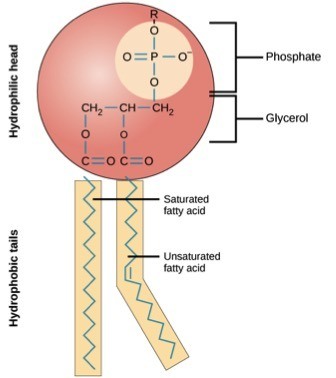
Saturated fatty acids occur when each carbon atom in the chain is linked by a single bond. The name saturated comes from the fact that each carbon atom has the maximum possible amount of hydrogens attached to it. They are typically solid at room temperature.
Unsaturated fatty acids have one carbon-carbon double bond.
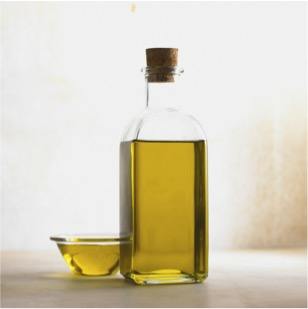
Polyunsaturated fatty acids happen when the chain has more than one carbon-carbon double bond. These types of lipids are typically liquid at room temperature, like olive oil.
Most lipids are made up of a glycerol molecule combined with three fatty acids, called a triglyceride. If the lipid has a phosphate group attached to two fatty acid chains, it is called a phospholipid.
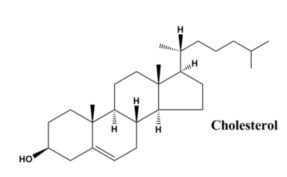
Steroids are the last type of lipid. They are used for chemical signals such as some hormones and vitamins.
Vocabulary Review:
Monomer : Any molecule that can react with other molecules of the same or different makeup to form a chain, or polymer
Polymer : A chain of monomers made of a specific type of compound
Macromolecule : A polymer that has a large (macro) molecular mass. There are four main types in organisms: carbohydrates, proteins, lipids, and nucleic acids
Saturated : Saturated fatty acids occur when each carbon atom in the chain is linked by a single bond
Unsaturated : Unsaturated fatty acids have one carbon-carbon double bond
Lipid : Fats and oils. Made up of a glycerol molecule and three fatty acid chains