Illustrated · 2 min

+1 contributors

Quick History Lesson:
Gregor Mendel was an Austrian monk and scientist who lived in the 1800s. He is remembered as the founder of modern genetics for his laws of inheritance, which are based on the results of his experiments with pea plants.
Although Mendel published his work, it didn't get recognized for its importance during his lifetime. It was only once his papers were rediscovered in the early 20th century that scientists realized his findings applied to and explained many observed patterns of inheritance. And the rest is history.

Image source: By Sylvia Freeman
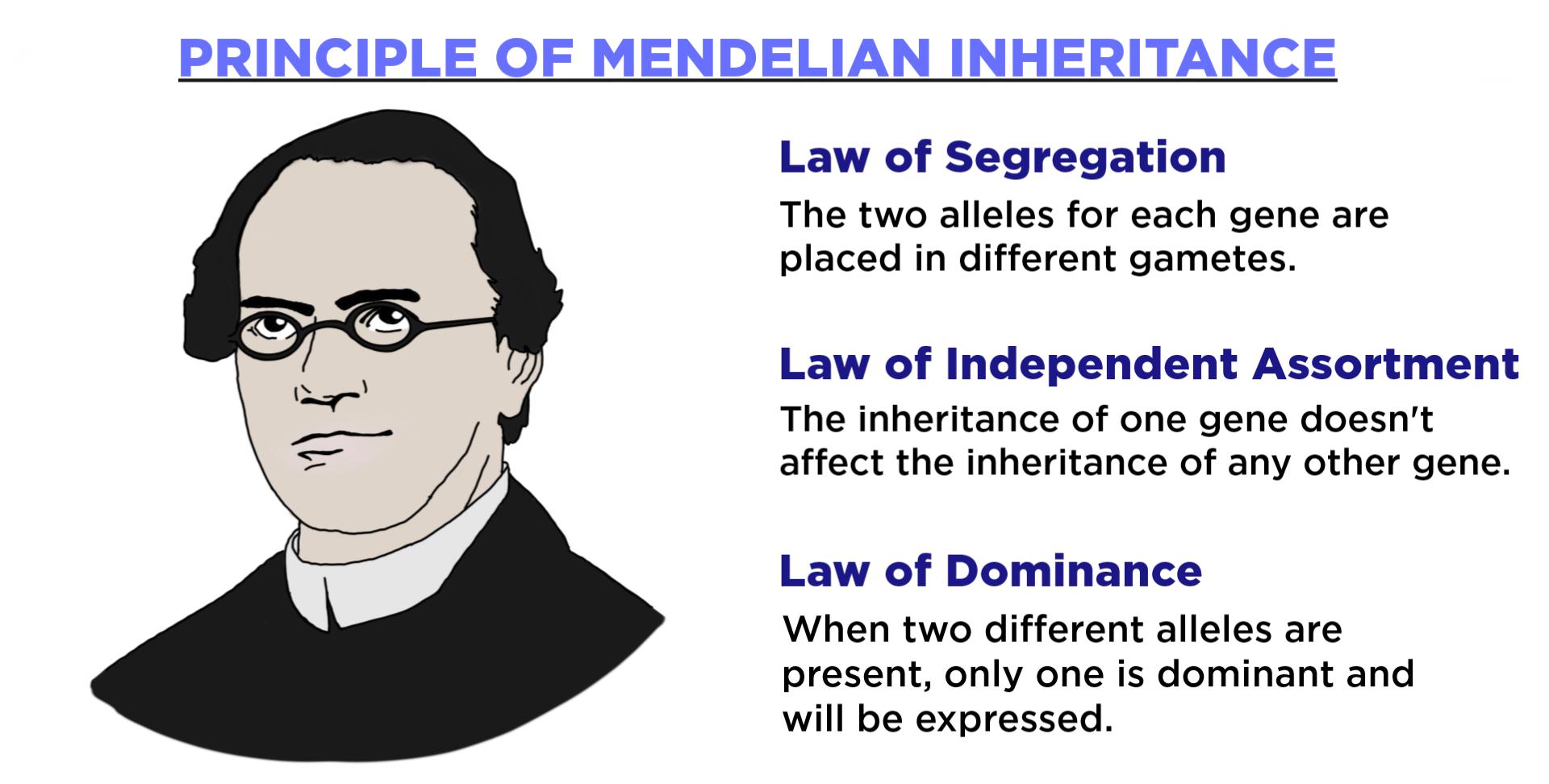
Mendel and his pea plants come up a lot for anyone studying either biology or genetics (Punnett squares, anyone?), but the key principles of Mendelian inheritance can be broken down into Mendel's three laws of inheritance:
Law of Independent Assortment
The law of independent assortment says that genes for different traits segregate independently of each other. It means that separate traits are separately inherited. This is because during meiosis the chromosomes line up randomly before the cell divides, allowing for gamete formation.
Law of Dominance
The law of dominance says that there are dominant and recessive traits. Dominant traits are defined as whichever phenotype is expressed in an organism that is heterozygous for the trait.
Law of Segregation
The law of segregation says that everyone has two versions (called alleles) for each trait—one from each parent—and that these alleles segregate randomly (see independent assortment) during meiosis.
A Brief Disclaimer:
Don't forget that Mendel's laws don't always work.
Mendel studied the results of crossing different traits in pea plants, which show relatively simple inheritance patterns. Luckily for Mendel, he didn't have to deal with any funky things like incomplete dominance, sex-linked genes, or polygenic traits in his pea plants. Although Mendel's laws work, they don't perfectly apply in all situations. See non-Mendelian inheritance for more.