From the Nuclear Model to the Neutron
In 1911 Ernest Rutherford discovered the atomic nucleus. His gold foil experiment revolutionized chemistry! He replaced the plum pudding model with the nuclear model. It was a significant insight. But Rutherford wasn't done! In 1917 he discovered the proton. Previously in 1897, JJ Thompson's cathode ray experiment uncovered the electron. So, we knew about two of the subatomic particles. At the time, physical chemists assumed we had discovered all the subatomic particles.
How did they imagine the nucleus without neutrons? They thought it consisted of protons and electrons. For example, consider nitrogen. We know it has an atomic mass of 14 amu. They thought the nucleus consisted of fourteen protons, seven core electrons, and seven orbiting electrons. The core electrons get embedded within the atomic nucleus. The orbiting electrons gave the atoms their chemical properties. The overall charge would still be neutral. Why? The protons and total electrons balance. A proton has a mass of 1 amu. So, the atomic masses also matched. But they quickly realized there were problems with the model.
Schrodinger published his quantum mechanical model in 1925. James Chadwick didn't discover the neutron until 1932. So, the arguments against the core electron model come from quantum mechanics. Let's look at a few of the critical challenges.
Remember, electrons have half-integer spin values. That's also true of protons. If nitrogen's nucleus has fourteen protons and seven core electrons, what's the spin? That's an odd number. So, it would have a half-integer spin. But, the experimental evidence showed that the nitrogen nucleus' spin equaled one. Today, we know that nitrogen has seven protons and seven neutrons. So, it has an even number of half-integer particles, producing a spin of one.
The next piece of evidence came from atomic spectra data. Electrons have a negative charge. So, they interact with other charged particles via electrostatic interactions. If there were core electrons, they should influence the orbiting electrons. On an atomic spectrum, the interaction should produce a splitting pattern. Two absorption or emission lines would be very close together. They would appear to be the same line. But, there is a slight gap. We would say that the expected spectral line got split. The atomic spectra data didn't have core electron-orbiting electrons splitting.
The final consideration comes from the Heisenberg Uncertainty principle. The details are slightly complicated. So, we'll only examine the conclusions. Confining electrons within the nucleus would cause them to have massive kinetic energies. It would far exceed the nuclear binding energy. So, The electron shouldn't remain in the nucleus. The kinetic energy would also exceed the energy of beta particles. A beta particle is an electron emitted from the nucleus during beta decay. At the time, they thought beta decay was ejecting a core electron. But the energies didn't match.
So, how did we actually discover the neutron? In 1931, a series of scientists uncovered an unusual phenomenon. They used polonium as an alpha particle source. They fired the alpha particles at beryllium, boron, and lithium. What was the result? A highly penetrating form of radiation. But there was a catch! It wasn't affected by a magnetic field. So, it was a neutral particle. Most scientists assumed that it was gamma radiation. But James Chadwick wasn't convinced. He performed a series of experiments that revealed some extraordinary results. His experiments confirmed the particle's neutral charge. But he made an unexpected discovery! It had a similar mass as a proton. Chadwick had discovered the neutron!
What Should I Know about Neutrons?
The Neutron's Mass
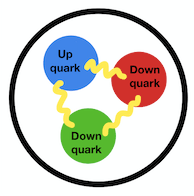
A common technique for measuring the mass of a charged particle is mass spectrometry. A mass spectrometer gives you a mass-to-charge ratio. But that won't work for a neutron. It doesn't have a charge. Thankfully, we have a workaround. We can use the hydrogen isotope deuterium. It has one proton and one neutron. So, we can subtract the proton's mass from the total. What's the result? A neutron's mass is 1.008 amu or 1.76×10⁻²⁷ kilograms. That's slightly larger than a proton at 1.007 amu. What causes the difference? Protons and neutrons have different combinations of quarks. Quarks technically do have their own mass. But the special relativity equation tells us that energy and mass are related. So, the interactions between quarks contribute most of the mass.
What's the Point of Neutrons?
So, are you wondering, "What's the purpose of neutrons?" They seem to be random neutral particles. They only reside in the nucleus. They don't influence chemical reactions. So, who cares? It turns out neutrons contribute to nuclear stability. Protons are positively charged. What should happen if you cram them into a tiny space, like an atomic nucleus? They should repel. So, why don't nuclei rip themselves apart? They are held together by the strong nuclear force.
The strong nuclear force is way more powerful than all the other fundamental forces. For example, it's approximately 130 times stronger than the electromagnetic force. The strong nuclear force is a property of quarks. Remember, quarks are the building blocks of protons and neutrons. It holds the quarks within the nucleons. It also keeps the nucleus together. The strong nuclear force only acts over a range of 2.5×10⁻¹⁵ meters. That's femtometers! That is about twice the diameter of a proton or neutron. So, within the nucleus, only neighboring nucleons feel the strong force. The neutrons contribute to the strong nuclear force. But they don't contribute to electrostatic repulsion.