Illustrated · 1 min
Nuclear Binding Energy
Learn how to calculate mass defect if you have not already.
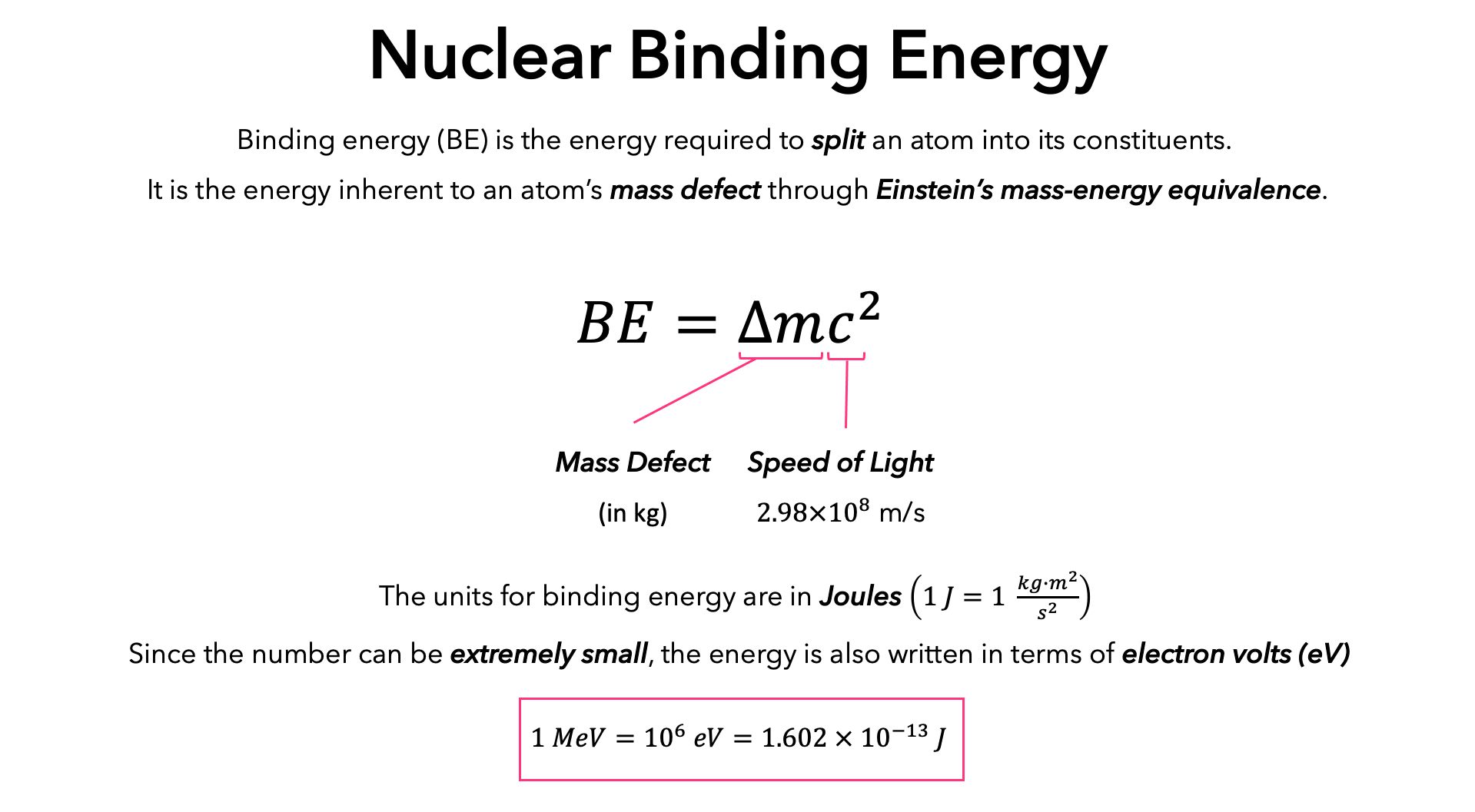
by T. Gibbons

by T. Gibbons

Before this, knowStrong Nuclear Force vs. Electrostatic Force — Overview
Illustrated · 1 min
Nuclear Binding Energy
Learn how to calculate mass defect if you have not already.
by T. Gibbons
by T. Gibbons
Read · 3 min
We're starting to study nuclear chemistry! We've left the world of electrons and chemical bonds. Now we care about protons, neutrons, and the nucleus. But, we can't forget everything. We have to remember some of our lessons from quantum mechanics. Why? Because at the quantum scale, nothing acts the same.
In 1905, Albert Einstien published his theory of special relativity. The problem was that Newtonian mechanics couldn't explain electromagnetism. Why? Because electromagnetic radiation is moving at the speed of light. At the speed of light, everything behaves in unique ways. So, Einstien had to rework mechanics to operate at unbelievably fast velocities.
What does this have to do with chemistry? Subatomic particles are moving at exceptionally high speeds. We saw that when we studied the strong nuclear force. The quarks that make up protons and neutrons are moving near the speed of light. How do they hold together? The strong nuclear force binds them. It's unbelievably powerful!
Special relativity had a lot of implications. But, the most famous was the equation, . In the equation, is energy, is mass, and is the speed of light. So, what's the equation telling us? Near the speed of light, energy and mass are interchangeable!
If mass and energy are equivalent, we should examine them for subatomic particles. The typical units we use for mass are grams or kilograms. But that's not very convenient for protons, neutrons, and electrons. So, what do we use instead? The atomic mass unit or . What's the conversion to kilograms? .
We also need to adjust our unit for energy. Most often, we use the joule. But, our masses are so small that our energy would be minuscule. So, we use the mega electron volt or . What's the conversion? .
Now that we defined our units, we can relate mass and energy. How much energy corresponds to an atomic mass unit? It turns out . So, we can list the mass and energy for our subatomic particles.
The periodic table tells you an element's atomic weight. But remember, the atomic weight on the periodic table is the weighted average of the isotopes. What happens if you calculate the mass of an individual isotope? For example, let's calculate the atomic mass of chlorine-35. We know it has 17 protons, 18 neutrons, and 17 electrons. Let's sum their masses.
.
Now, let's look up the mass of chlorine-35? Chemists have experimentally measured its mass as . The masses don't quite add up. What's causing the difference? Did we make a mistake in our calculations? Nope. Does it come from experimental error? No. We see that chemists can measure the masses to incredible precisions. So, what's the problem? Some of the expected mass is energy. That energy binds the nucleons together. We call it nuclear binding energy. We call the difference between the masses, the mass defect.
What's the formal definition of nuclear bind energy? It's "the energy required to disassemble an atomic nucleus into its constituent nucleons." But, I think it's easier to think of it as the energy needed to hold the nucleus together.
So, how do we calculate the binding energy? We use a modified form of the special relativity equation. . We can also use the conversion .
So, what's the binding energy for chlorine-35?
Video
by Chad's Prep

In this video, Chad presents nuclear binding energy. He starts by explaining why nuclear reactions release energy and how to calculate it. Then, you'll learn about the energy required to hold a nucleus together. In the end, Chad will show you two example problems. After watching this video, you'll understand nuclear binding energy.