The history of chemistry is a journey from ancient civilizations to our modern day. We know that ancient societies used chemistry concepts without even knowing it! However, chemistry became a scientific discipline in 430 BC. In 430 BC, Democritus defined the atom as the smallest unit of matter. Democritus' definition launched a winding history. We will start with the earliest forms of pseudo-science. By the end, we will reach the start of quantum mechanics.
Ancient Times to the 1500s:
The first person to expand on Democritus' definition was Aristotle in the 300s BC. Aristotle proposed that matter is composed of four elements: fire, air, water, and earth. Aristotles' proposal was the basis of alchemy. Alchemy was the belief that by combining the different elements in the correct way, the alchemist could make new materials. The main goal was to convert cheap metals into valuable gold. It was basically a get-rich-quick scheme.
The 1600s:
It wasn't until the 1600s that alchemy would begin to transform into what we call chemistry. In the early 1600s, Francis Bacon proposed that we could learn about the world through observation. Bacon laid the groundwork for our modern scientific method. In the late 1600s, Robert Boyle expanded on Bacon's ideas by emphasizing experimentation. Boyle's emphasis on experimentation led him to disagree with Aristotle's four elements. Bacon's and Boyle's ideas laid the foundation for the 1700s and the start of modern chemistry.
The 1700s:
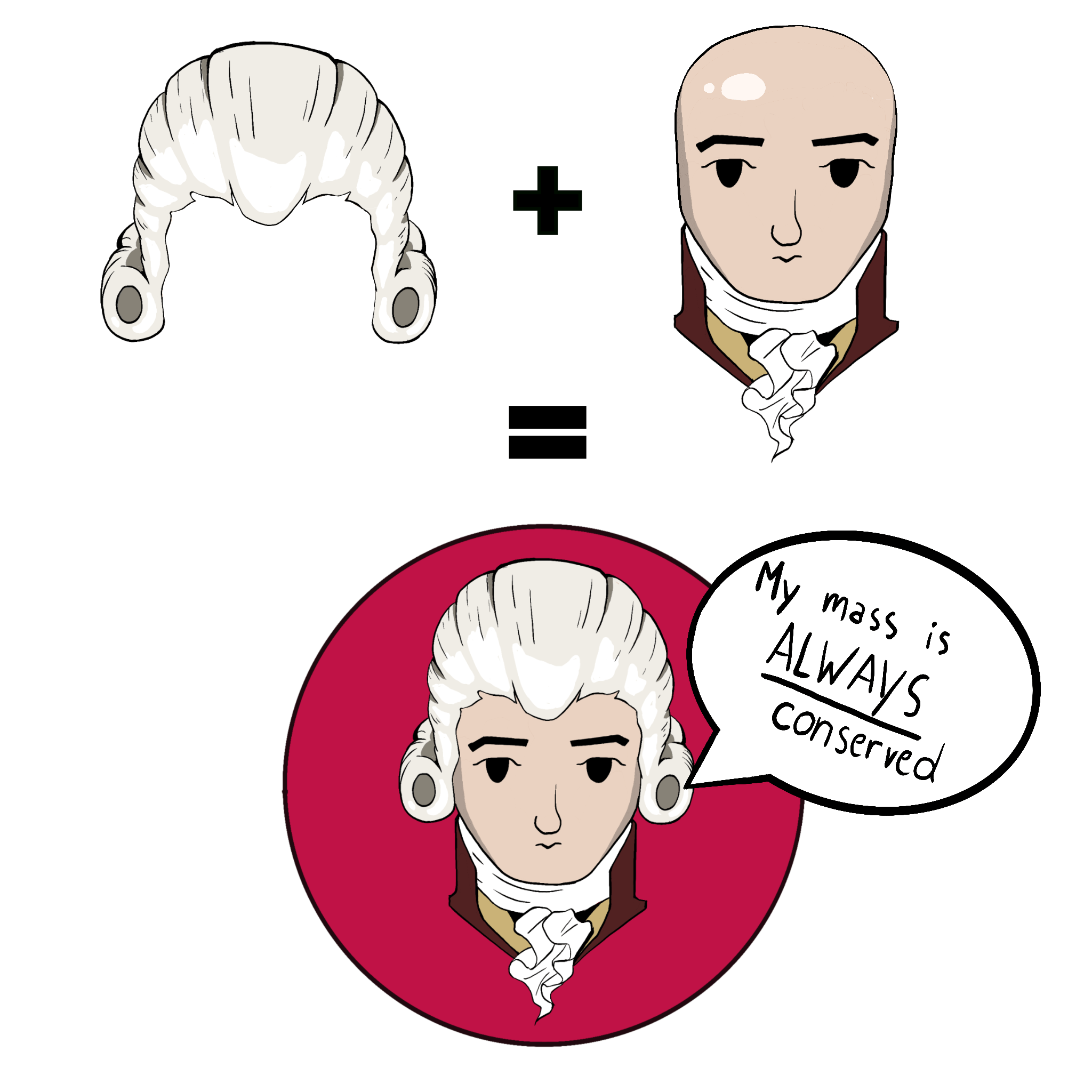
In the 1700s, Antoine Lavoisier and Joseph Priestley would conduct some of the most important experiments in chemistry! Lavoisier experimented with combustion reactions, an important chemical reaction we use everyday. He showed that when phosphorus (P) was combusted, it gained mass. We know today that the combustion reaction leads to phosphorus reacting with oxygen. At the same time, Joseph Priestley was heating mercuric oxide and producing oxygen gas. Today we call this a decomposition reaction. Although they did not know it at the time, they had proved the existence of elements and compounds!
Toward the end of the 1700's, Joseph Proust published the Law of Definite Proportions, also known as the Law of Constant Composition which states that the ratio of elemental components are fixed in a compound. This law laid an important foundation for stoichiometry.
The 1800s:
The 1800s had a series of important developments. The first was in 1803 when John Dalton proposed his atomic theory. Dalton's atomic theory explained the physical and chemical properties of matter. Next, was the creation of the periodic table by Dmitri Mendeleev in 1869. Folklore tells us that Mendeleev had a dream where the elements arranged themselves into a table. More realistically, Mendeleev noticed that if he arranged the elements by atomic mass he was able to predict some of their properties. He even predicted some of the properties of undiscovered elements. For example, Mendeleev predicted the properties of Gallium (discovered in 1875)! Finally, in the 1890s, Pierre and Marie Curie discovered radioactivity. Their work in radioactivity would be the foundation for some of the most important discoveries of the 1900s. Sadly, Marie Curie died of long-term radiation exposure.
The 1900s:
In 1906, Ernest Rutherford conducted one of the most important experiments in modern chemistry, the Gold Foil Experiment. Rutherford launched alpha particles (basically a Helium nucleus) at a sheet of gold foil and measured the deflection angles. The deflection of the alpha particles demonstrated that the nucleus of an atom was positively charged. Rutherford also concluded that electrons orbited around the positively charged nucleus and that the nucleus must contain neutrons. His conclusions led him to develop the nuclear model of the atom.
Rutherford's experiments paved the way for two other important ideas. In 1916, Neils Bohr concluded that electrons existed in atomic orbitals that had specific energies. Bohr then proposed a new model of the atom, now called Bohr's atomic model. The second was Gilbert Lewis' Valence bond theory. Valence Bond theory proposed that covalent bonds form by the sharing of pairs of valence electrons.
Finally, in the 1920's we have Lewis De Broglie and Erwin Schrodinger who start modern quantum mechanics. De Broglie applied the wave-particle duality to Bohr's atomic orbital model. Shrodinger created a mathematical equation. We very creatively call his equation the Schrodinger Equation. The Schrodinger Equation mathematically describes an atom's orbitals.