Illustrated · 1 min
Pascal Triangle and its derived identity
This article seems like to talk about combinatorics, but it is useful in algebra, since very unexpectedly, you may see lots of symbols or terms related to combinatorics appear in an algebra problem.
First let's have a trivial (maybe not lol) identity, that is THE SYMMETRY IDENTITY. It says for we have
This is easy to prove. We know
and
Therefore, they are the same. In fact, choosing winners from a group of people is the same as choosing losers.
Exercise: Show that .
Second identity, the summation identity. It says, ,
This is actually derived from Pascal Triangle
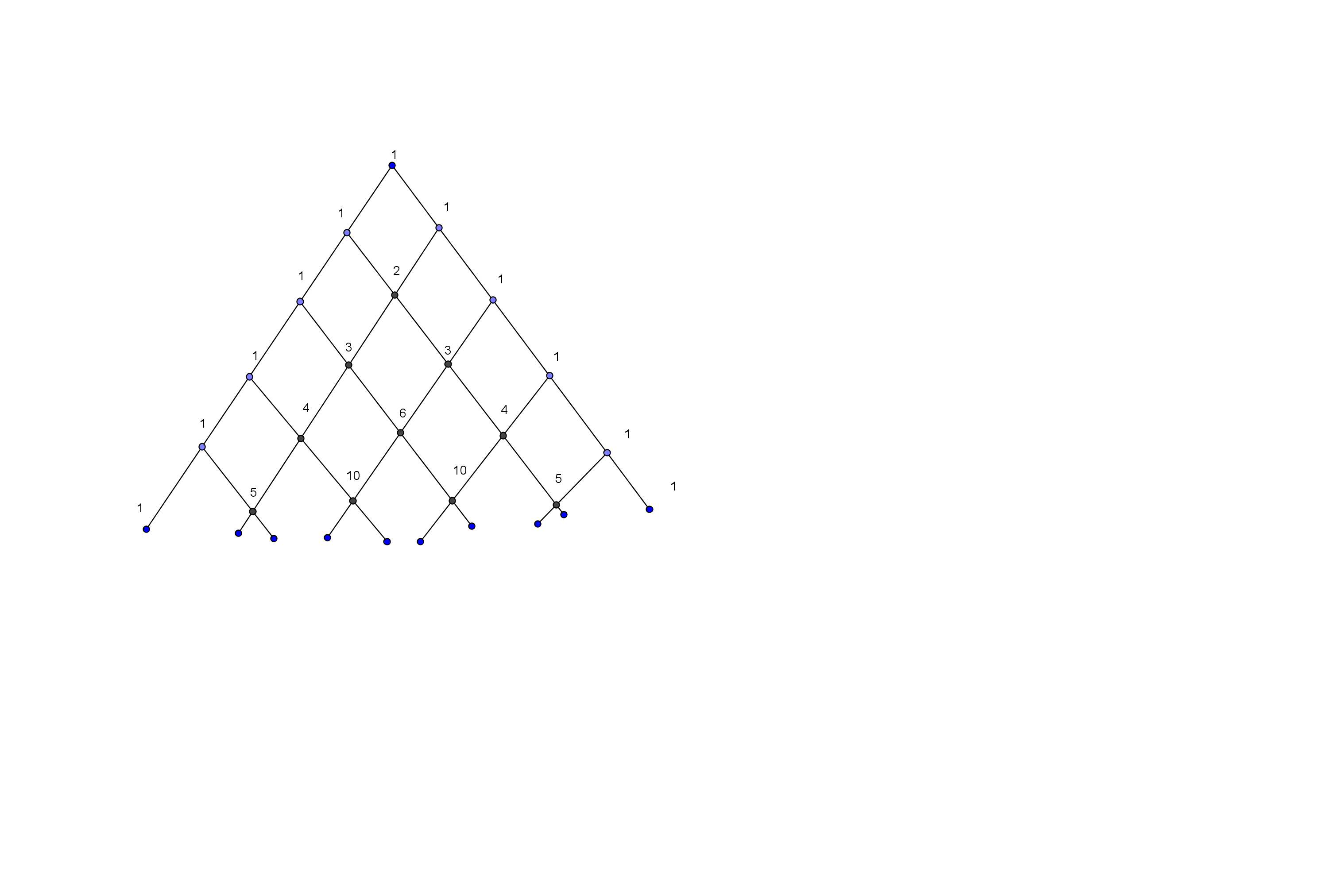
Sorry for any inconvenience, because this diagram was drawn in a rush.
Why I say so, see, every node (ignore the blue dots at the bottom, just look at the points with numbers above) is the sums of pairs of adjacent nodes of the previous row. As an example, 1+2=3 and 4+6=10 in the diagram above. In fact, all numbers can be written in the form of , like and , where represents the -th row and represents the -th row. In other words, the value at the -th row and the -th row equals to .
For the proof of this identity, it is left as an exercise to the reader. You can use the fact that
And a problem that I think is a nice application of the summation identity is this. Nice problem, bro!