Note: knowledge of rational square roots is necessary to understand irrational square roots.
We know that square roots are essentially the opposite of squaring a number. Some roots are not the squares of rational numbers—for example, the square root of 2. Although the approximation we give is 1.414, this is not exact. If a number can be written as a fraction and is then squared, the square root of that number is rational. Numbers that do not qualify under this specification do not have rational square roots. π, for example, is a known irrational number. If we square π and take the square root, we still have an irrational number. A number such as 3 can be squared to get 9, which means that 9 is rational.
So we know what rational numbers are: they can be represented as a fraction of integers. But how do we go about proving that a number can't be put into this form?
Consider 2. We will proceed to prove that this number is irrational by proving that math would break if it were rational. This uses a technique called proof by contradiction; we will assume the opposite of our desired conclusion and show that this fancy opposite conclusion can never be true in the first place.
Assume for the sake of contradiction that 2 is rational. This means that there exist integers p and q such that:
2=qp
We can square both sides of this equation to get:
2=q2p2
Which tells us that:
2q2=p2
So what can we get from this information? We know that p2 is even because it is the product of 2 and an integer (q2); this tells us that p must be even. Furthermore, since p2 must be even, q2 must similarly also be even, so q is even.
Then this means that we can reduce the fraction qp by a factor of 2. But then we can repeat the calculations above to conclude that the fraction can be reduced again. This means that the fraction can be reduced infinitely many times, which is nonsense. So our original claim - that 2 is rational - must be false.
Thus, 2 is irrational. An analogous proof can show that n is irrational for any nonnegative, non-perfect square n.
Here's a video by Derek Owens showing what irrational square roots are and how to simplify them.
Summary
A root is irrational if it can't be simplified into a rational number. 4 is a rational square root since it can be written as 2. But 2 is an irrational square root since there isn't a rational number to express it. We can, though, simplify irrational square roots. If you have 12 you can write it as 43. Since 4 is a rational square root you can simplify it even more to 23.
Test Yourself: Select the irrational square roots.
Properties of Real Numbers and Simplifying Square Roots
Rational Numbers(Q): Fractions, integers, decimals that end, and repeating decimals. (21,0.45,.3333333)Irrational Numbers(R\Q): Decimals that go on forever. (3,π,−11).
Rational numbers:
The sum of two rational numbers is always a rational number.
The difference of two rational numbers is always a rational number.
The product of two rational numbers is always a rational number.
The quotient of two rational numbers is always a rational number.
Irrational numbers:
The sum of two irrational numbers is either rational or irrational.
The difference of two irrational numbers is either rational or irrational.
The product of two irrational numbers is either rational or irrational.
The quotient of two irrational numbers is either rational or irrational.
To simplify irrational square roots, you find the greatest perfect square that divides evenly into the number and remove that from the square. Let's look at an example.
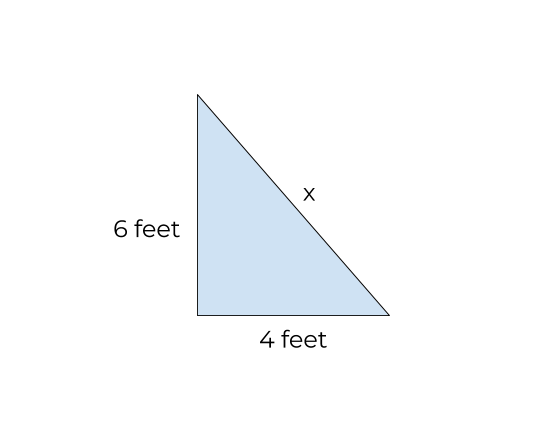
You are running a distance that is able to be found using the Pythagorean Theorem. You might not know how to use theorem this yet, but I will tell you! First of all, look at the diagram below, this is the path you are running.
You can find the distance of hypotenuse of a right using the formula a2+b2=c2. So, when figuring out the distance you are running in this problem, you find c with a being one side of the triangle and b being the other side of the triangle. So, c=a2+b2.
What is the value of c before it is simplified?
(Use the formula c=a2+b2).
We see,
cccc=a2+b2=(4)2+(6)2=(16+36=(52
Now, we can simplify that square root by "taking out" the biggest perfect square. We can see that 52=13⋅4
In this case, 4 is the greatest perfect square. We see,
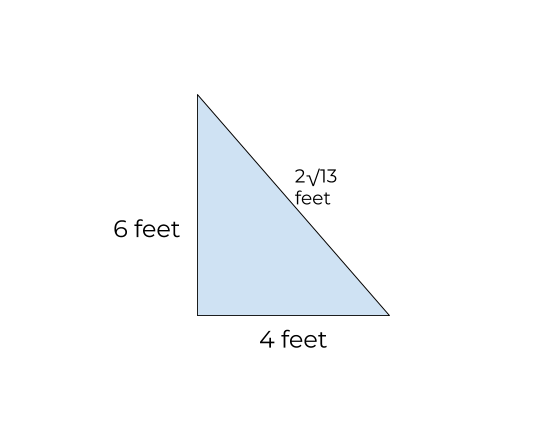
52=13⋅4=13⋅4=13⋅2=213
Therefore, the simplified square root for this problem is 213. The distance you travel is 213.