Interactive · 7 questions
+5 contributors




Divide the numerator and the denominator by the same number
The best way to simplify, or reduce, a fraction is to divide the top (the numerator) and the bottom (the denominator) by the largest common factor (in other words, the biggest number that they can both be divided by evenly). That can be tricky if your numerator and denominator are really big, so here are some steps that might make simplifying fractions, well, simpler. We call this reducing a fraction to lowest terms. That's just a fancy way of saying "reduce". You might see it in your textbook called that.
Step 1: Check if the denominator is evenly divisible by the numerator
Sometimes, the bottom number of the fraction will be evenly divisible by the top number. If it is, simplifying the fraction is easy! Just divide the numerator and the denominator by the numerator, and you've got your simplified fraction. Let's try it on an example:
What is divided by ?
We get a whole number, , when we divide by , so it works! Next, divide both the top and bottom of by to get the fully simplified fraction.
What is the most simplified form of ?
The most simplified form of is . Since the numerator of this fraction is , it can't be divided anymore—you're done!
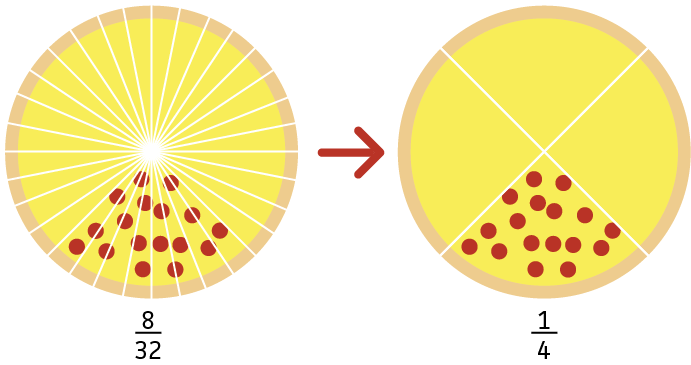
Step 2: If the bottom isn't divisible by the top, try dividing by a small common factor.
If the denominator isn't evenly divisible by the numerator, you might be able to divide both numbers by something else. Let's try it out on the fraction , starting from Step 1 just in case.
Is evenly divisible by ?
divided by is , which isn't a whole number—so is not evenly divisible by . However, and are both even, so let's try dividing them both by .
What will the fraction look like when we divide the top and the bottom by ?
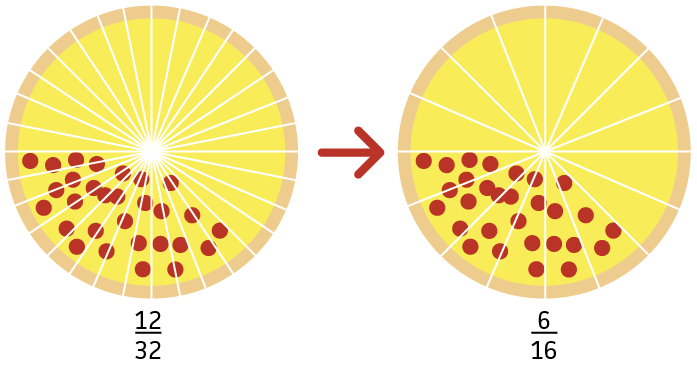
divided by is and divided by is , so our new fraction is .
Step 3: Repeat until you can't divide one side anymore
is closer to simplified, but it's not quite there yet. Try dividing both sides by 2 again.
What will if we divide the top and bottom by 2?
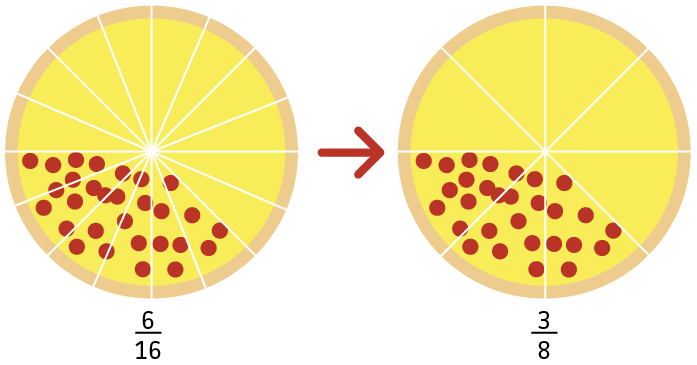
divided by is and divided by is , so our new fraction is . Let's try it one more time.
Is evenly divisible by ?
isn't evenly divisible by , so we can't do that anymore. Let's try Step 1 again, just to be sure.
Is evenly divisible by ?
isn't evenly divisible by , and since isn't divisible by , it isn't evenly divisible by anything. So we're done!