Related Rates

Before this, knowPhysical Applications of Derivatives

Read · 1 min

Related rates problems analyze the rate at which functions change for certain instances in time. These problems generally involve two or more functions where you relate the functions themselves and their derivatives, hence the name "related rates."

This is a concept that is best explained by example. Here is a classic.

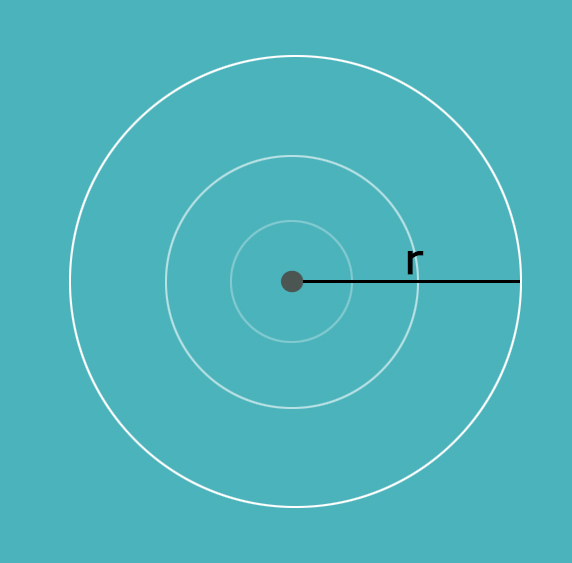
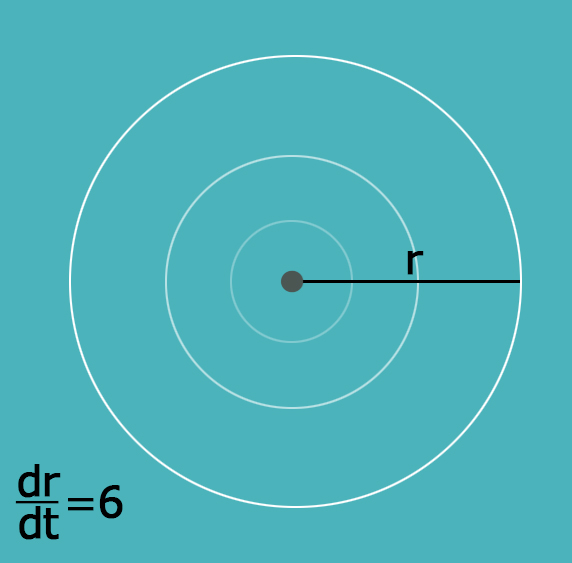
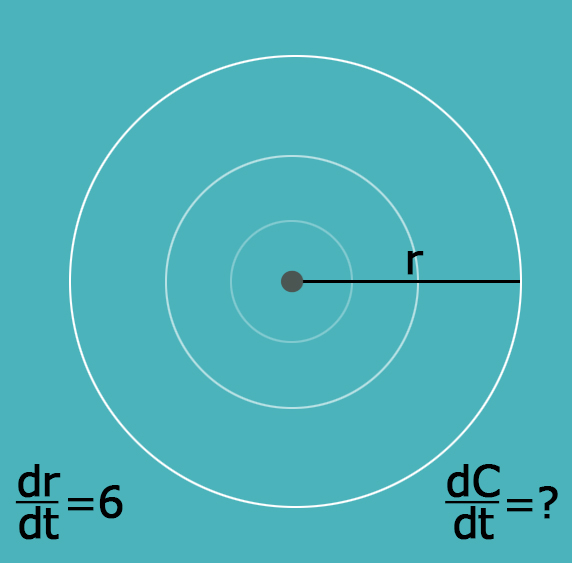
A circle's radius is initially 88 meters and grows at a constant rate of 22 meters per second. At time t=4t = 4, what is the rate at which the area of the circle is changing?

We let r=radiusr = radius and A=areaA = area. Since both variables are functions of time, we know that

r(0)=8r(0) = 8

drdt=2\frac{dr}{dt} = 2

We are asked to find dAdt\frac{dA}{dt} at time t=4t = 4. This involves differentiating the formula for the area of a circle to find the rate at which said area changes. The desired formula is

A=π⋅r2A = \pi \cdot r^2

For clarity, indicate that AA and rr are functions of time:
A(t)=π⋅r(t)2A(t) = \pi \cdot r(t)^2

Now differentiate the equation:

dAdt=2π⋅r(t)⋅drdt\frac{dA}{dt} = 2\pi \cdot r(t) \cdot \frac{dr}{dt}

We know that drdt=2\frac{dr}{dt} = 2, so

dAdt=4πr(t)\frac{dA}{dt} = 4\pi r(t)

Our only unknown is r(t)r(t) at t=4t = 4. However, as the initial radius is 88 meters and the radius grows at a constant rate of 22 meters per second, after 44 seconds the radius will be 1616 meters. Thus r(4)=16r(4) = 16:

dAdt=4π⋅16=64π\frac{dA}{dt} = 4\pi \cdot 16 = 64\pi

Interactive · 2 questions

"Related rates" problems, as the heading suggests, deal with functions that can be expressed in terms of one another. We might know that y=f(x)y = f(x), where both yy and xx are functions of tt. The function ff is often a well-known law of physics or geometry, and may not have been stated in the problem! Thus, your first step in these problems should always be to try to think of any relevant equations relating the variables, then take their derivatives with respect to the independent variable, which is often time.

Let's try this on an example. A 25m ladder is propped against a wall. Before you see the rest of the problem, try to think of a useful equation.

If we let the base of the ladder's distance to the wall be xx and the top's height be yy, then x2+y2=625x^2 + y^2 = 625.

What would be the derivative of this equation with respect to tt, given that xx and yy both change with time?

Choose one answer

Illustrated · 2 min

Related rates are an application of implicit, or partial, differentiation. These are dependent and related rates because the final answer will rely on two or more variables, so the rates are dependent on or related to each other.

The chain rule states that if z=f(x,y)z=f(x,y) and x=a(t)x=a(t), y=b(t)y=b(t) then dzdt=fx(x0,y0)a′(t)+fy(x0,y0)b′(t)\dfrac{dz}{dt}=f_x(x_0, y_0)a'(t)+f_y(x_0, y_0)b'(t). Another way to communicate this is dzdt=(∂z∂x)(dxdt)+(∂z∂y)(dydt)\dfrac{dz}{dt}=(\dfrac{∂z}{∂x})(\dfrac{dx}{dt})+(\dfrac{∂z}{∂y})(\dfrac{dy}{dt}).

Using the chain rule and information given in a problem, we are able to determine missing information.

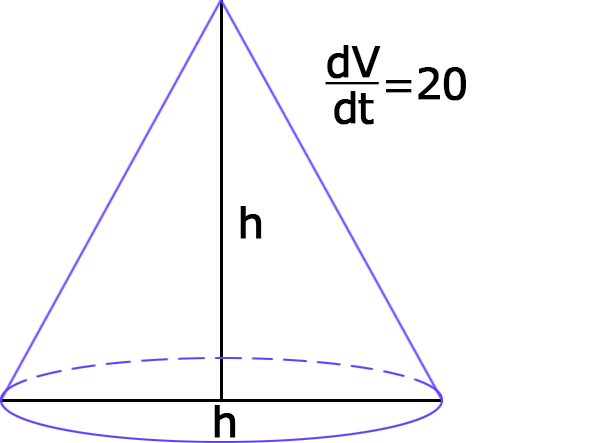
Example Problem: The radius of a right circular cone is increasing at a rate of 3 inches per second and its height is decreasing at a rate of 3 inches per second. At what rate is the volume of the cone changing when the radius is 20 inches and the height is 20 inches?

It is helpful to make a drawing when doing related rates problems to conceptualize the different aspects that need to be taken into consideration.

The item being solved for is the rate of change of the volume of the cone when h=20inh=20 \text{in} and r=20inr=20 \text{in}, so the derivative with respect to the volume. The information given is drdt=3in3/sec\dfrac{dr}{dt}=3 \text{in}^3/\text{sec} and dhdt=−3in3/sec\dfrac{dh}{dt}=-3 \text{in}^3/\text{sec}. These are our a′(t)a'(t) and b′(t)b'(t) values (or our dxdt\dfrac{dx}{dt} and dydt\dfrac{dy}{dt} values).

Because the volume of a right circular cone is V=πr2h3V=π{r^2}\dfrac{h}{3}, the partial or implicit derivatives will be taken with respect to the variables h and r and solved for.

∂V∂r=2πrh3\dfrac{∂V}{∂r}=2πr\dfrac{h}{3}

∂V∂h=πr213\dfrac{∂V}{∂h}=π{r^2}\dfrac{1}{3}

In order to find the values to actually plug into our initial equation dzdt=(∂z∂x)(dxdt)+(∂z∂y)(dydt)\dfrac{dz}{dt}=(\dfrac{∂z}{∂x})(\dfrac{dx}{dt})+(\dfrac{∂z}{∂y})(\dfrac{dy}{dt}), we need to plug in the r and h values provided to us by the problem into the partial derivatives. These are r=20inr=20\text{in} and h=20inh=20\text{in}.

∂V∂r=2π(20in)20in3=800π3in\dfrac{∂V}{∂r}=2π(20\text{in})\dfrac{20 in}{3}=\dfrac{800π}{3}\text{in}

∂V∂h=π(20in)213=400π3in\dfrac{∂V}{∂h}=π{(20\text{in})^2}\dfrac{1}{3}=\dfrac{400π}{3}\text{in}

Now it's time to plug these values into our main equation which will provide us with the rate of change of the volume of the right circular cone when r=20inr=20\text{in} and h=20inh=20\text{in}.

dzdt=(∂z∂x)(dxdt)+(∂z∂y)(dydt)\dfrac{dz}{dt}=(\dfrac{∂z}{∂x})(\dfrac{dx}{dt})+(\dfrac{∂z}{∂y})(\dfrac{dy}{dt})

dVdt=800π3in2(3in/sec)+400π3in2(−3in/sec)=800πin3/sec−400πin3/sec=400πin3/sec\dfrac{dV}{dt}=\dfrac{800π}{3}\text{in}^2(3\text{in/sec})+\dfrac{400π}{3}\text{in}^2(-3\text{in/sec})\\ =800π\text{in}^3/\text{sec}-400π\text{in}^3/\text{sec}\\ =400π\text{in}^3/\text{sec} so the rate of change of the volume of the right circular cone when r=20inr=20\text{in} and h=20inh=20\text{in} is 400πin3/sec400\pi\text{in}^3/\text{sec}.

Video · + 3 min read

(Video) Related Rates: Ships and Distance

by PatrickJMT

Here's a video by patrickJMT showing you how to solve related rate problems. Despite having some nice alliteration, related rates can be rough. They're word problems, they're puzzles, they're a pain. Hopefully though, Patrick the Math Savior can lead us through.

Before we begin he gives us a nice acronym in order to help us remember the general outline in which we solve these problems: DREDS. Clearly, there's some foreshadowing going on. DREDS stands for Diagram, Rates, Equation, Derivative, and Substitute.

  1. Diagram: Come up with a diagram to represent the problem.
  2. Rates: Label your rates.
  3. Equation: Find an equation.
  4. Derivative: Take a derivative.
  5. Substitute: Substitute in specific information.

The problem that he looks at in this video is

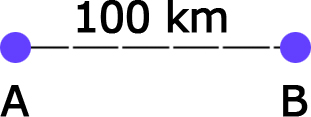
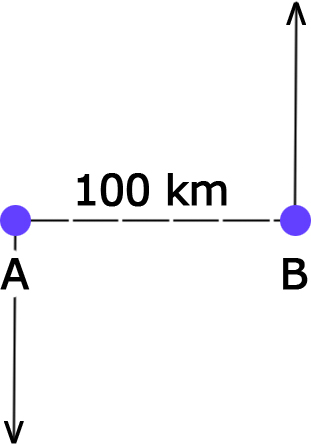
At noon, ship AA is 100 km100\ km west of ship BB. Ship AA is sailing south at 35 km/h35\ km/h and ship BB is sailing north at 25 km/h25\ km/h. How fast is the distance between the ships changing at 4:00 P.M.?

So our first step is to draw a diagram to represent this problem. So we know that at noon there's a ship AA and a ship BB 100 km100\ km west of it.

Next we know that AA is sailing south, and BB is sailing north.

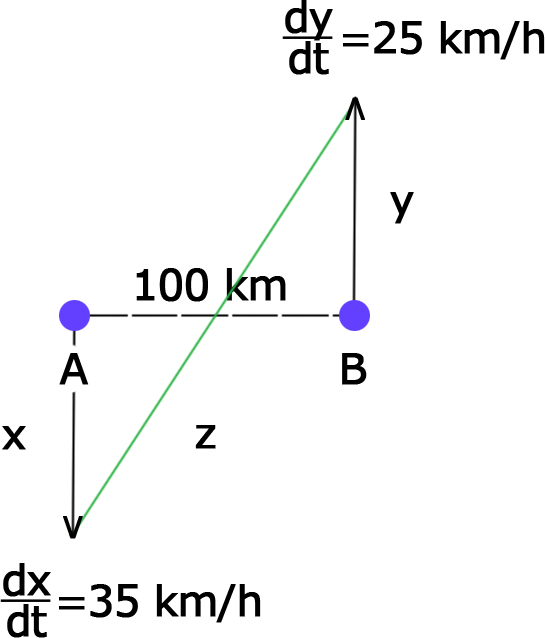
So here comes an important concept when solving these types of problems. Any quantities that vary with time you want to label them with variables. So certainly this distance AA is getting bigger as the ship travels further south, so we can label their distance traveled as xx. Similarly, we can say ship BB's distance is yy.

They also tell us the rate at which these ships are changing. It says ship AA is sailing at 35 km/h35\ km/h and ship BB is sailing at 25 km/h25\ km/h. You can write this as the change in the distance xx with respect to time, dxdt\frac{dx}{dt}, or similarly with the change in distance yy instead.

At some time later we will want to know this distance between these two ships. This distance will be the diagonal line between the two. Let's call it zz.

So what this problem is asking us to find is the change in the distance between the two ships with respect to time. In other words (or letters I guess), dzdt\frac{dz}{dt}.

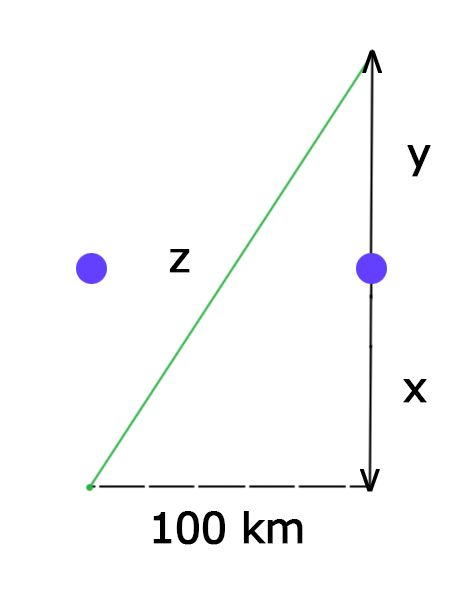
We have our diagram now, and we have our rates defined. The next step is to come up with an equation relating xx, yy, and zz. Okay? How do we do this? Here's the trick; we can redraw our diagram as a right triangle.

We now have a right triangle! And you know what that means!? PYTHAGOREAN THEOREM! 1002+(x+y)2=z2100^2+(x+y)^2=z^2

Our next step is to take the derivative with respect to time. This means we need to use implicit differentiation and solve for dzdt\frac{dz}{dt}. 1002+(x+y)2=z20+2(x+y)⋅[x+y]′=2z⋅[z]′2(x+y)(dxdt+dydt)=2zdzdt2(x+y)(dxdt+dydt)2z=dzdt(x+y)(dxdt+dydt)z=dzdt\begin{align} 100^2+(x+y)^2&=z^2\\ 0+2(x+y)\cdot\color{red}{[x+y]'}&=2z\cdot\color{red}{[z]'}\\ 2(x+y)\bigg(\frac{dx}{dt}+\frac{dy}{dt}\bigg)&=2z\frac{dz}{dt}\\ \frac{2(x+y)(\frac{dx}{dt}+\frac{dy}{dt})}{2z}&=\frac{dz}{dt}\\ \frac{(x+y)(\frac{dx}{dt}+\frac{dy}{dt})}{z}&=\frac{dz}{dt} \end{align}

We've finally made it to the last step, substitution. So we already had dxdt\frac{dx}{dt} and dydt\frac{dy}{dt} given to us in the problem. These were 35 km/h35\ km/h and 25 km/h25\ km/h respectively. (x+y)(35+25)z=dzdt\frac{(x+y)(35+25)}{z}=\frac{dz}{dt} We don't have xx, yy, or zz yet but we can figure these out with our given information. These ships started moving at noon and we want to find the distance between them at 4 P.M., which is 4 hours later. If ship AA is traveling 35 km/h35\ km/h how many kilometers will it travel in 4 hours? Well, 35∗4=140 km35*4=140\ km. The same can be done to find the distance ship BB traveled: 25∗4=100 km25*4=100\ km. So let's put these into our equation. (140+100)(35+25)z=dzdt\frac{(140+100)(35+25)}{z}=\frac{dz}{dt} What about zz? We can actually find zz from our Pythagorean Theorem equation. z2=1002+(x+y)2z=1002+(x+y)2\begin{align} z^2&=100^2+(x+y)^2\\ z&=\sqrt{100^2+(x+y)^2} \end{align} So plugging this into our equation we get: (140+100)(35+25)1002+(x+y)2=dzdt\frac{(140+100)(35+25)}{\sqrt{100^2+(x+y)^2}}=\frac{dz}{dt} And we already figured out what xx and yy are so we can just plug those values in again and then solve! (140+100)(35+25)1002+(140+100)2=dzdt(240)(60)10000+(240)2=dzdt1440010000+57600=dzdt1440067600=dzdt14400260=dzdt55.385≈dzdt\begin{align} \frac{(140+100)(35+25)}{\sqrt{100^2+(140+100)^2}}&=\frac{dz}{dt}\\ \frac{(240)(60)}{\sqrt{10000+(240)^2}}&=\frac{dz}{dt}\\ \frac{14400}{\sqrt{10000+57600}}&=\frac{dz}{dt}\\ \frac{14400}{\sqrt{67600}}&=\frac{dz}{dt}\\ \frac{14400}{260}&=\frac{dz}{dt}\\ 55.385&\approx\frac{dz}{dt} \end{align}

At 4 P.M. the distance between the ships is changing 55.385 km/h.\text{At 4 P.M. the distance between the ships is changing }55.385\ km/h\text{.}

Video · + 1 min read

(Video) Related Rates: Cones

by PatrickJMT

Here's another video by patrickJMT where he shows you how to solve a related rates problem involving cones.

The problem says:

Gravel is being dumped from a conveyor belt at a rate of 20 ft3/min20\ ft^3/min and its coarseness is such that it forms a pile in the shape of a cone whose base diameter and height are always equal. How fast is the height of the pile increasing when the pile is 10 ft10\ ft high?

We begin by drawing our diagram. In this problem we have a cone whose base diameter and height are equal.

The problem tells us that a gravel is being added at a rate of 20 ft3/min20\ ft^3/min. This is the change in volume of the cone with respect to time. If you didn't know this was referring to volume, the indicator is the cubed feet. Volume is measured with cubed units.

Finally, it wants us to find the change in height with respect to time. This means we're looking for dhdt\frac{dh}{dt}.

The equation we use should be pretty obvious for this problem: the volume for a cone. V=13πr2hV=\frac13\pi r^2h In this problem the diameter is the same length as height so we can rewrite the radius in terms of height in our equation. 2r=d2r=hr=h2\boxed{\begin{align} 2r&=d\\ 2r&=h\\ r&=\frac h2 \end{align}} V=13π(h2)2hV=13πh24hV=π12h3\begin{align} V&=\frac13\pi\bigg(\color{red}{\frac{h}2}\bigg)^2h\\ V&=\frac13\pi\frac{h^2}4h\\ V&=\frac{\pi}{12}h^3 \end{align}

Now we take the derivative with respect to time and solve for our unknown, dhdt\frac{dh}{dt}. dVdt=π123h2⋅[h]′dVdt=π123h2dhdtdVdt=π4h2dhdt4πh2dVdt=dhdt\begin{align} \frac{dV}{dt}&=\frac{\pi}{12}3h^2\cdot\color{red}{[h]'}\\ \frac{dV}{dt}&=\frac{\pi}{12}3h^2\frac{dh}{dt}\\ \frac{dV}{dt}&=\frac{\pi}{4}h^2\frac{dh}{dt}\\ \frac{4}{\pi h^2}\frac{dV}{dt}&=\frac{dh}{dt} \end{align}

Finally, we need to substitute in values. We know that dVdt=20\frac{dV}{dt}=20. We also know that the height is 10 ft10\ ft or h=10h=10. 4π(10)2⋅20=dhdt80100π=dhdt810π=dhdt0.255≈dhdt\begin{align} \frac{4}{\pi (10)^2}\cdot20&=\frac{dh}{dt}\\ \frac{80}{100\pi}&=\frac{dh}{dt}\\ \frac{8}{10\pi}&=\frac{dh}{dt}\\ 0.255&\approx\frac{dh}{dt} \end{align}

When the height is 10 feet, it is increasing by 0.255 ft/min.\text{When the height is }10\text{ feet, it is increasing by }0.255\ ft/min\text{.}

Video · + 1 min read

(Video) Related Rates: Point on a Graph

by PatrickJMT

Here's another video by patrickJMT on related rates. This one deals with a point moving on a graph.

The problem says:

A point is moving on the graph of 3x3+4y3=xy3x^3+4y^3=xy. When the point is at P=(17,17)P=(\frac17,\frac17), its yy-coordinate is increasing at a speed of 99 units per second. What is the speed of the xx-coordinate at that time and in which direction is the xx-coordinate moving?

So we have an equation: 3x3+4y3=xy3x^3+4y^3=xy We know that at the point P=(17,17)P=(\frac17,\frac17) the yy-coordinate is increasing at a speed of 9 units per second, or: dydt=9\frac{dy}{dt}=9 Finally, what we want to know is the speed of the xx-coordinate, or: dxdt=?\frac{dx}{dt}=?

So we can start by taking the derivative of the equation with respect to time and solving for our unknown, dxdt\frac{dx}{dt}. 3x3+4y3=xy9x2⋅[x]′+12y2⋅[y]′=[x]′y+x[y]′9x2dxdt+12y2dydt=ydxdt+xdydt9x2dxdt−ydxdt=xdydt−12y2dydtdxdt(9x2−y)=dydt(x−12y2)dxdt=dydt(x−12y2)9x2−y\begin{align} 3x^3+4y^3&=xy\\ 9x^2\cdot\color{red}{[x]'}+12y^2\cdot\color{red}{[y]'}&=\color{red}{[x]'}y+x\color{red}{[y]'}\\ 9x^2\frac{dx}{dt}+12y^2\frac{dy}{dt}&=y\frac{dx}{dt}+x\frac{dy}{dt}\\ 9x^2\frac{dx}{dt}-y\frac{dx}{dt}&=x\frac{dy}{dt}-12y^2\frac{dy}{dt}\\ \frac{dx}{dt}(9x^2-y)&=\frac{dy}{dt}(x-12y^2)\\ \frac{dx}{dt}&=\frac{\frac{dy}{dt}(x-12y^2)}{9x^2-y} \end{align}

Now all we need to do is substitute in values. We know that x=y=17x=y=\frac17 and we know that dydt=9\frac{dy}{dt}=9. dxdt=9(17−12(17)2)9(17)2−17dxdt=9(17−1249)949−17dxdt=9(749−1249)949−749dxdt=9(−549)249dxdt=−4549249dxdt=−452\begin{align} \frac{dx}{dt}&=\frac{9(\frac17-12(\frac17)^2)}{9(\frac17)^2-\frac17}\\ \frac{dx}{dt}&=\frac{9(\frac17-\frac{12}{49})}{\frac{9}{49}-\frac17}\\ \frac{dx}{dt}&=\frac{9(\frac7{49}-\frac{12}{49})}{\frac{9}{49}-\frac7{49}}\\ \frac{dx}{dt}&=\frac{9(-\frac{5}{49})}{\frac{2}{49}}\\ \frac{dx}{dt}&=-\frac{\frac{45}{49}}{\frac{2}{49}}\\ \frac{dx}{dt}&=-\frac{45}{2} \end{align}

So the xx-coordinate is changing at a speed of 452\frac{45}{2} units per second. Notice that we did not include the negative symbol for the speed. This is because speed is always positive. It is the absolute value of velocity. But because of this negative sign we know that it is decreasing at a speed of 452\frac{45}{2}.

Video · + 1 min read

(Video) Related Rates: Trigonometry

by PatrickJMT

Here's another video by patrickJMT where he looks at a related rates problem which involves trig.

The problem states:

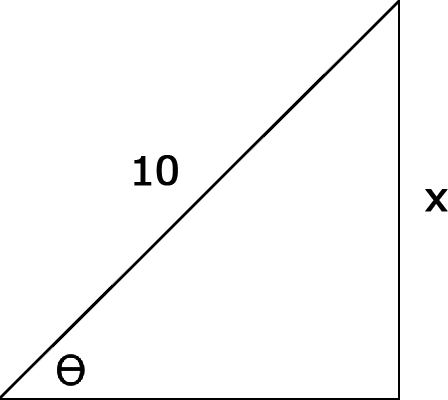
In the right angle triangle, the angle θ\theta is increasing at a constant rate of 66 radians per hour. At what rate is the side of length xx increasing when x=6x=6 feet?

The diagram is given in the problem.

So we know that theta is increasing at a constant rate of 6 radians per hour. dθdt=6\frac{d\theta}{dt}=6 What we want to find is the rate at which the side xx is increasing when it's at 6 feet. dxdt=?  when  x=6\frac{dx}{dt}=?\ \text{ when }\ x=6

So how can we relate xx and θ\theta? Well, we can use sine to do that. Remember that sine of an angle is the opposite over the hypotenuse. sin⁡θ=x1010sin⁡θ=x\begin{align} \sin\theta&=\frac{x}{10}\\ 10\sin\theta&=x \end{align} So now all we have to do is take the derivative with respect to time. 10sin⁡θ=x10cos⁡θ⋅[θ]′=dxdt10cos⁡θdθdt=dxdt\begin{align} 10\sin\theta&=x\\ 10\cos\theta\cdot\color{red}{[\theta]'}&=\frac{dx}{dt}\\ 10\cos\theta\frac{d\theta}{dt}&=\frac{dx}{dt} \end{align}

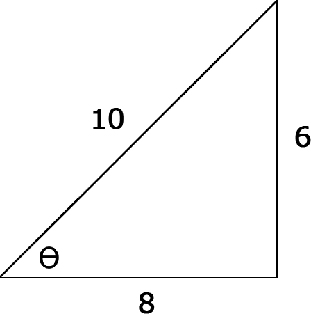
We want to find cos⁡θ\cos\theta now. Remember that cosine is the adjacent over the hypotenuse. We can find the adjacent by using the Pythagorean Theorem, since we know the side xx is 66. a2+62=102a2+36=100a2=64a=8\begin{align} a^2+6^2&=10^2\\ a^2+36&=100\\ a^2&=64\\ a&=8 \end{align}

So the cosine of theta is cos⁡θ=810=45\cos\theta=\frac{8}{10}=\frac45

Plugging this all in we get: 10⋅45⋅6=dxdt48=dxdt\begin{align} 10\cdot\frac45\cdot6&=\frac{dx}{dt}\\ 48&=\frac{dx}{dt} \end{align}

When the side x is at 6 feet it is increasing at a rate of 48 ft/h.\text{When the side }x\text{ is at }6\text{ feet it is increasing at a rate of }48\ ft/h\text{.}

Video · + 1 min read

(Video) Related Rates: Baseball!

by PatrickJMT

Here's another video by patrickJMT dealing with related rates.

The problem states:

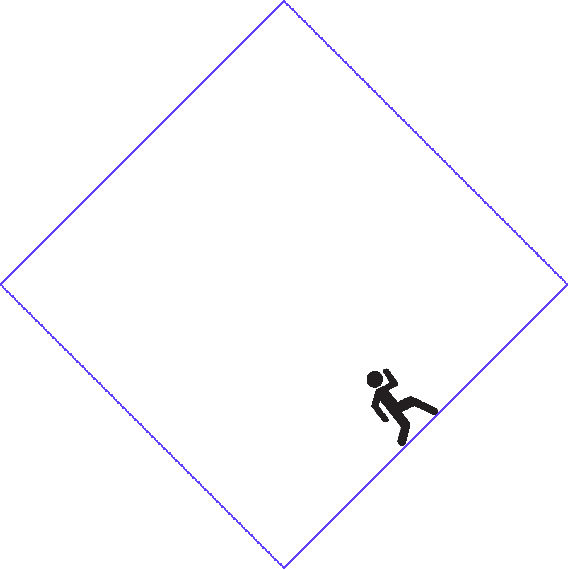
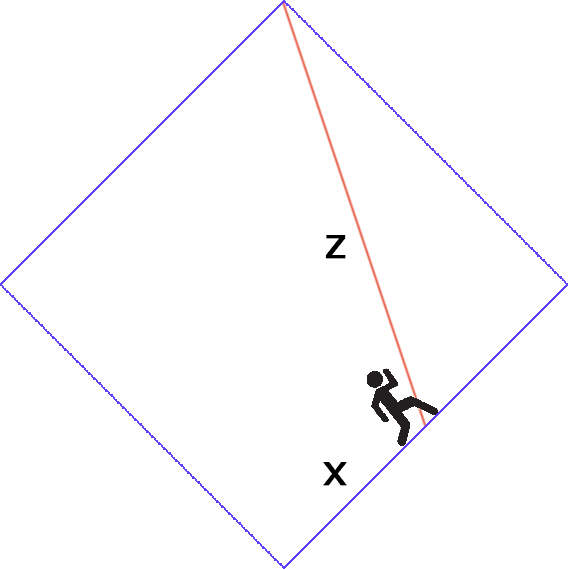
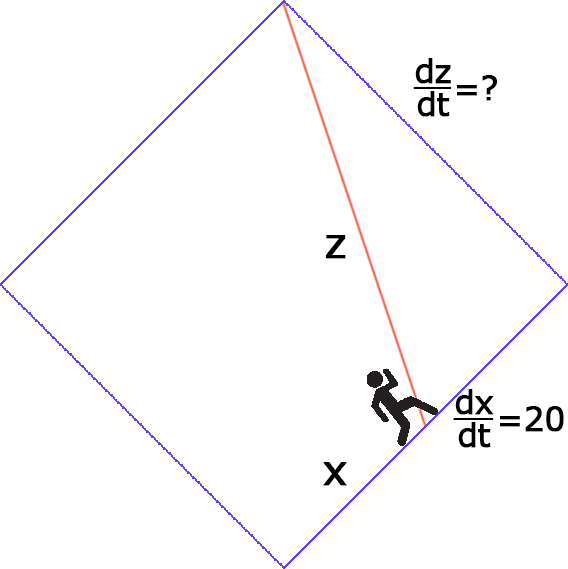
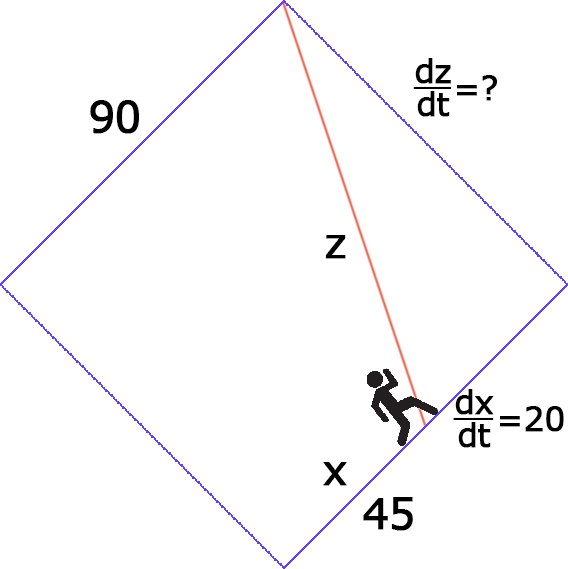
A baseball diamond is a square with side 9090 feet. If a batter hits the ball and runs towards first base with a speed of 2020 feet per second, at what speed is his distance from second base decreasing when he is halfway to first base?

So we have a baseball diamond and a batter who's halfway to first base.

Let's denote his distance to second base as zz and his distance from home plate as xx.

We are given that the batter runs towards first base with a speed of 2020 feet per second. What we want to find is the speed at which his distance from second base is decreasing.

Since we know the length of a side to be 9090 feet, and the runner is halfway to first base, we can conclude that x=45x=45 feet.

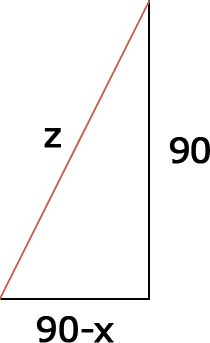
To come up with an equation to use, we can actually pull out the right triangle that's being made.

Since we denoted the distance between the batter and home to be xx, the distance between the batter and first is 90−x90-x.

Now, by using the Pythagorean Theorem, we can get our equation. (90−x)2+902=z2(90-x)^2+90^2=z^2 Which we can then take the derivative of with respect to time. 2(90−x)⋅[x]′+0=2z⋅[z]′2(90−x)⋅−dxdt=2zdzdt−2(90−x)2zdxdt=dzdt−90−xzdxdt=dzdt\begin{align} 2(90-x)\cdot\color{red}{[x]'}+0&=2z\cdot\color{red}{[z]'}\\ 2(90-x)\cdot-\frac{dx}{dt}&=2z\frac{dz}{dt}\\ -\frac{2(90-x)}{2z}\frac{dx}{dt}&=\frac{dz}{dt}\\ -\frac{90-x}{z}\frac{dx}{dt}&=\frac{dz}{dt} \end{align}

We can begin substituting in our known values. Remember that zz is found with the Pythagorean Theorem. −90−xzdxdt=dzdt−90−x(90−x)2+902dxdt=dzdt−90−45(90−45)2+902⋅20=dzdt−452025+8100⋅20=dzdt−90010125=dzdt−45≈dzdt\begin{align} -\frac{90-x}{z}\frac{dx}{dt}&=\frac{dz}{dt}\\ -\frac{90-x}{\sqrt{(90-x)^2+90^2}}\frac{dx}{dt}&=\frac{dz}{dt}\\ -\frac{90-45}{\sqrt{(90-45)^2+90^2}}\cdot20&=\frac{dz}{dt}\\ -\frac{45}{\sqrt{2025+8100}}\cdot20&=\frac{dz}{dt}\\ -\frac{900}{\sqrt{10125}}&=\frac{dz}{dt}\\ -4\sqrt{5}&\approx\frac{dz}{dt} \end{align}

When the batter is halfway to first base,his speed is decreasing by 45 ft/sec.\text{When the batter is halfway to first base,}\\ \text{his speed is decreasing by }4\sqrt{5}\ ft/sec\text{.}

Video · + 1 min read

(Video) Related Rates: Circumference

by PatrickJMT

Here's another video by patrickJMT going over a related rates word problem. This one deals with the change in a circles circumference.

Th problem states:

A pebble is dropped into a pool of water, generating circular ripples. The radius of the largest ripple is increasing at a constant rate of 66 inches per second. What is the increase in the circumference of the ripple after 33 seconds have passed?

Let's start by making a diagram.

We have our pebble dropped in the pond and it creates ripples which increase as the time increases. Let's suppose that, from where the pebble was dropped out to the largest ripple, it's a radius of rr.

We also know the radius of the largest ripple is increasing at a constant rate of 6 inches per second. Which means the radius is changing with respect to time.

What we want to find is the change in the circumference of the ripple; the change in circumference with respect to time.

Now that we have a diagram and the rates, we can go ahead and create an equation. Since we're looking for the change in circumference, the equation for circumference should be a safe bet. C=2πrC=2\pi r

Next, let's take the derivative with respect to time. dCdt=2πdrdt\frac{dC}{dt}=2\pi\frac{dr}{dt} Notice that we have no need for the t=3t=3 information described in the problem (we know this because there's no tt in our derivative equation). So the change in circumference with respect to time is independent of time. We can now finish this problem by substituting in the specific information. dCdt=2π(6)dCdt=12π\begin{align} \frac{dC}{dt}&=2\pi\color{red}{(6)}\\ \frac{dC}{dt}&=12\pi \end{align}

The circumference of the circle is increasing at a rate of 12π in/sec.\text{The circumference of the circle is increasing at a rate of }12\pi\ in/sec\text{.}

Video · + 2 min read

(Video) Related Rates: Sliding Ladder

by PatrickJMT

Here's another video by patrickJMT showing you how to solve a related rates problem involving a sliding ladder.

The problem states:

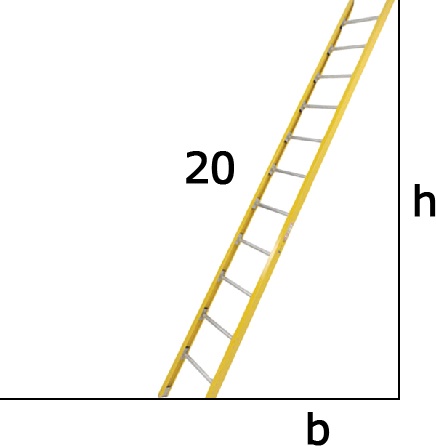
A 2020 foot ladder is being pulled away from a wall at a rate of 55 feet per second. What is the rate of change in the area beneath the ladder when the ladder is 88 feet from the wall?

Let's draw our diagram to represent this.

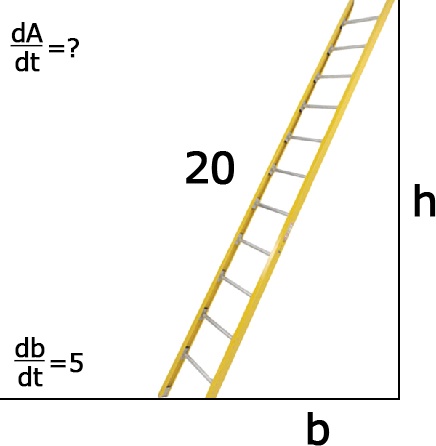
The ladder is being pulled away from the wall as time progresses. That means its height will change with respect to time so we should label it with a variable, hh. Similarly, the base will be pulling out from the wall, meaning it will change with respect to time. So we need to label the base with a variable, bb. Finally, the length of the ladder is not changing as time goes on. It is constant. So we can label it with a constant, 2020.

Furthermore, we know the ladder is being pulled away at a rate of 55 feet per second. This translate to a change in base with respect to time, dbdt\frac{db}{dt}. We also want to find the rate of change of the area below the ladder, dAdt\frac{dA}{dt}.

Since we're looking for the change in area, we should probably start with the equation for the are of a triangle. A=12bhA=\frac12bh But before we take the derivative take a look at what would happen with our variables. The AA and bb would give us rates that we either want to find or have information for. But the hh would give is dhdt\frac{dh}{dt}. We don't have any information about this in the problem. So, we need to come up with a way to re-express hh. Do we have any other formulas related to triangles that could help us? Hell yeah we do! Pythagorean Theorem. b2+h2=202h2=400−b2h=400−b2\boxed{\begin{align} b^2+h^2&=20^2\\ h^2&=400-b^2\\ h&=\sqrt{400-b^2} \end{align}}

Now, let's plug this into our area equation. A=12b400−b2A=\frac12b\sqrt{400-b^2} Since it's all in terms of base now, and we have a rate for base, we can take the derivative. dAdt=12([b]′400−b2+b[400−b2]′)=12(dbdt400−b2+b⋅12400−b2⋅[400−b2]′)=12(400−b2dbdt+b2400−b2⋅−2b⋅[b]′)=12(400−b2dbdt+−2b22400−b2dbdt)dAdt=12dbdt(400−b2−b2400−b2)\begin{align} \frac{dA}{dt}&=\frac12(\color{red}{[b]'}\sqrt{400-b^2}+b\color{red}{[\sqrt{400-b^2}]'})\\ &=\frac12\bigg(\frac{db}{dt}\sqrt{400-b^2}+b\cdot\frac{1}{2\sqrt{400-b^2}}\cdot\color{red}{[400-b^2]'}\bigg)\\ &=\frac12\bigg(\sqrt{400-b^2}\frac{db}{dt}+\frac{b}{2\sqrt{400-b^2}}\cdot-2b\cdot\color{red}{[b]'}\bigg)\\ &=\frac12\bigg(\sqrt{400-b^2}\frac{db}{dt}+\frac{-2b^2}{2\sqrt{400-b^2}}\frac{db}{dt}\bigg)\\ \frac{dA}{dt}&=\frac12\frac{db}{dt}\bigg(\sqrt{400-b^2}-\frac{b^2}{\sqrt{400-b^2}}\bigg)\\ \end{align}

So now we just need to plug in the rate of change of the base, dbdt=5\frac{db}{dt}=5. We also know that the rate of change of the area is happening when the ladder is 88 feet away from the wall, b=8b=8. dAdt=12dbdt(400−b2−b2400−b2)dAdt=12(5)(400−(8)2−(8)2400−(8)2)dAdt=52(400−64−64400−64)dAdt=52(336−64336)dAdt≈37.097\begin{align} \frac{dA}{dt}&=\frac12\frac{db}{dt}\bigg(\sqrt{400-b^2}-\frac{b^2}{\sqrt{400-b^2}}\bigg)\\ \frac{dA}{dt}&=\frac12(5)\bigg(\sqrt{400-(8)^2}-\frac{(8)^2}{\sqrt{400-(8)^2}}\bigg)\\ \frac{dA}{dt}&=\frac52\bigg(\sqrt{400-64}-\frac{64}{\sqrt{400-64}}\bigg)\\ \frac{dA}{dt}&=\frac52\bigg(\sqrt{336}-\frac{64}{\sqrt{336}}\bigg)\\ \frac{dA}{dt}&\approx37.097 \end{align}

The rate of change of the area beneath the ladderwhen the base is 8 ft is 37.097 ft2/sec.\text{The rate of change of the area beneath the ladder}\\ \text{when the base is }8\ ft\text{ is }37.097\ ft^2/sec\text{.}

Video · + 2 min read

(Video) Related Rates: Traveling Cars

by PatrickJMT

Here's the final video by patrickJMT on related rates. This one deals with cars traveling from an intersection.

The problem states:

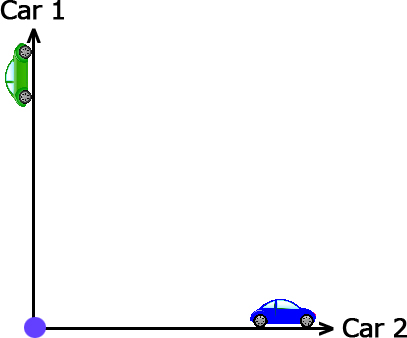
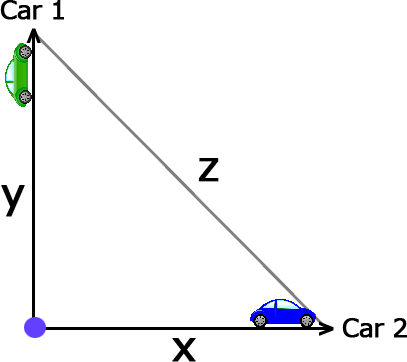
Two cars leave an intersection at the same time, one headed east and the other north. The eastbound car is moving at 30 mph30\ mph while the northbound car is moving at 60 mph60\ mph. Twenty minutes later, what is the rate of change in the perimeter of the right triangle created using the two cars and the intersection?

As always, we draw our diagram.

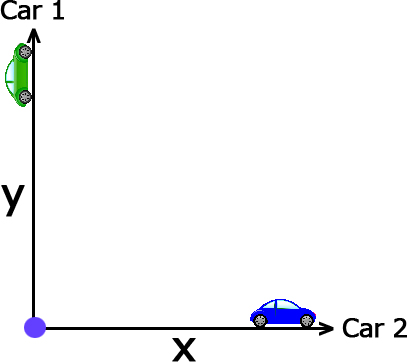
Since the distance from each car to the intersection is changing with time, we need to label these distances with variables, say xx and yy.

Since there's a right triangle being made by these two cars, we can make the distance between them be a line. This is also changing with respect to time, so we can label it with a variable zz.

Now, we can start labeling our rates. It says the eastbound car is traveling at 30 mph30\ mph. This means dxdt=30\frac{dx}{dt}=30. Similarly, dydt=60\frac{dy}{dt}=60 because the northbound car is traveling at 60 mph60\ mph. Finally, what we're looking for is the rate of change in the perimeter, or dPdt\frac{dP}{dt}, after 20 min20\ min has passed. Since this time is in minutes and our rates are in hours, we need to rewrite the time in terms of hours, t=2060=13t=\frac{20}{60}=\frac13.

So now let's use the equation for the perimeter. P=x+y+zP=x+y+z Notice, though, that if we took the derivative immediately we would get dzdt\frac{dz}{dt} which we don't have any information for. So, like in the previous example, we need to rewrite zz in terms of xx and yy. And, like before, we do it using the Pythagorean Theorem. x2+y2=z2x2+y2=z\boxed{\begin{align} x^2+y^2&=z^2\\ \sqrt{x^2+y^2}&=z \end{align}}

Let's fix our equation now. P=x+y+x2+y2P=x+y+\sqrt{x^2+y^2}

Now that everything is in terms of xx and yy, and we have rates for those, we can take the derivative. P=x+y+x2+y2dPdt=dxdt+dydt+12x2+y2⋅[x2+y2]′dPdt=dxdt+dydt+12x2+y2⋅(2x⋅[x]′+2y⋅[y]′)dPdt=dxdt+dydt+12x2+y2⋅(2xdxdt+2ydydt)dPdt=dxdt+dydt+1x2+y2⋅(xdxdt+ydydt)\begin{align} P&=x+y+\sqrt{x^2+y^2}\\ \frac{dP}{dt}&=\frac{dx}{dt}+\frac{dy}{dt}+\frac{1}{2\sqrt{x^2+y^2}}\cdot\color{red}{[x^2+y^2]'}\\ \frac{dP}{dt}&=\frac{dx}{dt}+\frac{dy}{dt}+\frac{1}{2\sqrt{x^2+y^2}}\cdot(2x\cdot\color{red}{[x]'}+2y\cdot\color{red}{[y]'})\\ \frac{dP}{dt}&=\frac{dx}{dt}+\frac{dy}{dt}+\frac{1}{2\sqrt{x^2+y^2}}\cdot\bigg(2x\frac{dx}{dt}+2y\frac{dy}{dt}\bigg)\\ \frac{dP}{dt}&=\frac{dx}{dt}+\frac{dy}{dt}+\frac{1}{\sqrt{x^2+y^2}}\cdot\bigg(x\frac{dx}{dt}+y\frac{dy}{dt}\bigg) \end{align}

Finally, we can plug in all our information, but notice that we don't have values for xx and yy. Here is where we use the fact that t=13 hrt=\frac13\ hr. The car that was going east was traveling at 30 mph30\ mph. In 13\frac13 of an hour it traveled x=303=10x=\frac{30}{3}=10 miles.

Similarly, if the other car is traveling north at 60 mph60\ mph, after 13\frac13 of an hour it will have traveled y=603=20y=\frac{60}{3}=20 miles.

Let's plug this all in. dPdt=dxdt+dydt+1x2+y2⋅(xdxdt+ydydt)dPdt=30+60+1102+202⋅[10(30)+20(60)]dPdt=90+300+1200100+400dPdt=90+1500500dPdt≈157.082\begin{align} \frac{dP}{dt}&=\frac{dx}{dt}+\frac{dy}{dt}+\frac{1}{\sqrt{x^2+y^2}}\cdot\bigg(x\frac{dx}{dt}+y\frac{dy}{dt}\bigg)\\ \frac{dP}{dt}&=30+60+\frac{1}{\sqrt{10^2+20^2}}\cdot[10(30)+20(60)]\\ \frac{dP}{dt}&=90+\frac{300+1200}{\sqrt{100+400}}\\ \frac{dP}{dt}&=90+\frac{1500}{\sqrt{500}}\\ \frac{dP}{dt}&\approx157.082 \end{align}

The rate of change of the perimeter of the triangle is 157.08 mi/hr.\text{The rate of change of the perimeter of the triangle is }157.08\ mi/hr\text{.}

Type a concept, like “slope” or “photosynthesis”.

↑ ↓ to choose · Enter to openSearch explanations and problems