Structure and Function of Ribosomes
The ribosome plays a crucial role in protein synthesis. Ribosomes are responsible for reading a strand of mRNA and, with the help of tRNA, finding the corresponding amino acid for each codon in the mRNA code.
The structure of the ribosome is pretty unique. Ribosomes are composed of both proteins and RNA, in this case a class of RNA called ribosomal RNA (rRNA). The rRNA is very important in ribosome function because it is the RNA, not the protein, which makes the peptide bonds between amino acids.
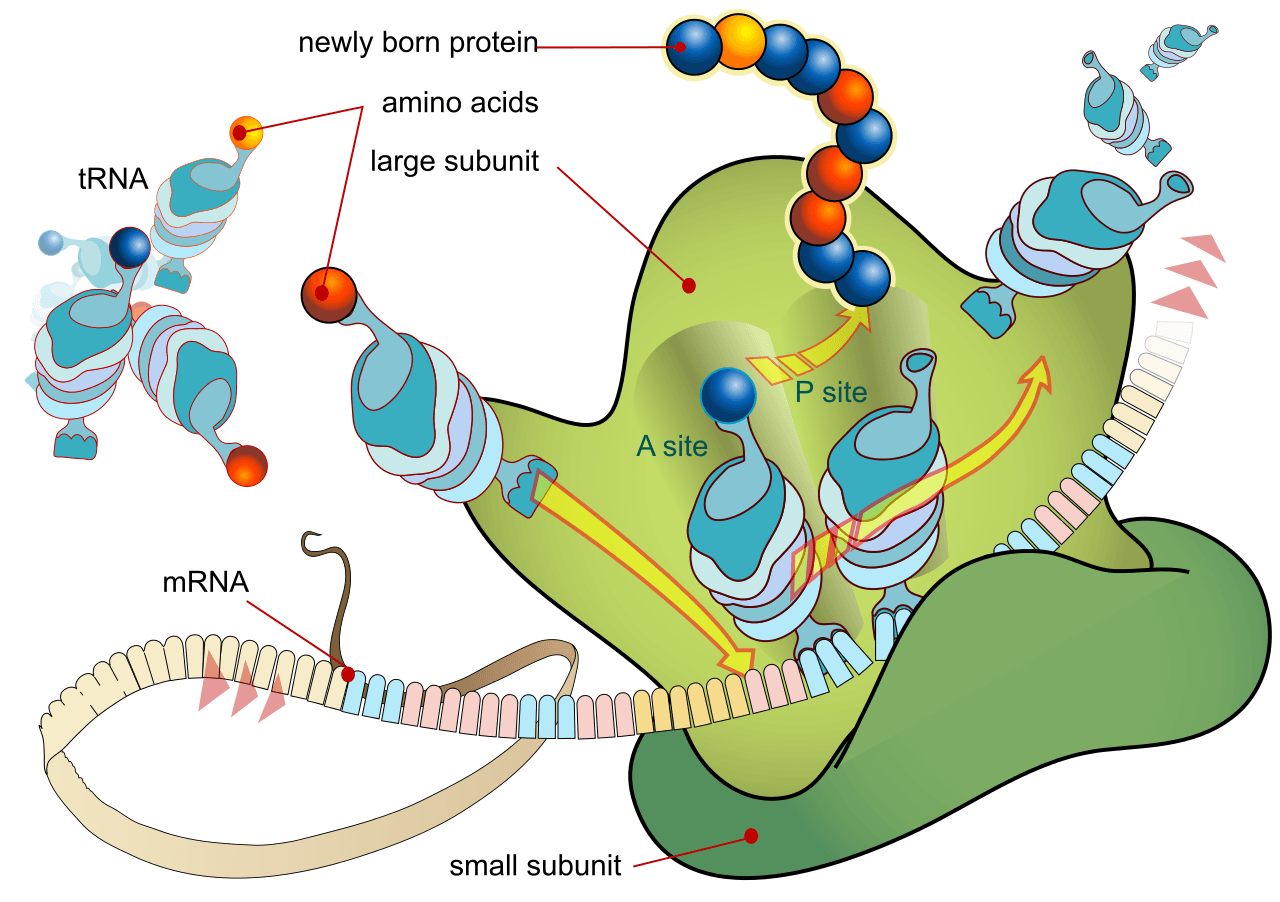
Ribosomes can be split into two distinct subunits: the large subunit and the small subunit. The small subunit is the first subunit to attach to the mRNA strand. It then moves down the strand until it finds the start codon (AUG), at which point it recruits the large subunit. The large subunit then allows tRNA molecules to pass through and check if their anticodon matches the corresponding mRNA codon. This is basically like a game of guess and check; if there is not a match the large subunit will push the tRNA out, but if there is a match the large subunit will assist in adding the amino acid to the amino acid chain. This process will keep going until a stop codon is reached, signaling the end of translation.
Above is a good model of a ribosome in action. This ribosome is already in the second phase of translation: elongation. This means that the ribosome is moving in the 5' → 3' direction along the mRNA strand, adding amino acids when the right match is made between the codon on the mRNA strand and the anticodon on the tRNA.