Read · 2 min
+1 contributors

What is Scientific Notation and Why is it Useful?
Scientific notation is a specific way of writing large numbers or small numbers. It is useful because it simplifies the way numbers are written. It also, is a great way to include significant figures in a value or calculation.
How to write in Scientific Notation
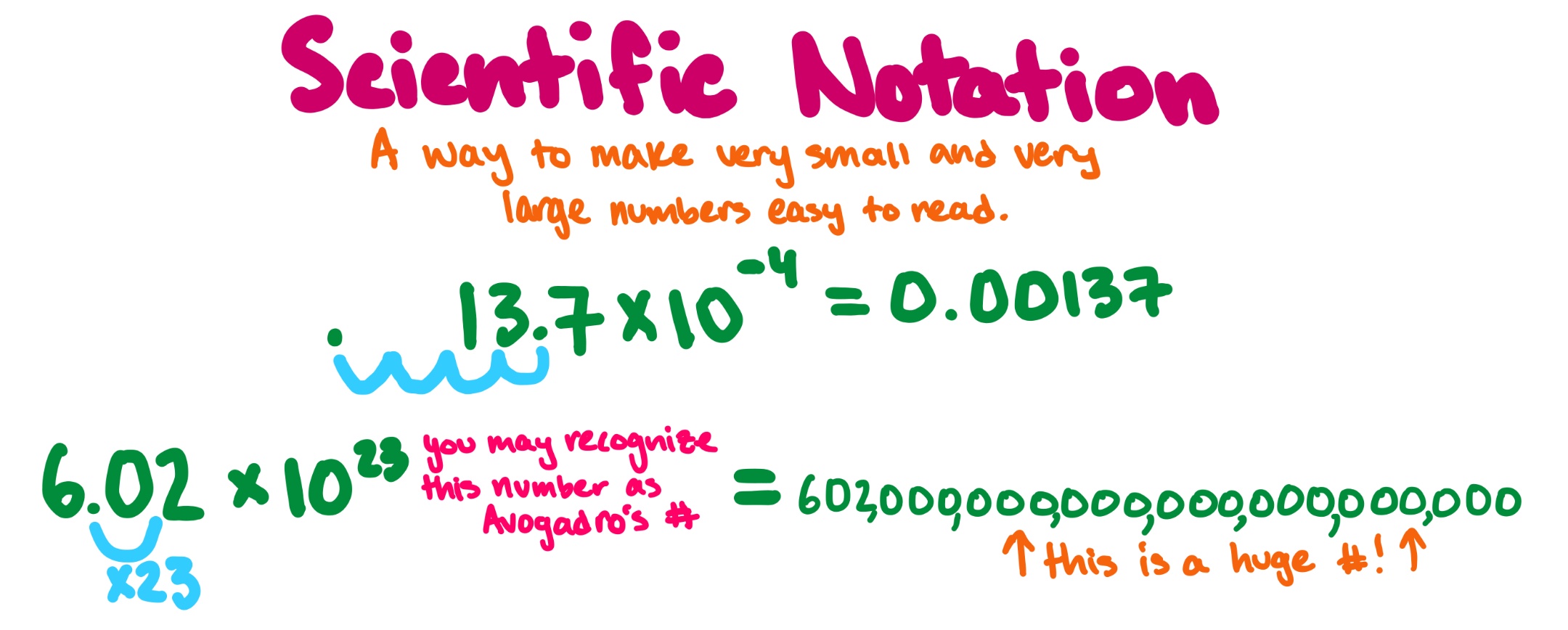
In scientific notation the decimal point is moved to the left (large number) or right (small number) until there is only one non-zero digit to the left of the decimal point. After we move the decimal point, the number of places the decimal is moved is denoted as a positive (move left) or negative (move right) raised to the power of ten.
Example of a large number converted to scientific notation Example of a small number converted to scientific notation
Notice that the number of significant figures are varied between the two values in scientific notation. It can be difficult to judge how many significant figures to include in measured value. If the measuring device is known, it will report how precise measurements can be taken and the number of significant figures can be included. If the number of significant figures is unknown two or three digits is standard in scientific notation, unless otherwise noted.
Examples of rounding in scientific notation
Significant Figures and Scientific Notation
In scientific notation, it is important to consider what digits are significant. When calculating values that are large or small, scientific notation can be used. The number of digits used should correspond to the number of significant figures.
Example: Calculate the number of moles in 0.0839 mL of water (density= 1.0 g/mL) and report the answer in scientific notation.
The number of significant figures will be three which matches the original measured number of milliliters. If doing a multi-step calculation, it is important to wait until the end of the calculation to round the value.
Addition and Subtraction
Numbers in scientific notation can be added or subtracted if both of the exponents are the same. It is possible to change the exponent of one value to support the exponent of another value.
Addition example: Addition and subtraction are carried out the same way for the exponents.
Multiplication and Division
Numbers in scientific notation can multiplied by first carrying out the calculation of the numbers in front of the and then adding the exponents together
Multiplication example:
Division is similar to multiplication, but instead of adding the exponents, they are subtracted. The denominator exponent is substracted from the numerator exponent.
Division example: