Smooth Endoplasmic Reticulum (SER) — Structure & Function

Illustrated · 1 min

The Cellular Synthesizer

In eukaryotic cells there are a lot of different organelles, so it can be hard to remember what all of them do. The job of the smooth endoplasmic reticulum, or smooth ER for short, is to synthesize things. What it makes depends on the type of cell. It is not found in prokaryotic cells.

This is a cartoon illustration of a smooth endoplasmic reticulum wearing sunglasses and playing a synthesizer keyboard. The image text reads: Remember: the smooth ER synthesizes.

Image source: By Sylvia Freeman

The smooth ER synthesizes lipids, phospholipids, and steroids (which are important for hormone production). It is also involved in carbohydrate metabolism and detoxifying things like metabolic waste products, alcohol, and drugs.

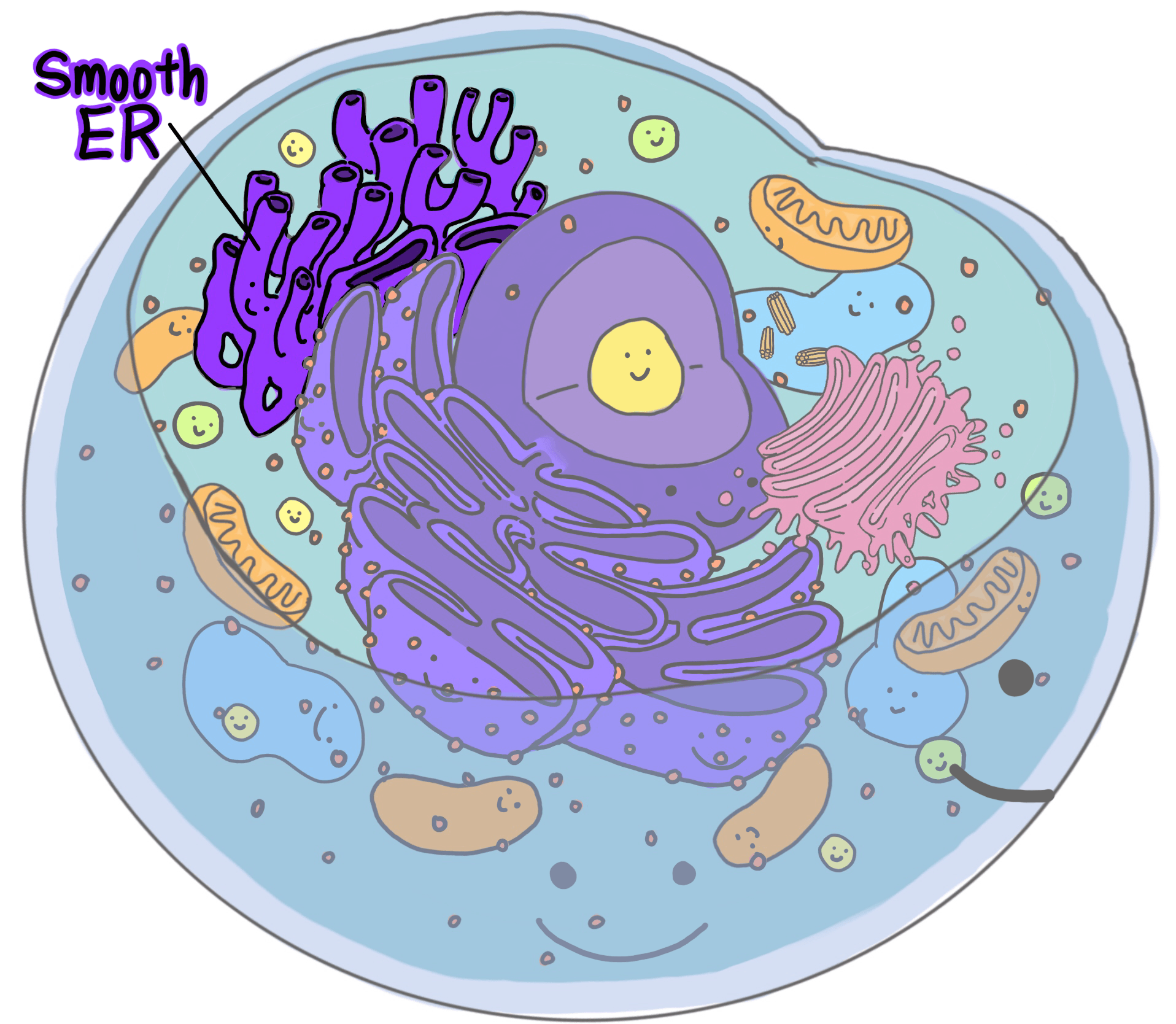
This is a cartoon image showing a smooth endoplasmic reticulum inside of a cell.

Image source: By Sylvia Freeman

Be careful not to get this confused with the rough ER (RER), which has its own unique functions. Both the smooth and rough ER are found in the cytosol. The rough ER is attached to the nucleus. The smooth ER and the rough ER are connected as well.

You can tell the smooth and rough ER apart because the rough ER has ribosomes on it, which give it a rough and bumpy appearance under a microscope.

Illustrated · 1 min

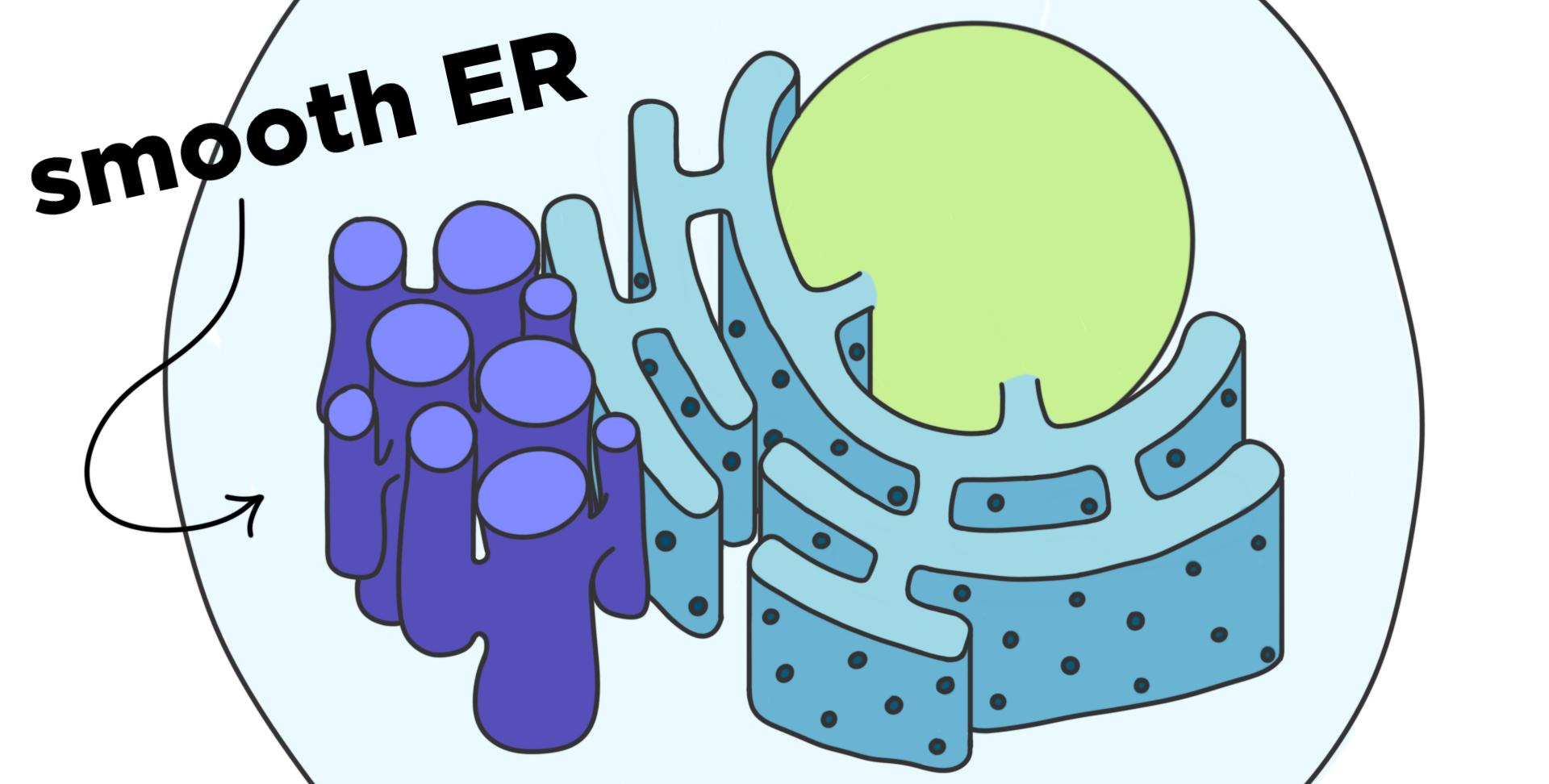
Picture of smooth ER

Image source: By Gabi Slizewska

The endoplasmic reticulum (ER) is an organelle found inside many types of cells. It consists of two parts: the rough ER and the smooth ER.

Although both types look similar, you can tell them apart because only the rough ER has ribosomes attached to it. The smooth endoplasmic reticulum lacks ribosomes, so it appears to be "smooth".

The structure of cholesterol and the phospholipid bilayer

Image source: By Gabi Slizewska

The two types of ER also have very different functions. The smooth one is responsible for making lipids. These are things like steroidal hormones and phospholipids used to make the cell membrane.

Smooth ER can also help with the transport of things around the cell and to different organelles, like the Golgi apparatus. Sometimes, it also plays an important role in getting rid of harmful chemicals in the cell. This is why you will find a lot of smooth ER inside liver cells.

Interactive · 2 questions

A Tale of Two Endoplasmic Reticulums

The endoplasmic reticulum is an organelle found in most eukaryotic cells. It is made up of two parts: one is smooth, while the other is rough. The most basic differences between these two sub-units are what they look like and what they synthesize:

This is a Venn diagram comparing and contrasting SER and RER. Smooth endoplasmic reticulum does not have ribosomes, and it makes and stores lipids and steroids. Rough endoplasmic reticulum is covered in ribosomes, and it makes and stores proteins. Both types make cellular materials.

Image source: By Valeri Natole

The smooth endoplasmic reticulum (SER) is essentially a network of membranes that assembles the lipid parts of the cell membrane and helps with the detoxification of drugs. It also assists in the transportation of macromolecules.

It's called smooth because it's literally smooth; this part of the ER does not contain any ribosomes.

How Does It Work?

Like we said before, the SER doesn’t have ribosomes working along its membrane—it doesn’t need to, because it doesn’t build proteins. (Remember: ribosomes help string amino acids together to form proteins.) So, how does the smooth endoplasmic reticulum make lipids and send them off to where they belong? How does it break down substances?

Making Lipids‾\underline{\color{#3DB917}{\text{Making Lipids}}}

Lipids are made by enzymes embedded in the membrane of the SER. That’s because they have hydrophobic parts that don’t like the watery inside of the organelle. Meanwhile, the hydrophilic parts of the fats face into the cisternal space. When they’re finished, the lipid products get packaged into vesicles and sent off to their destinations.

Detoxification‾\underline{\color{#3DB917}{\text{Detoxification}}}

Enzymes in the SER break down harmful substances into water-soluble compounds. Those compounds don’t just sit around in the cell. They get excreted. You know, like when you use the bathroom.

What About Sarcoplasmic Reticulum?

“Sarcoplasmic reticulum” is a special name for the SER located in skeletal muscle cells. This special SER’s job is to collect calcium ions so that your muscles can contract. Remember to thank your sarcoplasmic reticulum for helping you out at the gym.

Sarcoplasmic reticulum is specialized smooth endoplasmic reticulum in skeletal muscle cells.

Image source: By Chippolito CC BY-SA 4.0, via Wikimedia Commons

Practice

The smooth endoplasmic reticulum does not perform which of the following functions?

Choose one answer

Video · + 1 min read

(Video) Intracellular Organelles - Smooth Endoplasmic Reticulum

by Medic Tutorials

This video explains the difference between the SER and RER. It also describes the structure and functions of the SER.


Summary

The endoplasmic reticulum is a network of membranes found in eukaryotic cells. There are actually two parts to it: the rough and the smooth part. The rough ER (RER) extends from the nucleus. It is studded with ribosomes. The ribosomes help build proteins through a process called translation, in which they convert a strand of mRNA into a chain of amino acids.

The smooth part of the endoplasmic reticulum (SER) is called such because it lacks ribosomes. The SER contains many enzymes with different roles depending on what type of cell they are in. Unlike the RER, it does not have a role in protein synthesis.

Special Roles‾\underline{\color{#3DB917}{\text{Special Roles}}}

Here are some functions the SER has:

  • Lipid metabolism in liver cells
  • Cholesterol synthesis (making steroids)
  • Drug detoxification in the liver and kidneys
  • Breaking down glycogen into glucose for energy in liver cells

There is usually not a lot of SER in cells except for a few special cases, like muscle cells. They have something called a sarcoplasmic reticulum, which is a specialized SER that stores calcium ions.

Illustrated · 1 min

The SER: Form Follows Function

The endoplasmic reticulum is contiguous with the nuclear envelope. It has a convoluted shape.

Image source: By OpenStax CC BY 3.0, via Wikimedia Commons

There’s no denying that the endoplasmic reticulum (ER) has a funky shape. What’s that shape called? Well, the shape itself doesn’t have a name, but its parts do.

The folds of the ER membrane are called cisternae. Ribosomes cover the outside of the RER. The space inside the ER is called the cisternal space, or the lumen.

Image source: By OpenStax (modified by expii) CC BY 3.0, via Wikimedia Commons

Biologists like to say that form follows function. That means living things evolve their shapes because those shapes add to the organism's fitness. So, the shape of the endoplasmic reticulum helps it do its job. For the smooth endoplasmic reticulum (SER) that means synthesizing lipids and breaking down dangerous chemical substances.

The folds of the ER's membrane are called cisternae. The membrane is folded like this so that the organelle has more surface area. This gives it extra space to make proteins and lipids.

Ribosomes cover the outside of the RER, but not the SER. That's because the SER doesn't build proteins, so it won't ever need to use ribosomes.

The space inside the ER is called the cisternal space or the lumen. The hydrophilic parts of the fats built by the SER point out into the lumen.

Type a concept, like “slope” or “photosynthesis”.

↑ ↓ to choose · Enter to openSearch explanations and problems