What is standard temperature and pressure (STP)
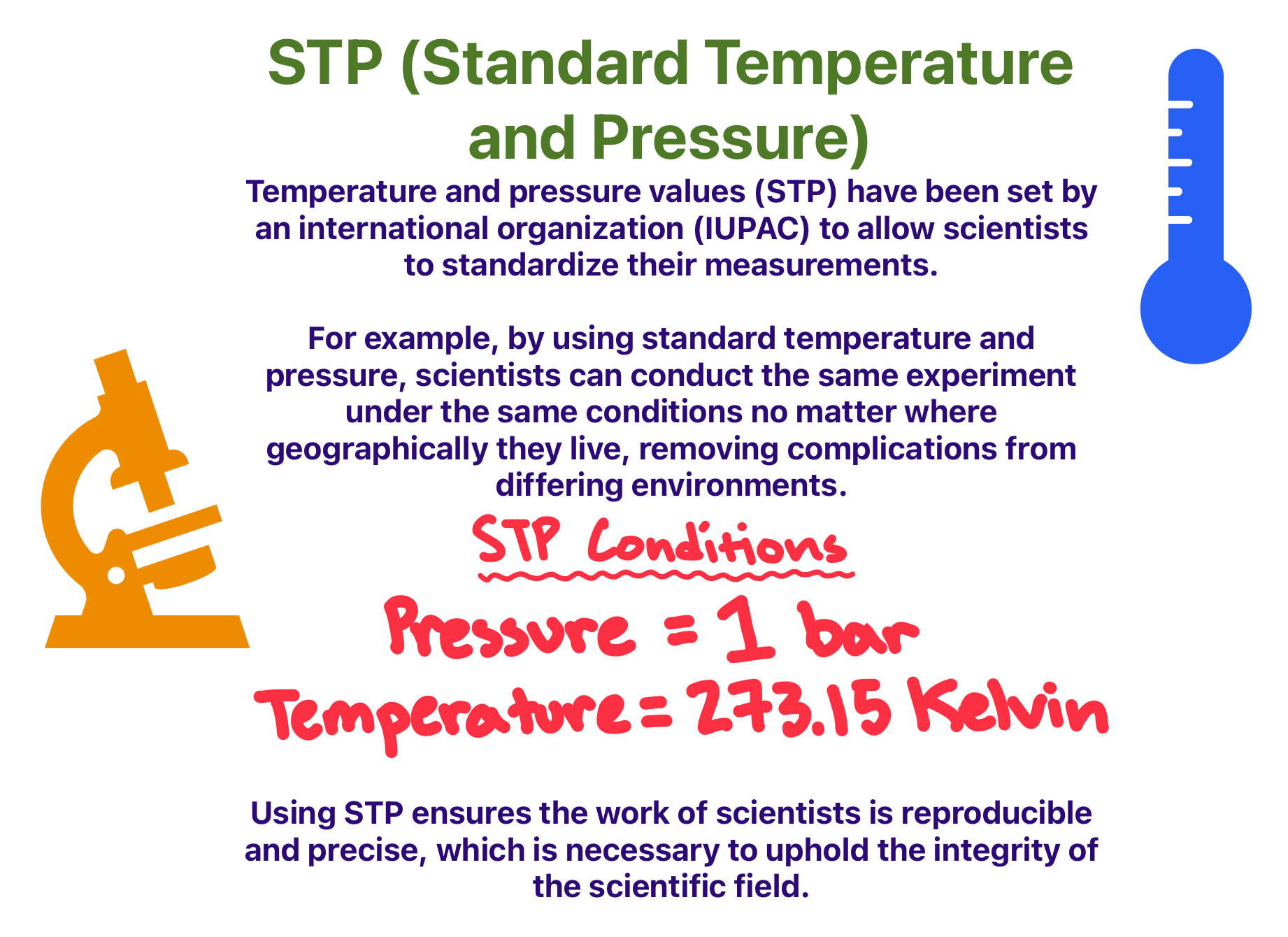
STP is an acronym that stands for standard temperature and pressure. It is a specific set of values defined by institutional organizations. Why? To create a standard that allows for accurate evaluations of different conditions. The organization responsible for defining STP is IUPAC (The International Union of Pure and Applied Chemistry).
The conditions for STP are:
Pressure = 1 bar
Temperature = 273.15 Kelvin
From these values, we are able to convert to different units through unit conversions.
The IUPAC definition of STP is the most widely recognized and used. But, it is worthwhile to mention other organizations that have slightly different definitions of STP. The National Institute of Standards and Technology (NIST) defines temperature the same way as IUPAC. But it identifies 1 atmosphere as the standard pressure. What's the difference in the pressure values between NIST and IUPAC? It's 1.013 bar versus 1 bar, respectively. So they are very close. There is also the SATP acronym. It stands for standard ambient temperature and pressure. It's defined as 25oC and 1 atm. That's approximately the temperature and pressure of an average room.
Why is STP important though?
By creating a “baseline” or a reference standard, scientists working at nonstandard conditions -- be it hotter in the laboratory or at an elevation affecting the pressure -- can correct for their own conditions. For example, let's say two scientists perform the same experiment. But, one is in Colorado, and the other is in Florida. They may get different data because of the contrasting elevations. Florida is at sea level. So, the atmospheric pressure in Colorado will be much lower. So, to compare the data, it needs to be corrected. So, both chemists better look at the barometer so they know the pressure.
In previous lessons, we investigated the properties of gases and the various gas laws. Using STP we are also able to calculate different values using the ideal gas law. For example, when we plug STP into the ideal gas law, we calculated that 1 mole of any gas is 22.4 liters. We often use the molar volume in stoichiometry problems, when using dimensional analysis, when calculating the molar mass or density of a gas, or in unique gas stoichiometry problems. As a side note, if we are working with solutions, we also need a standard concentration. So, we use 1.0 molar.
The final reason for defining standard conditions is to create standard values. Across every branch of chemistry, we need set conditions. Even when we're not at STP we use the standard condition as our baseline. We convert the standard values to nonstandard values. For example, in thermodynamics, we have the standard enthalpy of formation, the standard Gibbs free energy, and the standard free energy of formation. In electrochemistry, we use the standard electrode potentials. If we are not at the standard state, we have to calculate nonstandard electrode potentials.