Illustrated · 2 min
Recall that in , . What if was , so that we are working in ? What are the possible norms that an element in can have? Well, we know that norms are multiplicative, so let's see which primes can be norms, because we can multiply them to determine if a composite can be a norm.
First, let's state a theorem and its proof:
Minkowski's Convex Body Theorem In an -dimensional lattice spanned by the vectors
let .
Then, if we have a convex region symmetric about the origin with volume greater than , then there exists a non-zero point of the lattice in .
Whew. That was a mouthful. Let's try a two-dimensional example to see what this is trying to show.
Let's take the vectors and . Then, the lattice looks like so:
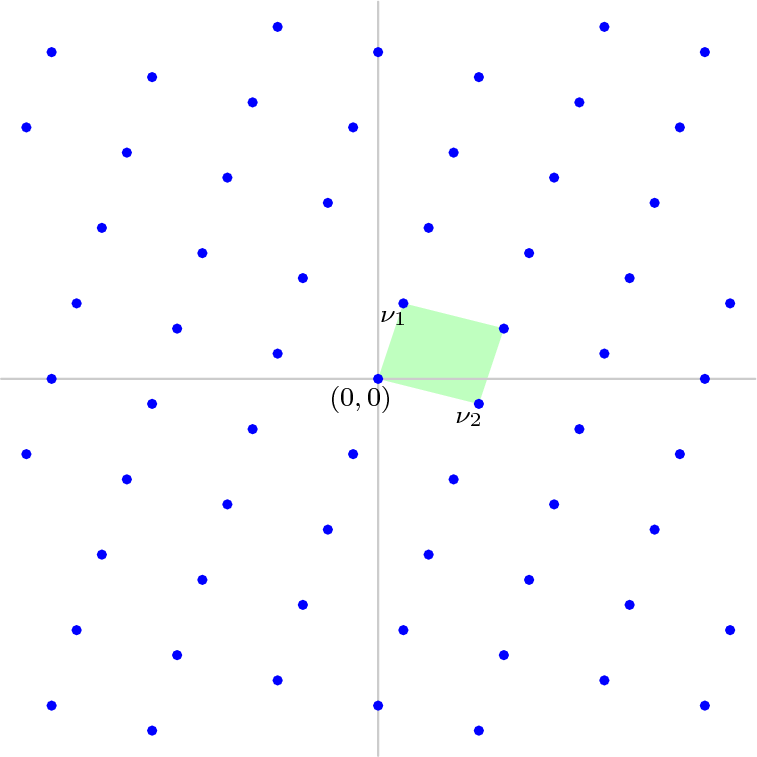
Additionally, we have that the green region has area . Thus, since all of the parallelograms have the same area, the region below has area .
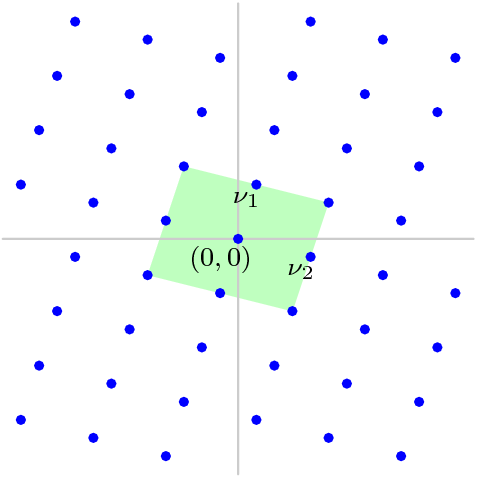
Minkowski's theorem states that if we have a convex region symmetric about the origin with area greater than , then it will have a lattice point other than the origin. That seems reasonable enough. Let's try to prove the general case.
Suppose we have an -dimensional lattice spanned by the vectors
and let .
Consider the region with the area greater than . Consider the congruence classes Then, we know that each point in the region is congruent to a point in the region of area . By the pidgeonhole principle, since the area of is greater than , there exists two distinct points such that Since is symmetric about the origin, we know that , and then since is convex, the midpoint of and is in . Thus, Note that since and are distinct, at least one of is non-zero, so we have found a non-zero lattice point in .
Now let's state and prove Fermat's Christmas Theorem.
Theorem A prime is the sum of two squares if and only if .
Lemma If , then is a quadratic residue modulo . From the Legendre symbol or Euler's criterion, we know . In order for to be true, must be even. Thus, for some . Rearranging yields for some . Thus, if , then is a quadratic residue modulo .
Proof By our lemma, we know that there exists such that . Consider the lattice spanned by the vectors and . Note that every lattice point has a distance that is a multiple of from the origin: Additionally, we have that . Now, consider the set of points such that . This is a convex region symmetric about the origin. We also know that this is a circle with radius and area . Since we know , we have . Thus, there must exist a point on the lattice such that and . However, this means that , which is what we wanted to prove.
Now you might be thinking, Why did we prove Minkowski's Theorem for -dimensions when we only needed it for two dimensions? Well, here, we use it in four dimensions!
