Systems of Linear Inequalities, Word Problems - Examples

Before this, knowGraphing Systems of Linear Inequalities - Process & Examples

Interactive · 6 questions

Word Problems with Systems of Linear Inequalities

Solving word problems with systems of linear inequalities involves 2 steps:

  1. Translate the word problem into mathematical expressions. We're finding a system of linear inequalities.

  2. Solve! One strategy you can use to find solutions is to graph each inequality. Then, use the overlapping areas of the graphs to identify the solutions to the word problem.

Let's look at an example:

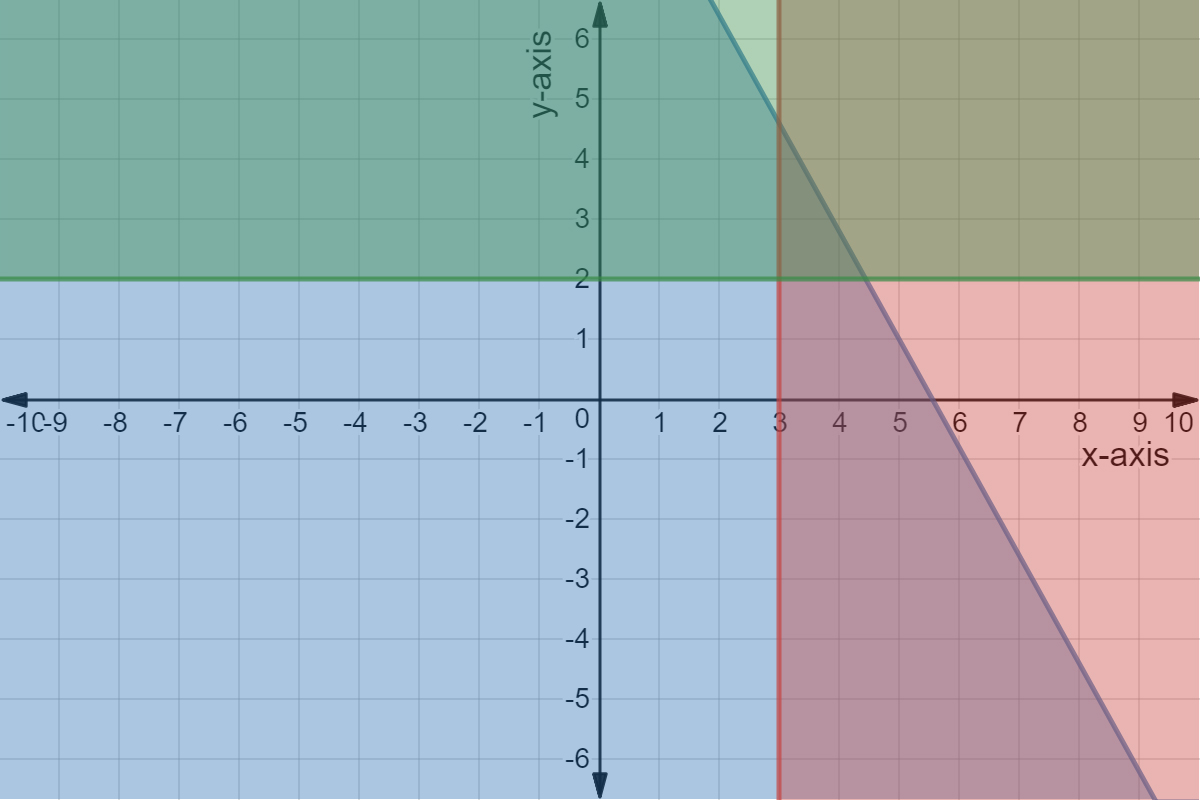
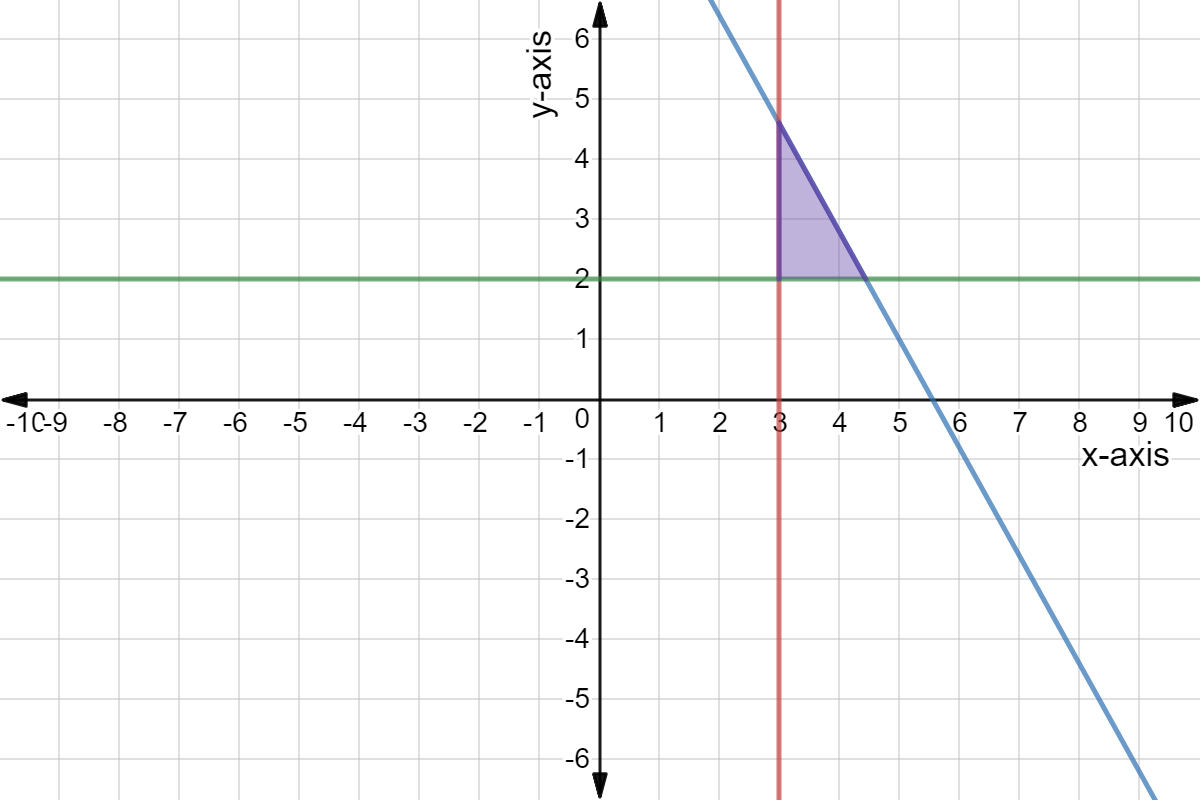
Pilar is buying pizza and cookies for a party. Pizzas cost $9 each and cookies cost $5 per pound.
Pilar wants to spend no more than $50, but she needs at least 3 pizzas and at least 2 pounds of cookies. Use a graph to show how many of each item Pilar can buy.

Image source: by Hannah Bonville

STEP 1: Translate the word problem into inequalities.

We're going to use xx for the number of pizzas and yy for the number of pounds of cookies.

Which inequality represents the number of pizzas Pilar needs?

Choose one answer

Video · + 2 min read

(Video) Solving Inequalities: Word Problems

by Anusha Rahman

This video by Anusha Rahman walks you through an example word problem of how to solve a system of inequalities.

Summary

Example: Jackson is having a party for his friends on Saturday. Jackson expects at least 7 people to show up on Saturday. He is trying to figure out the total costs of all of the pizzas. He calls his local pizza place, Meredith’s pizza, who says that the cost of his pizzas will be less than 5 more than 2 times the number of people he needs pizza for.

Step 1: Establish variables x=the number of peoplex=\text{the number of people} y=the cost of all pizzasy=\text{the cost of all pizzas}

Step 2: Set up the inequalities x≥7x \ge 7 y<5+2xy < 5 +2x

Step 3: Graph the inequalities to find the solution

Graph of: x≥7x \ge 7

Graph of x greater than/equal to 7.

Made using Desmos

Graph of y=5+2xy=5+2x

Graph of y=5+2x

Made using Desmos

This is the graph of the line, y=5+2xy=5+2x. In order to graph the inequality, y<5+2xy < 5 +2x, we have to figure out what area on the graph to shade. To do that, we test out some points and see whether the inequality remains true!

Let's test the point (10,2)(10,2). 2<2(10)+52<2(10)+5 2<20+52<20 + 5 2<252<25 This statement is true! So we will probably shade in this area, the bottom area of the graph. But, let's just check one more point to make sure.

Let's test the point (−10,2)(-10,2). 2<2(−10)+52<2(-10)+5 2<−20+52<-20+5 2<−152<-15 This statement is false.

Graph of $y < 5 +2x $, with the area under the line shaded in blue.

Made using Desmos

So, we can see in the above graph that the area under the dotted line is shaded. This is the graph of y<5+2xy < 5 +2x.

Now, let's put both inequalities on the same graph to see the area of intersection!

Graphs of: $x \ge 7$ and $y < 5 +2x $ with an intersecting region.

Made using Desmos

The area shaded in purple is the solution to the system of inequalities! Because Jackson probably won't have negative friends or pay negative dollars, we can assume x>0x > 0 and y>0y>0.

Jackson won’t know for certain what the price of his pizzas will be. Why? Because Jackson doesn’t know how many of his friends will be coming to his party. Especially when solving real-world problems, a system of inequalities is really helpful when we’re looking at something in the future, and we don’t have exact numbers, but we have a general idea, like Jackson does.

Illustrated · 1 min

Systems of Linear Inequalities: Word Problems

When you are presented with a word problem that deals with inequalities, it may seem daunting at first to solve the problem. The good news is that there are two simple steps to follow in order to solve systems of linear inequalities!

Systems of Linear Inequalities: Word Problems
Step #1: translate words to inequalities
Step #2: solve the inequalities

Image source: by Anusha Rahman

Let's walk through an example problem together.

Example

Jenn and John want to go on a road trip together. Jenn drives an average of 5050mph, and John drives an average of 4545mph. They want to drive less than 2020 hours, but at least 500500 miles. Write a system of linear inequalities to figure out how many miles John and Jenn must drive to make that happen.

Step 1: Translate the word problem into inequalities.

Let's start with establishing our variables. x=Jennx=\text{Jenn} y=Johny=\text{John}

We know that Jenn and John want to drive at least 500500 miles. At least generally means greater than or equal to. So if we incorporate the speed at which the two of them drive, we can say that:

50x+45y≥50050x+45y \geq 500

We also know that, combined, John and Jenn want to drive less than 2020 hours. So, we can say that: x+y=20x+y=20

Therefore, our system of linear equations is:

50x+45y≥50050x+45y \geq 500 x+y=20x+y=20

Step 2: Solve the inequalities.

Let's solve these inequalities by graphing. Here is a graph of the two inequalities.

Graph of the two inequalities.

Made using Desmos

50x+45y≥50050x+45y \geq 500 is represented by the red shading. x+y=20x+y=20 is represented by the blue shading. The overlap, or the solution, is represented by the purple shading.

Type a concept, like “slope” or “photosynthesis”.

↑ ↓ to choose · Enter to openSearch explanations and problems