Transfer RNA (tRNA) — Overview & Role in Translation

Before this, knowMessenger RNA (mRNA) — Overview & Role in Translation

Illustrated · 1 min

What Is Transfer RNA?

Transfer RNA is a molecule which helps to translate the genetic code during protein synthesis. It is a looped strand of RNA (ribonucleic acid) that carries amino acids. It contains a section of three nucleotides on its bottom loop called anticodons (the anticodon loop). These anticodons are complementary to the codons that are being read by the ribosome on the mRNA strand.
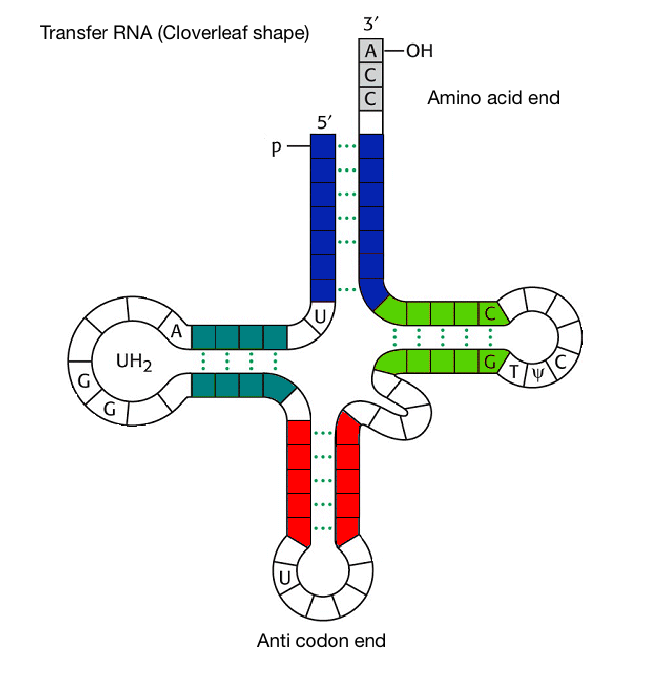
tRNA has a distinct cloverleaf shape.

The secondary structure of transfer RNA

Image source: By Yersinia~commonswiki (modified by expii) CC BY-SA 3.0, via Wikimedia Commons

It also has an amino acid bonded to the stem section of its structure (the acceptor stem). Each amino acid is specific to the anticodon at the other end of the structure. The process of attaching amino acids to transfer RNA is called tRNA charging, which is done by the enzyme aminoacyl-tRNA synthetase.

3D image showing the tertiary structure of DNA. The secondary structure is shown alongside it as a flat model.

The tertiary structure of transfer RNA

Image source: By Yikrazuul CC BY-SA 3.0, via Wikimedia Commons

Illustrated · 1 min

Purpose of Transfer RNA

Transfer RNA has a huge role in protein synthesis. It is like the construction worker that carries materials into a construction zone. It brings specific amino acids to the ribosome which are then matched up to the mRNA blueprints.

A diagram showing tRNA molecules bringing amino acids to the ribosome and mRNA strand.

Image source: By Boumphreyfr CC BY-SA 3.0, via Wikimedia Commons

The tRNA and mRNA work together to make sure the correct amino acids are bonded together to form a protein. As the mRNA passes through the ribosome one codon at a time, the transfer RNA brings in the amino acids that match the instructions. Each can only carry one specific type of amino acid, so many specific tRNA molecules are needed to build the whole polypeptide.

The ribosome breaks the bond between the transfer RNA molecule and the amino acid, which allows an enzyme (aminoacyl tRNA synthase) to add the same amino acid back on to the transfer RNA.

This process continues until a stop codon shows up, at which point the protein is completely built.

Vocabulary Review:\color{#8925AE}{\text{Vocabulary Review:}}

Translation\color{#8925AE}{\text{Translation}} : The cell uses the information from RNA to make proteins

mRNA\color{#8925AE}{\text{mRNA}} : Messenger RNA. mRNA codons act as instructions for the cell to build polypeptides

tRNA\color{#8925AE}{\text{tRNA}} : Transfer RNA. Carries a specific amino acid to the ribosomes to help build proteins

Codon\color{#8925AE}{\text{Codon}} : A group of three nucleobases (base pairs) that codes for a specific amino acid

Video

(Video) What Is tRNA???

By Toms Teachings

The video above describes the structure of transfer RNA and its function in gene expression.

Summary

Proteins are made up of chains of amino acids. Every three nucleotides (called a codon) on the mRNA strand code for one amino acid. Transfer RNA matches codons with their corresponding amino acid to help build the protein chain.

Transfer RNA molecules are specific in their acceptor stems and their anticodons. This double method of checking ensures that the correct amino acid will be matched with its codon.

Anticodons read mRNA via hydrogen bonds.

Type a concept, like “slope” or “photosynthesis”.

↑ ↓ to choose · Enter to openSearch explanations and problems

