Read · 2 min

Transformations of Hyperbolas

As we’ve learned, a hyperbola is a type of conic section, just like an ellipse, parabola, or circle.

A hyperbola is formed when a plane cuts through a double cone.

Because of the way it is formed, a hyperbola has two separate branches. These branches open in opposite directions from each other.

The standard form of a hyperbola equation centered at the origin with a horizontal transverse axis is: x2a2−y2b2=1\frac{x^2}{a^2} - \frac{y^2}{b^2} = 1

The standard form of a hyperbola equation centered at the origin with a vertical transverse axis is: y2a2−x2b2=1\frac{y^2}{a^2} - \frac{x^2}{b^2} = 1

There are several ways we can change, or transform, the parent hyperbola equation.

Just like with other functions and polynomials, we can translate, rotate, or dilate a hyperbola.

A translation moves the hyperbola left, right, up, or down. A rotation turns it around a point. A dilation stretches or shrinks the graph.

These transformations change how the hyperbola looks, but it is still a hyperbola.

###Translation

Translating a hyperbola means shifting it horizontally or vertically by adding or subtracting constants to the xx and yy terms. For example, if you have a hyperbola centered at (h,k)(h,k) with a horizontal transverse axis, you can write the equation as: (x−h)2a2−(y−k)2b2=1\frac{(x-h)^2}{a^2} - \frac{(y-k)^2}{b^2} = 1

If you have a hyperbola centered at (h,k)(h,k) with a vertical transverse axis, the equation will look like: (y−k)2a2−(x−h)2b2=1\frac{(y-k)^2}{a^2} - \frac{(x-h)^2}{b^2} = 1

For example, if you want to write the equation for a hyperbola with a center at (2,0)(2,0) and a horizontal transverse axis: (x−2)2a2−y2b2=1\frac{(x-2)^2}{a^2} - \frac{y^2}{b^2} = 1

In this example, h=2h=2 and k=0k=0, indicating a horizontal translation by 22 units to the right.

###Rotation

We can also rotate hyperbolas! Rotating a hyperbola involves changing the orientation of its axes. We can do that by replacing xx and yy with linear combinations of themselves, such as x=x′cos⁡(θ)−y′sin⁡(θ)x=x'\cos(\theta) - y'\sin(\theta) and y=x′sin⁡(θ)+y′cos⁡(θ)y=x'\sin(\theta) + y'\cos(\theta), where θ\theta is the angle of rotation.

(xcos⁡(θ)−ysin⁡(θ))2a2−(xsin⁡(θ)+ycos⁡(θ))2b2=1\frac{(x \cos(\theta) - y \sin(\theta))^2}{a^2} - \frac{(x \sin(\theta) + y \cos(\theta))^2}{b^2} = 1

For example, the equation for a hyperbola rotated 30∘30^{\circ} counterclockwise is:

(xcos⁡(30∘)−ysin⁡(30∘))2a2−(xsin⁡(30∘)+ycos⁡(30∘))2b2=1\frac{\left( x \cos(30^\circ) - y \sin(30^\circ) \right)^2}{a^2} - \frac{\left( x \sin(30^\circ) + y \cos(30^\circ) \right)^2}{b^2} = 1

###Dilation

We can also stretch or compress a hyperbola. This type of change is called a dilation.

We create a dilation by multiplying the xx and/or yy terms by constants.

When you dilate a hyperbola, the center stays the same. The graph does not move.

Instead, the branches spread out more or move closer together. In other words, you are increasing or decreasing the distance between points on the graph.

###Combining Transformations

Just like with function transformations, we can combine transformations to drastically change our hyperbola. Order matters. The order matters because transformations are not commutative. Their effects change as the order changes.

Say we're given the following equation:

(x−2)24−(y+1)29=1\frac{(x-2)^2}{4} - \frac{(y+1)^2}{9} = 1

You want to translate it 33 units to the right, then rotate it 45∘45 ^{\circ} counterclockwise, and finally dilate it by a factor of 22 with respect to the origin.

Video · + 1 min read

(Video) Hyperbola Transformations

by Anusha Rahman

In this video by Anusha Rahman, you will learn about the various types of hyperbola transformations.

Summary

A hyperbola is a type of conic section. Conic sections are shapes formed when a plane cuts through a double cone.

A hyperbola looks like two curved lines that are mirror images of each other. These curves are symmetrical across two perpendicular lines called the axes.

There are two main types of hyperbolas. A vertical hyperbola opens up and down. A horizontal hyperbola opens left and right.

Looking at the standard form of a horizontal hyperbola:

x2a2−y2b2=1\frac{x^2}{a^2} - \frac{y^2}{b^2} = 1
  • aa is the distance from the origin to the vertices along the x-axis (horizontal axis)
  • bb is the distance from the origin to the vertices along the y-axis (vertical axis)
  • The distance from the center to the vertices along the transverse axis (horizontal axis) is aa, and the distance from the center to the vertices along the conjugate axis (vertical axis) is bb.The vertices are located at (±a,0)(\pm a,0).

Looking at the standard form of a vertical hyperbola: y2a2−x2b2=1\frac{y^2}{a^2} - \frac{x^2}{b^2} = 1

  • aa is the distance from the origin to the vertices along the y-axis (vertical axis)
  • bb is the distance from the origin to the vertices along the x-axis (horizontal axis)
  • The distance from the center to the vertices along the transverse axis (vertical axis) is aa, and the distance from the center to the vertices along the conjugate axis (horizontal axis) is bb.The vertices are located at (0,±a)(0,\pm a).

Illustrated · 1 min

Hyperbola Transformations

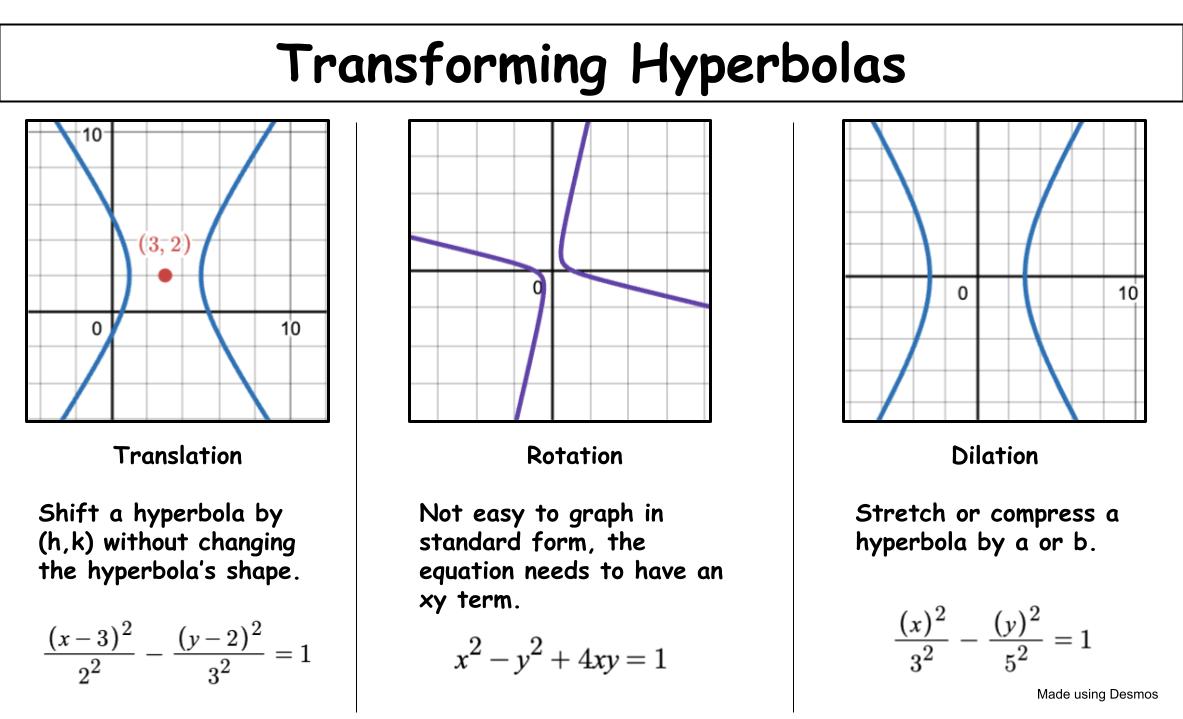
We've learned about hyperbolas extensively. We will now learn how they can be moved, turned, or stretched. In all of these examples, the basic shape of the hyperbola will not change. We will still see two curved branches that open away from each other.

Transforming Hyperbolas
Translation: Shift a hyperbola by (h,k) without changing the hyperbola’s shape.
Rotation: Not easy to graph in standard form, the equation needs to have an xy term.
Dilation: Stretch or compress a hyperbola by a or b.

Made using Desmos

Translation: Sliding the Hyperbola

A translation moves the hyperbola to a new location without changing its shape. In both the horizontal and vertical hyperbolas, the point (h,k)(h,k) will tell you how far the hyperbola is translated from the origin. The center will no longer be at the origin, (0,0)(0,0), but at the new center, (h,k)(h,k). All points, including the vertices, co-vertices, foci, and asymptotes, move along with the center.

Rotation: Turning the Hyperbola

A rotation turns the entire hyperbola around the origin or another point. This happens with there's a mixed xyxy term in the equation. For example: Ax2+Bxy+Cy2+Dx+Ey+F=0Ax^2 + Bxy + Cy^2 + Dx + Ey + F =0

If B≠0B \neq 0, the hyperbola is rotated and you can't easily use the standard form of a hyperbola. These hyperbolas are tilted diagonally and need special steps to graph. Rotation changes the direction the branches open, so they are no longer just left/right or up/down, but at an angle.

Dilation: Stretching or Shrinking

A dilation changes how wide or narrow the hyperbola is. This happens when you change the values of aa and bb in the equation.

  • Larger aa or bb →\rightarrow wider spread
  • Smaller aa or bb →\rightarrow more narrow curve

This value affects the size of the rectangle used to draw the asymptotes. That rectangle helps us sketch the overall shape of the graph.

When we apply a dilation, the center of the graph does not change. The graph still stays centered at the same point.

However, dilation does change how wide or narrow the branches are. It controls how far the branches spread out from the center.

Type a concept, like “slope” or “photosynthesis”.

↑ ↓ to choose · Enter to openSearch explanations and problems