Read · 1 min

In the past few lessons, we have learned what polar coordinates are and how to convert from polar to rectangular coordinates and vice versa.

We are not limited to converting just points. We can also convert whole equations from rectangular form to polar form.

Sometimes, writing an equation in polar form makes it easier to understand or model certain situations.

For example, polar equations are useful in robotics and engineering, especially when describing motion in circles or rotations.

Using the right coordinate system can make a problem much easier to solve.

Transforming rectangular equations into polar form

Think back to the equations we used to convert from polar to rectangular coordinates!

x=r cos θy=r sin θ\begin{align} x=r \text{ cos } \theta \\ y=r \text{ sin } \theta \\ \end{align}

When we are given an equation in rectangular form, we can just substitute these equations in place of xx and yy.

Let's try an example in order to better understand.

We are given the rectangular equation:

2x2+6x+2y2=02x^2 +6x + 2y^2 = 0

We can substitute...

2(rcos⁡θ)2+6rcos⁡θ+2(rsin⁡θ)2=02(r\cos{\theta})^2 + 6r\cos{\theta}+ 2(r\sin{\theta})^2 = 0

And simplify...

2r2cos⁡2θ+2r2sin⁡2θ=−6rcos⁡θ2r^{2}\cos^2{\theta} + 2r^{2}\sin^2{\theta} = -6r\cos{\theta} 2r2(cos⁡2θ+sin⁡2θ)=−6rcos⁡θ2r^2 (\cos^2{\theta}+\sin^2{\theta}) = -6r\cos{\theta}

Remember the trig identity that cos⁡2θ+sin⁡2θ=1\cos^2{\theta}+\sin^2{\theta} = 1

2r2(1)=−6rcos⁡θ2r^2 (1) = -6r\cos{\theta} 2r2=−6rcos⁡θ2r^2 = -6r\cos{\theta} −13r=cos⁡θ-\frac{1}{3}r = \cos{\theta}

Therefore, r=−3cos⁡θr = -3\cos{\theta}

We have now transformed the rectangular equation into polar form!

In the future, you will also learn about converting complex numbers between rectangular and polar form.

Video

(Video) Converting Rectangular Equations to Polar Equations

by Mario's Math Tutoring

We've already learned about polar coordinates and how to convert from polar to rectangular coordinates and vice versa. Now, check out this video by Mario's Math Tutoring to learn how to convert equations from rectangular to polar form!

Just like Mario says in his video, there are 4 equations we need to know...

x=rcos⁡(θ)x = r\cos(\theta) y=rsin⁡(θ)y = r\sin(\theta) r=x2+y2r = \sqrt{x^2+y^2} tan⁡(θ)=yx\tan(\theta) = \frac{y}{x}

Using our knowledge of trig inverses, we can simplify the last equation to ...

θ=tan⁡−1(yx)\theta = \tan^{-1}(\frac{y}{x})

Essentially, to convert from rectangular to polar form, you must convert all the x's and y's into r's and θ\theta's using the 4 equations above.

Try an example problem from Mario's video!

Convert y=5y=5 from rectangular form to polar form.

Choose one answer

Illustrated · 1 min

Transform Polar Equations from Rectangular to Polar

In rectangular coordinates, points are written as: (x,y)(x,y).

In polar coordinates, points are written as: (r,θ)(r, \theta).

Both systems describe the same points, but they use different information. Rectangular coordinates use horizontal and vertical positions, while polar coordinates use distance and angle.

Transforming equations from rectangular to polar means rewriting and equation using rr and θ\theta, instead of xx and yy.

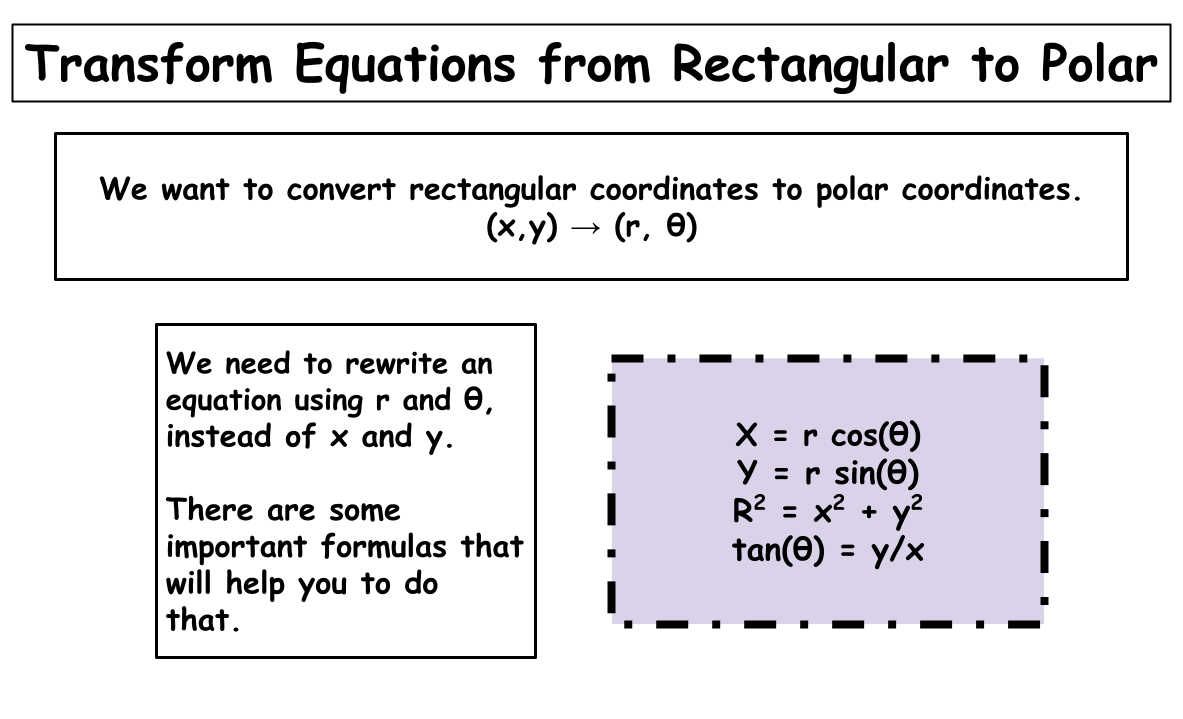
Transform Equations from Rectangular to Polar
We need to rewrite an equation using r and θ, instead of x and y.

There are some important formulas that will help you to do that.

X = r cos(θ)
Y = r sin(θ)
R2 = x2 + y2
tan(θ) = y/x

Image source: by Anusha Rahman

To help us with this transformation, there are some key formulas to memorize.

x=rcos⁡(θ)x = r \cos(\theta) y=rsin⁡(θ)y = r \sin(\theta) r2=x2+y2r^2 = x^2 + y^2 tan⁡(θ)=yx\tan(\theta) = \frac{y}{x}

These relationships let you replcae rectangular variables with polar expressions.

####Example

Let's say we want to convert a circle. We will start with the circle equation in rectangular form.

x2+y2=16x^2 + y^2 = 16

We can use one of our handy key formulas.

r2=x2+y2r^2 = x^2 + y^2

We will substitute that in.

r2=16r^2 = 16

Taking the square root,

r=4r=4

This is the polar form of the circle. So, instead of saying, "all points 44 units from the origin horizontally and vertically,", we can say "all points 44 units from the origin".

Sometimes equations will simplify nicely in polar form. Other times they may look more complicated. The best coordinate system depends on the shape of the graph.

Rectangular coordinates focus on left/right movement and up/down movement. Polar coordinates focus on distance from the origin and direction from the positive xx-axis. This makes polar coordinates the most useful for circular motion and rotational symmetry.

Type a concept, like “slope” or “photosynthesis”.

↑ ↓ to choose · Enter to openSearch explanations and problems
