
Illustrated · 1 min

+3 contributors



Evidence of Evolution: Universal Genetic Code
All organisms use DNA to store genetic information (with the exception of some viruses). They all use the same four bases ( and —or if you're talking about RNA) and make the same amino acids. This is why DNA provides us with the universal genetic code. Because of the genetic code, a lot of very different species have the same genes. Similarities and differences between the same gene in two different species can tell us how closely related they are.
Studying Mutations
DNA mutations for specific genes occur at a relatively steady rate which allows us to create a molecular clock. Molecular clocks use the rate of mutation in a segment of DNA common between two species to estimate how long ago the two species shared a common ancestor. If there are few differences in the gene, then the two species shared a common ancestor relatively recently.
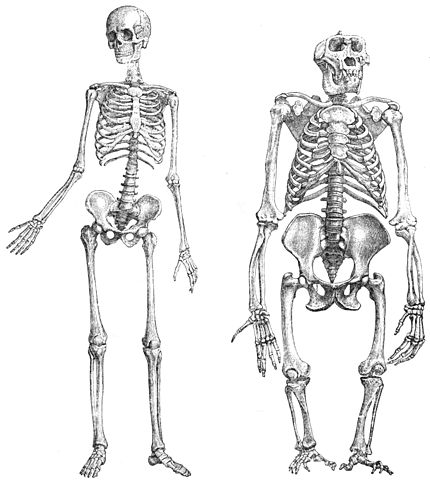
Image source: By Brehms Tierleben, Small Edition 1927 [Public domain], via Wikimedia Commons
What Is an Example?
For example, look at a segment of DNA that codes for hemoglobin in multiple animals. Gorillas and humans only have a one nucleotide difference in this segment, showing one mutation. Humans and chickens have 45 nucleotide differences, showing 45 mutations. This shows the relative distance in relatedness between humans, gorillas, and chickens.
How Do Scientists Use This Information?
The use of DNA to determine relationships among species helps us create better evolutionary trees. We used to determine relatedness based on physical appearance, but we now know that appearance can be misleading.

This is just a tiny, simplified part of an evolutionary tree. Here we can see that a hippo is more closely related to a dolphin than to a pig. Image source: By Gabi Slizewska


