Illustrated · 2 min

UV-Visible spectroscopy is an analytical technique most commonly used in conjunction with Beer's law in order to determine concentration. This document will give an overview in the operation and use of a typical UV-Vis spectrophotometer.
How it Works
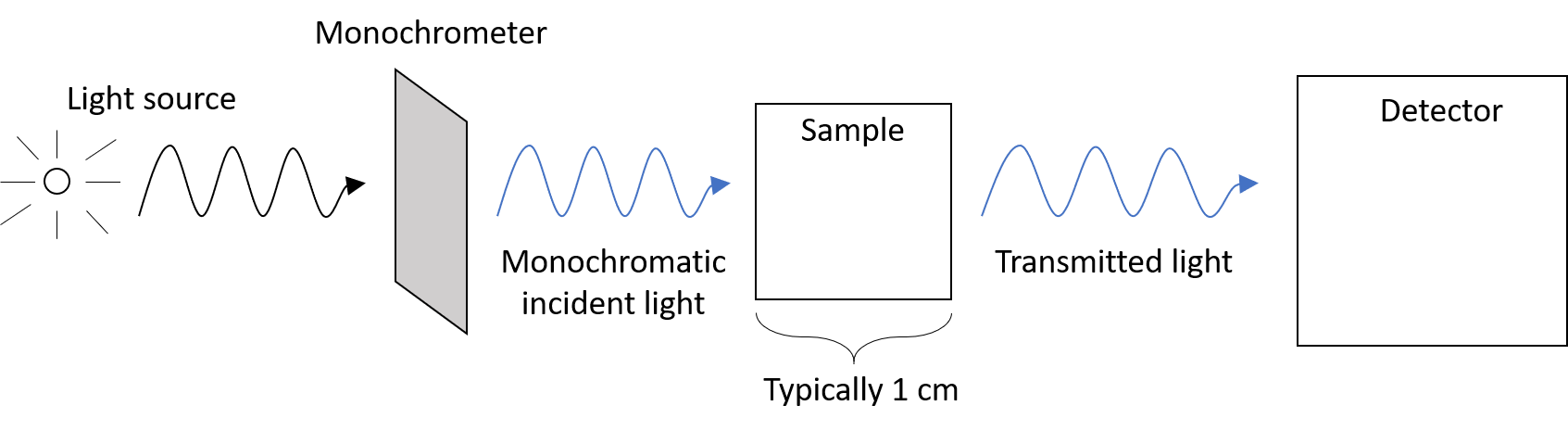
UV-Vis spectrophotometers must be run at least twice in order to gather data. The first run has no sample and serves only as a baseline for what 100% intensity looks like. The subsequent trial measures how this intensity differs when the sample is present. Light is first generated from a light source. Light sources are typically either tungsten filaments, xenon arc lamps, or deuterium arc lamps. This light is then passed through a monochrometer, which blocks out all the undesired wavelengths of light. The monochromatic light that remains is then passed through the sample. The light that is transmitted through the sample is collected by the detector, and compared with the initial intensity, according to the equation below, This comparison yields the absorbance, , a measure of how much light was absorbed that should be between 0 and 1. A diagram of this process is shown below.
Using Data
The first step in using data acquired from a UV-Vis spectrophotometer is finding the . This is the wavelength that experiences the most absorption. In the spectrum of a gold nanoparticle shown below, the can be seen to be about 520 nm.
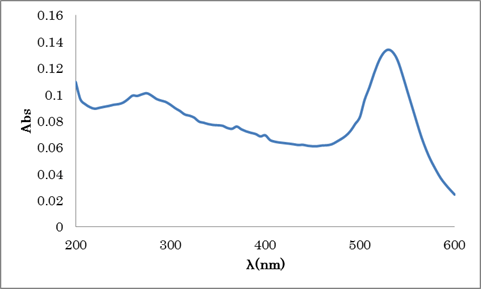
Image source: By Taku Ueki CC BY 2.0, via Wikimedia Commons

We choose this point of the graph for 2 reasons. The first is a mathematical consideration. By choosing the point with the most signal, we are able to obtain the most significant figures when calculating concentration. The second reason is that this is the point that is most electrically active, and if we use UV-Vis spectroscopy in conjunction with fluorescence spectroscopy, then this is the wavelength we will want to excite our sample at.
Beer's law
As stated previously, the most common use of UV-Vis spectroscopy is in conjunction with Beer's law in order to determine the concentration. Beer's law relates the absorbance, , to the concentration, , in the following manner. Where is the molar extinction coefficient (experimentally determined for each material), and is the length of the sample, which is typically 1 cm. If the molar extinction coefficient is unknown it can be determined by running samples of known concentration and determining the slope required for the changing absorbance. That is to say, if we double the concentration, the absorbance of should double as well. An important note on Beer's law is that it is only valid for dilute solutions. Absorbance is only linearly related to concentration when the concentration is small. If the absorbance is measured to be greater than 1, then the solution is too concentrated to apply Beer's law.