We've been studying the structure of atoms. We started with the discovery of the electron. JJ. Thompson's cathode ray experiment was the first contradiction of Dalton's atomic theory. Atoms had smaller subcomponents! As an explanation, Thompson proposed his plum pudding model. But, his model got dispelled by Rutherford's gold foil experiment. He found that atoms have a concentrated mass. In response, he proposed the nuclear model. It was a massive improvement from the plum pudding model. But it wasn't quite right.
In future lessons, we'll explore more atomic models. We'll start with Bohr's atomic model and then examine the quantum mechanical model. But to understand them, we need to take a quick detour. Both models require us to understand how electromagnetic radiation interacts with matter. So, we'll spend this lesson studying light!
Wavelength and Frequency in Chemistry
In classical physics, we considered electromagnetic radiation (light) to be a wave. Eventually, Albert Einstein solved the photoelectric effect by considering light as a particle. That would lead to the wave-particle duality. But in the late 1800s and early 1900s, we thought light was a wave. So, we have two ways to classify waves. We can use either their wavelength or their frequency.
The wavelength is a measure of length. So, it's the distance between identical points on consecutive cycles. I think it's easiest to measure from peak to peak or trough to trough. But if the locations are equivalent, the answer is always the same. You may have studied waves in math class. If you did, you most likely used radians. Please know that radians are not equivalent units to meters. Radians measure an angle. But in physics and chemistry, the wave travels linearly through space. So, the x-axis will be in meters.
The other option is frequency. Frequency is the number of cycles per second. We're seeing another way that physics and chemistry differ from math. If a wave is moving through space, there is a time component. The unit for frequency is Hertz (Hz). A Hertz is equivalent to a reciprocal second (s1 or s−1). Let's say we had a frequency of 400Hz. What does that tell us? The wave experiences four hundred cycles each second.
Relating Wavelength, Frequency, Momentum, and Energy
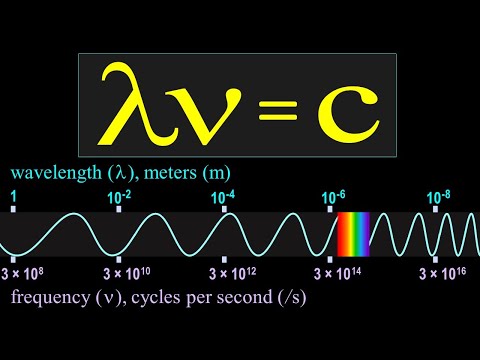
So, we can use either wavelength or frequency to describe light. But how do they relate? Let's consider the units. Wavelength is in meters. Frequency is in reciprocal seconds. What would happen if we multiplied them? We would have meters per second (sm). That's the units for velocity. So, the equation is v=λ×ν. λ is the symbol for wavelength. ν is the symbol for frequency. This equation works for any wave. But, we're discussing light. So, we can alter it to c=λ×ν. c is the notation for the speed of light in a vacuum. It's equal to 299792458sm. Please note this is a specific value for light in a vacuum. If the light is traveling through another material, the value changes.
Since light has a wavelength and a frequency, we can calculate its energy and momentum. We'll learn more when we begin studying quantum mechanics. But for now, here are the equations. The energy equation is E=hν. h is Planck's constant (6.626×10⁻³⁴ Joule-sec). We'll learn about it when we study Planck's quantum theory. The momentum equation is p=h×ν×c.
Atomic Spectra
So, how does all of this relate to chemistry? In a future lesson, we'll study atomic spectra. But for now, know that an atom's electrons can absorb and emit light. When light hits an electron, the electron gets elevated to a higher energy level. But there's a catch! Only specific wavelengths or frequencies work. That's because electrons can only absorb exact energies. If there is too little energy, nothing happens. We say that the energy is quantized.
So, once an electron gets promoted, how does it lose that energy? It has to emit light. When an electron falls to a lower energy level, it releases a photon. The light's energy equals the difference between the energy levels. Again, the energy has a specific quantity. Why? Because energy levels are quantized.
It turns out that chemists can measure an atom's absorbed and emitted frequencies. What's the result? A spectrum of frequencies. We know that many chemists were developing various atomic models. A successful model would theoretically predict the spectra. In future lessons, we'll see that the Bohr model predicted the hydrogen and helium ion spectra. But, it failed for larger elements. The quantum mechanical model proved more accurate for heavier elements.
Using Light: Analytical Chemistry
Why do we spend so much time learning about light? For analytical chemists, light has a variety of applications. Spectroscopy is an analytical tool that studies the interaction between matter and electromagnetic radiation. What does that mean practically? In spectroscopy, we shine light through a sample. How light interacts with the sample's atoms and molecules tells us valuable information. But there's a catch! Different wavelengths of light have unique interactions.
Let's look at a few different types of spectroscopy. In IR spectroscopy, we use infrared light. It turns out that IR radiation causes covalent bonds to stretch and bend. But these occur at distinct wavelengths for various bonds. For example, let's consider a carbon-oxygen bond. A single bond will have a different wavelength than a double bond. The chemist can tell what types of bonds are present from the absorbed wavelengths.
What's another example? Let's say we had a solution with an unknown concentration. We could use UV-visible spectroscopy. The sample's molarity is related to absorption by the Beer-Lambert law. For example, in college, I performed an experiment using UV-visible spectroscopy. Our goal was to find the amount of iron in a sample. First, you have to make a calibration curve. To do that, you make solutions with various concentrations and measure the absorbance. You've created a calibration curve. Then, you measure your unknown sample's absorbance. From the calibration curve, you can determine the concentration!
Let's consider one last example. X-ray crystallography uses x-rays to determine three-dimensional crystal structures. Remember, in crystals, the atoms arrange to form a lattice. X-rays have a lot of energy. So they diffract off the atoms' electrons. The angle of diffraction allows the chemist to specify the atoms' locations. The most famous example of using X-ray crystallography was the discovery of DNA's double-helix structure. So, you can see that X-ray crystallography is a powerful technique.
So what's the overall takeaway? In general chemistry, you don't need to worry about the different types of spectroscopy. But, you do need to understand the interaction of light and matter. Different wavelengths of light interact with atoms and molecules in unique ways. That's why we spend so much time studying light.