
Video
By Deena Hauze

+4 contributors




(Video) What Are Introns and Exons?
by A Tale of Two Genes


Image source: By Frank Starmer CC0, via Wikimedia Commons
Video
by A Tale of Two Genes
Image source: By Frank Starmer CC0, via Wikimedia Commons
Illustrated · 1 min
Exons are the regions of RNA that are used to produce amino acids and proteins. A gene on DNA contains more base pairs than necessary to produce the desired protein.
These extra base pairs have to be removed so that the protein can function properly. The removal of these base pairs is called RNA splicing and is performed by an enzyme called a spliceosome. This enzyme severs the RNA strand, removes the introns, and puts the RNA molecule back together. The regions of the mRNA that are actually used to produce the desired mRNA sequence are the exons.
Before the spliceosome modifies the RNA it is called pre-mRNA. After modification, it is just mRNA.

Image source: By Nastypatty CC BY-SA 4.0, via Wikimedia Commons
Illustrated · 2 min
A gene is a sequence of nucleotide bases that holds the information for how to make a protein. All the different proteins in our body are responsible for the way we look, act, and the way our body works. But within a single gene, there are two different types of sequences: exons and introns.
I'm going to walk you through exons here, but feel free to check out some explanations on introns too.
Exons are the parts of the gene that have coding sequences for proteins. Introns are found between these regions, and they don't code for anything.
To make a protein, DNA has to first be transcribed into an mRNA strand. At first, this strand contains both exons and introns. We call this pre-mRNA. Then, the introns are spliced out of the strand, leaving behind only the exons. The product is called mature mRNA and is ready to be translated into a functional protein.
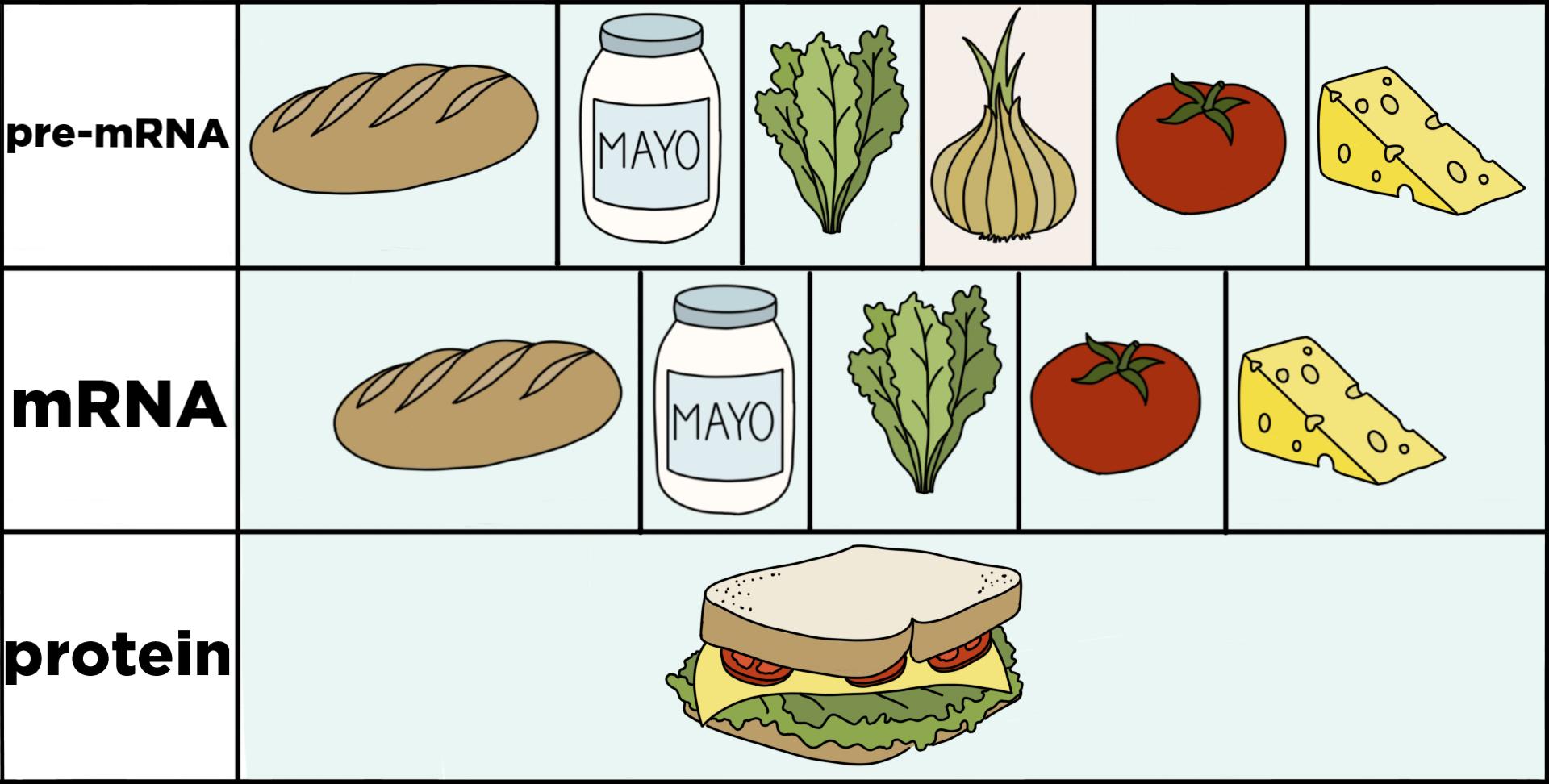
Not the best sandwich Image source: By Gabi Slizewska
You go to a restaurant and order a sandwich. It comes with bread, mayo, lettuce, onion, tomato, and cheese. That's our pre-mRNA. But let's be honest, onions are nasty and serve no purpose in a sandwich. So, naturally you need to take them off. Those are our introns.
We are left with the exons: the bread, mayo, lettuce, tomato, and cheese. These are the parts that can be used to make an edible sandwich.
The purpose of the two different gene regions isn't completely clear, but we do know that it can let one gene code for more than one protein. Pretty cool.
This happens because when introns are spliced out, some exons can also be taken out. This is called alternative splicing, and it allows different combinations of exons to be left in the final mRNA molecule. Since the base sequence of the final mRNA strand changes, so does the resulting protein.
If we go back to the sandwich example, you can imagine that alternative splicing is like taking off one of the other ingredients. Although a tomato can be used to make a sandwich, you can still make a sandwich without it. It will just look and taste different.
