Illustrated · 2 min
+3 contributors


Nonlinear Functions
Before we get into some common nonlinear functions, make sure you understand what nonlinear functions are and what makes them different from linear functions.
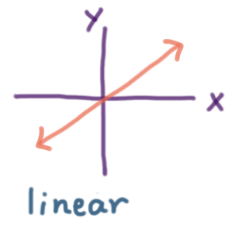
When graphed, nonlinear functions are not straight lines (i.e., they are non linear).
Nonlinear functions are those that DO NOT follow the form:
So, functions that have a term where is part of a complicated operation (like , , or ) are examples of nonlinear functions.
On this page, we'll look at three of the most common nonlinear functions: , , and .
Functions with
Functions with the term have a distinct U-shape when they are graphed. This shape is called a parabola. Think of it like a smile or a rainbow!

Image source: by Hannah Bonville
Notice that when the function includes the term , the parabola faces up. When the function includes the term , the parabola faces downward.
The term in the function that doesn't include (i.e., the naked/plain number) tells us where the parabola crosses the y-axis.

Made using Demos
The function graphed above is . Because the naked/plain number in the function is , we know that the parabola crosses the y-axis at .
The coefficient of the term in the function determines how narrow or wide the parabola is. The larger the coefficient is, the narrower the parabola will be.
Functions with
Functions that include the term have a double J-shape when they are graphed. Imagine drawing a squiggly line in the middle of the graph.

Made using Demos
As with the functions, the sign in front of the determines which way the shape of the graph goes. Here is a graph of .
It grows faster than a straight line (linear) or a U-shape (quadratic).

Made using Demos
Functions with
Functions that include (or any form of that fraction where is in the denominator), have an L shape, like a swoop.
There are two symmetrical swoops per graph, and two asymptotes. An asymptote is a place on the graph where the line absolutely cannot pass.
Because is the denominator of a fraction, there is a vertical asymptote at . That means that there's no possible value for (because you can't divide by )!
(There's also a horizontal asymptote at , but you don't have to worry about that yet!)

Graph made using desmos
Notice how both swoops approach, but never touch, . This is the location of the asymptote.
As with the other nonlinear functions, when we make the leading term negative, the graph changes. It flips over diagonally, but the asymptotes remain the same.

Made using Desmos
There are other factors that can change where all of these graphs appear on the plane, but the shapes will always stay roughly the same!