Interactive · 5 questions
+2 contributors

No coincidences - just math
Ancient mathematicians were fascinated with geometric coincidences. Let's get a feel for this ourselves.
I drew a triangle in the sand, and noticed that it was possible to draw a perfect circle through the the 3 points. Wow!
Is that special?
Quadrilaterals time
Given any square, is it always possible to draw a circle through its points?
And, it always looks like some rotation of this:
How about any rectangle? Do you think it's always possible to draw a circle through its points?
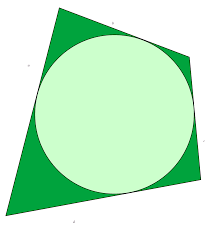
It would be nice to understand more general quadrilaterals, like this one:
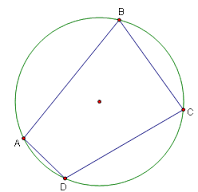
We say that a quadrilateral is cyclic if it's possible to draw a circle through its four points. Some quadrilaterals are obviously not cyclic, like this one:
What are some reasons why that quadrilateral isn't cyclic?
It turns out that there's a beautiful theorem which characterizes cyclic quadrilaterals.
Theorem: A quadrilateral is cyclic if and only if opposite pairs of angles add up to 180 degrees.
Proof:
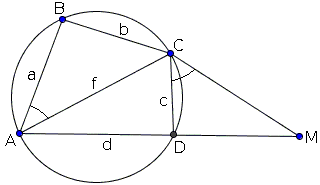
Let the center of the circle be . Then draw and . By the Inscribed Angle Theorem, and (where ). Since , . Our theorem has been proven!
Is that a proof?
We can use the part that we just proved to finish the proof of the theorem. Let's do so.
Suppose there exists a quadrilateral with opposite angles that sum up to , but is not cyclic. [This technique is called Proof by Contradiction – assuming that what we wish to prove is false and then finding an issue that contradicts our assumption] That quadrilateral is below. Note that is cyclic, and is on .
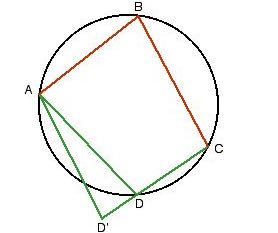
Since it is not cyclic, the circumcircle of must not also go through . Now locate point on . By our assumption, . However, our proof of the first part demonstrates that is also supplementary to and therefore .
The exterior angle of cannot be the same size as an interior angle. This contradiction proves the theorem. Thus a quadrilateral with opposite angles summing up to means that it is cyclic.
WOOT! That was a lot. Also, the waiting period is now over. After 8 months (?) you now have the proof of both the "if" and the "only if" parts of the theorem :D