Рівняння з модулем добутку

Interactive · 1 question

Absolute values make the expression within nonnegative. Earlier, we saw absolute values with sums.

Let's look at a few examples of how to perform multiplication with absolute values.

Example 1

∣−8∣×∣2∣|-8| \times |2| 8×28 \times 2 1616

The product of these two values is 1616.

Example 2

∣(−3×3)+1∣|(-3 \times 3) + 1|

We have a set of parentheses inside the absolute value signs. According to the Order of Operations (PEMDAS), we need to handle the stuff inside the parentheses first.

∣(−9)+1∣|(-9) + 1|

Now, we're all set to perform the operation inside the absolute value sign to evaluate the expression.

∣−8∣=8|-8| = 8

Example 3: Variables

4∣−3x∣=244|-3x| = 24

First, we need to isolate the xx term on one side of the equation. (Hopefully this sounds familiar −- it's the same approach we take almost every time we solve for xx!)

Absolute Value Equations with Products
Steps:
1) Isolate the absolute value.
2) Set the absolute value to both the negative and nonnegative values.
3) Solve both equations to get two solutions.
4) Check your work!

Image source: by Anusha Rahman

Solve this equation. What are the possible values of xx?

Choose one answer

Video

(Video) Solving a multi step absolute value equation

by Brian McLogan

This video by Brian McLogan works through a complex absolute value problem.

Summary\large{\text{Summary}}

First of all, check out a review of finding the solution to an absolute value equation with sums.

Now, lets solve this equation.

8x=2∣2x−2∣8x=2|2x-2|

First, we have to get the absolute value alone. To do that, we divide by 22.

4x=∣2x−2∣4x=|2x-2|

Now, we can split this into two equations.

solve the equations 4x=2x-2 and -4x=2x-2. The answers are -1 or 1/3

Interactive · 2 questions

Variables

Simple cases

Absolute value equations with products are similar to absolute value equations with sums. The process is identical in the most basic examples. For example, lets solve for xx in the equation:

7×∣x∣=217 \times |x| = 21

First, we need to isolate the absolute value expression on one side of the equation. To do that, we can divide both sides by 77:

∣x∣=217∣x∣=3\begin{align} |x| &= \frac{21}{7}\\ \\ |x| &= 3 \end{align}

Now that we've isolated ∣x∣|x| on one side, we can look at the two possible cases when we remove the absolute value brackets:

x=3x=−3\begin{align} x &= 3\\ x &= -3 \end{align}

So, xx equals 33 or −3-3.

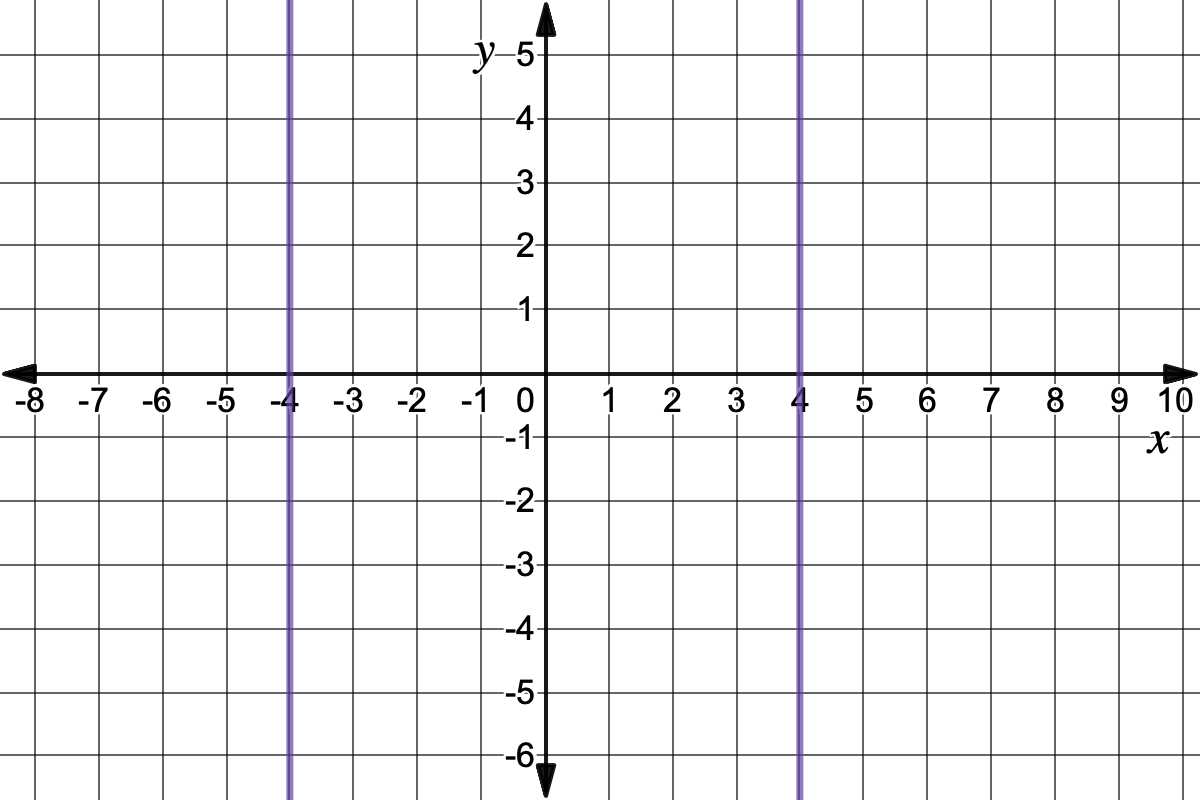
graph of 7|x|=21

Made using Desmos

More complex cases

In many absolute value equations, xx will be part of a larger absolute value expression. In these cases, you will have to first isolate the absolute value expression on one side of the equation, then unpack it into your two cases, and then isolate the variable you're trying to solve for. For example, let's look at the equation:

5+∣2x∣=135 + |2x| = 13

First, what will the equation look like once we've isolated ∣2x∣|2x| on one side?

Choose one answer

Type a concept, like “slope” or “photosynthesis”.

↑ ↓ to choose · Enter to openSearch explanations and problems