Read · 1 min
+2 contributors
Contributors

Accuracy and Precision
When taking measurements of anything there can be some measurement uncertainty due to limitations of the measuring instrument, random error, observational error, or human error. We aim to avoid systematic error in science because that would mean there is a recurring issue causing error that must be fixed. There are 2 terms used to describe the amount of uncertainty in a measurement.
-
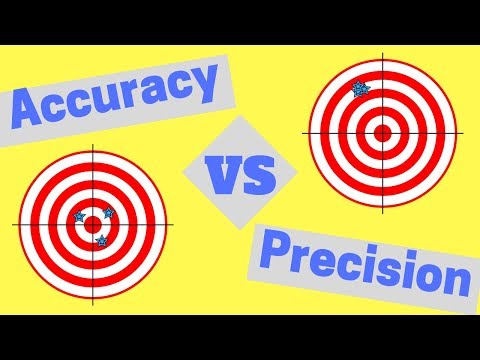
Accuracy: the closeness of a measured value to the true value
-
Precision: the closeness of different measured values to each other
Ideally, measurements would be both precise and accurate, but that is not always the case.
Comparison Example
Imagine you measure the mass of a metal sphere with a true mass of 15.000g. If three measurements are taken the possible options are:
- Accurate and precise: average of measurements is close to true mass and the measurements are all approximately the same
- Average: 15.001g, measurements: 15.000g, 15.001g, 15.001g
- Accurate and not precise: average of measurements is close to true mass, but measurements are not close together
- Average: 15.001g, measurements: 15.811g, 14.301g, 14.891g
- Not accurate and precise: average of measurements is not close to true mass, but measurements are close to each other
- Average: 15.827g, measurements: 15.826g, 15.8297g, 15.825g
- Not accurate and not precise: average of measurements is not close to true mass and measurements are not close to each other
- Average: 15.289g, measurements: 16.020g, 15.324g, 14.523g