Додавання радикалів

Interactive · 4 questions

Adding Radical Terms

Radical terms (also known as roots) can be added just like integers. However, adding radicals might not be simplified in certain cases because you can only add or subtract ‘like’ radical terms.

You can combine radicals that have the same number under the root same root. Think of it like variables, you can combine two xx terms but not an xx in a yy. Similarly, you can combine two terms with 2\sqrt{2}, but not one with 2\sqrt{2} and 3\sqrt{3}.

Let’s take a look at an example. Say we want to simplify 6+76.\sqrt{6}+ 7\sqrt{6}.

These two terms have the same number under the radical, so we can add the terms and simplify radical expressions.

6+76=16+76=(1+7)6=86\begin{align} \sqrt{6}+ 7\sqrt{6} &= 1\sqrt{6} + 7\sqrt{6} \\ &= (1+7) \sqrt{6} \\ &= 8 \sqrt{6} \\ \end{align}

Now, let’s simplify 3+45+93\sqrt{3}+ 4\sqrt{5}+ 9\sqrt{3}

We can only combine ‘like’ radicals/roots. The first and last term can be combined, but not the middle term.

3+45+93=3+93+45=13+93+45=(1+9)3+45=103+45\begin{align} \sqrt{3}+ 4\sqrt{5}+ 9\sqrt{3} &= \sqrt{3} + 9\sqrt{3} + 4\sqrt{5} \\ &= 1 \sqrt{3}+ 9\sqrt{3} +4\sqrt{5} \\ &= (1+9) \sqrt{3} + 4\sqrt{5} \\ &= 10 \sqrt{3} + 4\sqrt{5} \\ \end{align}

Important note: Adding and subtracting radicals is different than addition or subtraction under the same radical.

Let's take a look at some of the types of problems you might encounter about adding radical terms.

Example One

Simplify 711+17117\sqrt{11}+17\sqrt{11}

Choose one answer

Interactive · 2 questions

Treat Terms with Radicals like Variables

First off: a radical is another way of saying a root of something. The "radical" is the checkmark-looking symbol that tells you to take the root of the number, so we just call terms that have that symbol in them "radicals," too. The term 5\sqrt{5} is a radical, as is 16x\sqrt{16x}. The term x2x\sqrt{2} has a radical in it (multiplied by xx). In fact, these radicals are square roots, which is what we will usually be working with.

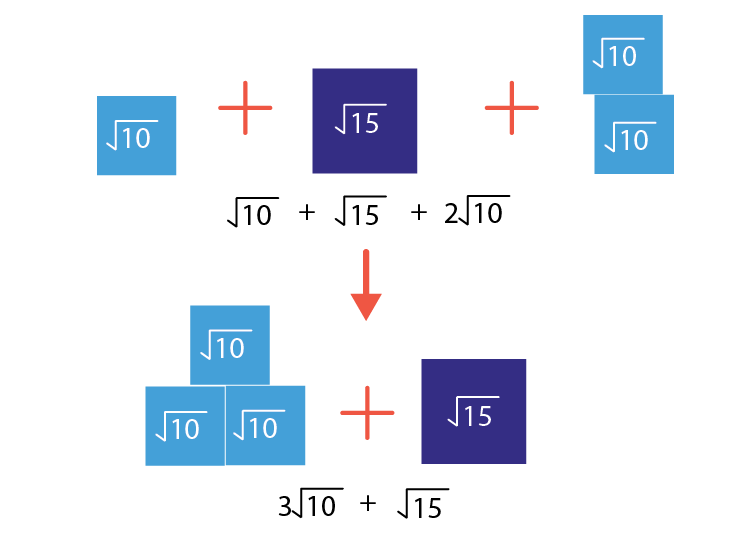
Radicals work similarly to variables: you can add two of the same kind together, but not two of different kinds. We can only combine like terms! Let's say we have the expression:

10+15+210\sqrt{10} + \sqrt{15} + 2\sqrt{10}

Since 10\sqrt{10} and 2102\sqrt{10} are both square roots and they both have the same number under the radical, we can combine them and get:

10+15+210=10+210+15=(1+2)10+15=310+15\begin{align} \sqrt{10} + \sqrt{15} + 2\sqrt{10} &= \sqrt{10}+ 2\sqrt{10}+ \sqrt{15}\\ &=(1+2)\sqrt{10} + \sqrt{15}\\ &=3\sqrt{10} + \sqrt{15} \end{align}

We still don't know exactly what 10\sqrt{10} is equal to, so we're just keeping track of how many multiples of it we have (just like when we add 2x+3x2x+3x).

Root 10 + root 15 + 2 root 10
=
3 root 10 + root 15

Image source: by Zora Gilbert

Think of radicals as blocks. Different blocks are different sizes, and you can only stack blocks that are the same size.

Let's try it! Can you simplify 12+415\sqrt{12} + 4\sqrt{15}?

Choose one answer

Video

(Video) Adding Radical Terms

by Mahalo Math

Mahalo Math has a couple videos that explain radical arithmetic. The first one is linked above and there is another later in the explanation.

Summary\large{\text{Summary}}

The most important rule is you cannot add radicals unless they have the same number under the radical. 2+3(Cannot add.)2+22(Can add.)\begin{align} \sqrt2+\sqrt3&\quad(\text{Cannot add.})\\ \sqrt2+2\sqrt2&\quad(\text{Can add.}) \end{align}

When you can add radicals, you DO NOT add the terms inside the radical. Only those outside. For example, if you have 23+232\sqrt3+2\sqrt3, you add the 22s outside together, leaving the radical the same. 23+23=(2+2)3=43\begin{align} 2\sqrt3+2\sqrt3&= (2+2)\sqrt{3}\\ &=4\sqrt3 \end{align}

(Video) Adding Radical Terms

by Mahalo Math

It is important to reduce radicals into their simplest form before deciding whether or not they can be added.

Look at 115+2011\sqrt5+\sqrt{20}. At first glance, it looks like they cannot be added because they have two different numbers under the radical. However, 20\sqrt{20} can be simplified. 20=4×5=25\sqrt{20}=\sqrt{4\times5}=2\sqrt5

Now, can you add 115+2511\sqrt5+2\sqrt5? Yup! 115+25=(11+2)5=135\begin{align} 11\sqrt5+2\sqrt5&=(11+2)\sqrt{5}\\ &=13\sqrt5 \end{align}

Type a concept, like “slope” or “photosynthesis”.

↑ ↓ to choose · Enter to openSearch explanations and problems