Read · 3 min
When we learned about solids, we studied crystals. Ionic crystals have a repeating lattice composed of a unit cell. Molecular crystals have a repeating VSEPR geometry. In both cases, their molecular geometries repeat. Metallic crystals consist of alkali, alkaline-earth, or transition metals. Metals experience metallic bonding. So, their atoms pack tightly.
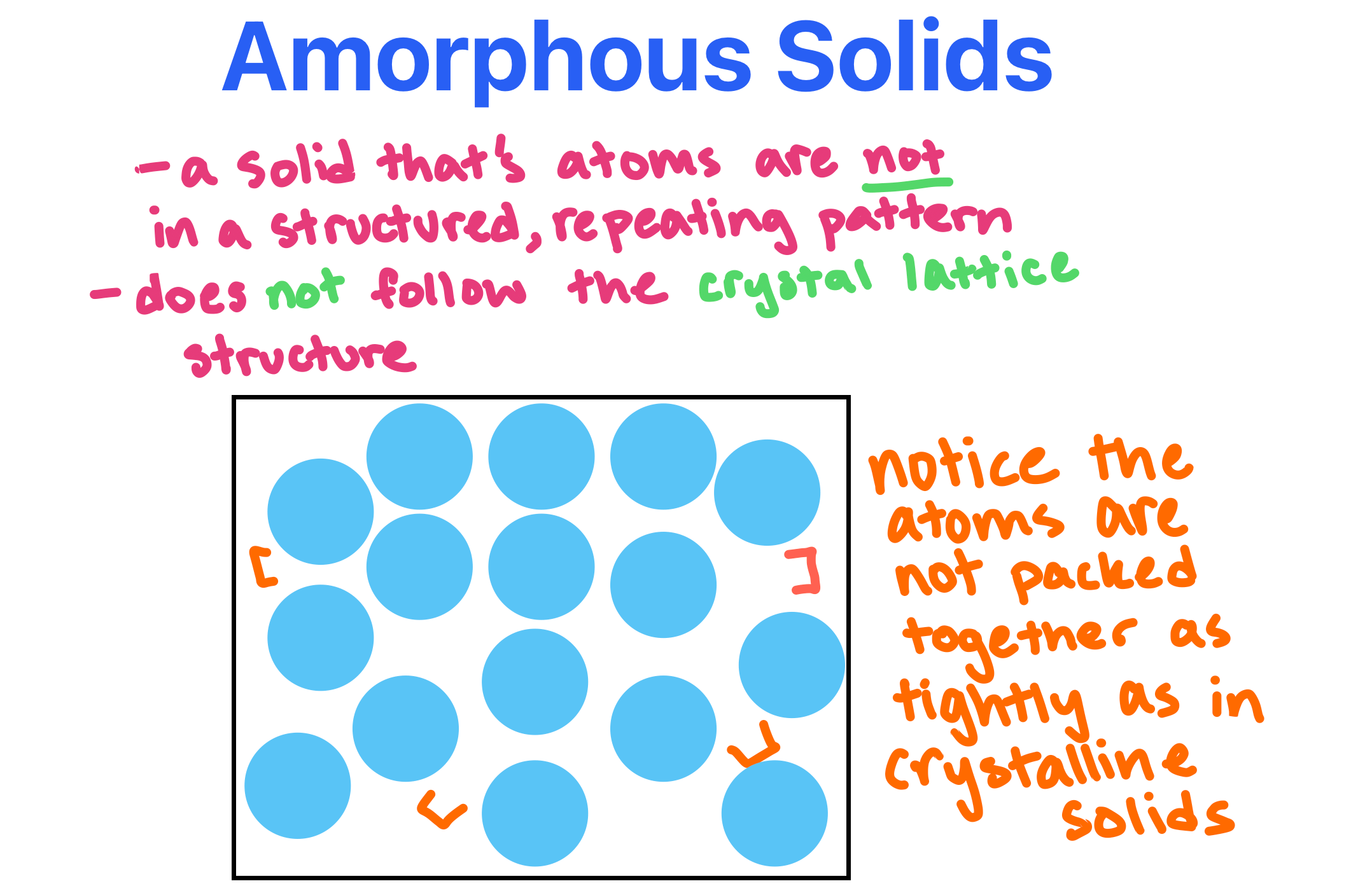
In contrast, amorphous solids are materials with no repeating structure. They are often composed of nonmetals or metalloids. The bonds in amorphous solids are covalent. If we zoomed in on one atom, we would not see anything peculiar. The atom has bonded to neighboring atoms and has a VSEPR geometry. Everything is as we expect! But, if we compare it to another atom, it might have a different geometry. The differences in structure lead to unique chemical and physical properties.
Physical Properties of Amorphous Solids
When we discuss the properties of amorphous solids, we need to talk about a range. For example, we don't have a melting point. We have a melting range. In a crystal, every atom has the same electrostatic interactions. Sometimes, there can be lattice defects. But they do not affect the melting point significantly. In amorphous structures, one part could be melting. Yet, another part is still ten degrees off.
Their most important property is their glass transition point. It is the temperature where an amorphous material changes from brittle to malleable. We use some materials below their glass transition point. For example, styrofoam is a polymer of polystyrene. Polystyrene's glass transition temperature is 100 degrees celsius. That is 212 degrees Fahrenheit! So, we use styrofoam cups for hot liquids. In contrast, the polyester polymers in your clothing are flexible. It would be uncomfortable if your clothing became hard and brittle. But, it would be funny!
Quartz vs. Amorphous
Let's highlight the difference between crystals and amorphous solids. Consider silicon dioxide, . The crystalline form is quartz. One fascinating use for quartz is in electronics. Quartz is piezoelectric. When you apply a physical force, it generates electricity. Let's consider a guitar pickup. When guitar strings vibrate, they create a force on the bridge. A quartz pickup converts that force into an electrical signal. The signal travels to the amplifier. Next, the amplifier amplifies the signal. Finally, we hear the music through the speakers. We get to enjoy the sound of the electric guitar!
Amorphous silicon dioxide is an insulator. It does not conduct electricity. So we use the amorphous allotrope to insulate semiconductor chips. Is that not crazy? One allotrope has electrical properties, while the other is the opposite.
You are familiar with amorphous silicon. Look out the window. You are looking through glass. Glass is the common name of rapidly cooled amorphous silicon dioxide. It is hard and brittle. Hardness is desirable for construction. Think of a New York skyscraper. They have windows hundreds of meters high. Of course, glass is also very brittle. So, if your neighbor hits a baseball through your window, it will shatter.
Polymers
Polymers are long chains of organic molecules. To make a polymer, you need to have a continuous chemical reaction. Each reactant will have a reactive group on both ends of the molecule. That way, the end of the chain always reacts. In polymerization reactions, we don't make one long chain. Instead, we are making many chains. When the polymerization terminates, we have different sizes of chains woven together. There is no coherent structure. So, many polymers are amorphous.
Some polymers are crystalline. The chains line up parallel to one another. However, these are rare and need industrial processes. If you want to learn more about polymers, take organic chemistry.
Volcanic Glass
A natural amorphous solid is volcanic glass. When volcanic magma cools rapidly, the atoms and molecules rearrange. But, they do not have time to form an ordered structure. When a volcano erupts, the earth's core no longer heats the magma. So, we get volcanic glass!