Застосування раціональних виразів: текстові задачі

Before this, knowДілення раціональних виразівДодавання та віднімання раціональних виразів

Read · 1 min

Word Problems Involving Rational Equations

Example 11:

Seven divided by the sum of a number and two is equal to half the difference of the number and three. Find all such numbers.

Let's begin by defining our variable. Let x=the number\text{Let }x=\text{the number} Now we can set up our equation. Seven divided by the sum of a number and two 7x+2\frac{7}{x+2} is equal to 7x+2=\frac{7}{x+2}= half the difference of the number and three. 7x+2=x−32\frac{7}{x+2}=\frac{x-3}{2} Before we solve, take note that there's a variable in the denominator which means we will have a restricted value. So, x≠−2x\ne-2 because that would make the denominator zero which would make the expression undefined. Now we can cross multiply and solve! 7x+2=x−327⋅2=(x+2)(x−3)14=x2−x−6−14=          −140=x2−x−200=(x−5)(x+4)x=5 or x=−4\begin{align} \color{royalblue}{\frac{7}{x+2}}&=\color{magenta}{\frac{x-3}{2}}\\ \color{royalblue}{7}\cdot\color{magenta}{2}&=\color{royalblue}{(x+2)}\color{magenta}{(x-3)}\\ 14&=x^2-x-6\\ \color{#8925AE}{-14}&=\ \ \ \ \ \ \ \ \ \ \color{#8925AE}{-14}\\ \hline 0&=x^2-x-20\\ 0&=(x-5)(x+4)\\ x=5&\text{ o}\text{r }x=-4 \end{align} None of the solutions are our restricted value so we know both these will work. Finally we state our answer. The numbers are 5 and−4.\text{The numbers are }5\text{ and}-4\text{.}

Illustrated · 2 min

Distance, Rate, and Time Word Problems

Let's talk about how to solve word problems involving distance, rate, and time. These problems can be tricky, but here is a good guide on how to solve them.

Example:

A boat that can travel fifteen miles per hour in still water can travel thirty-six miles downstream in the same amount of time that it can travel twenty-four miles upstream. Find the speed of the current in the river.

The general formula we use for these problems is:

Overall Rate == speed of the vehicle (with no current/wind) ±\pm speed of the water or wind

Since these are distance, rate, and time problems, we will be using the distance formula as well: Distance=Rate×Timed=rt\text{Distance}=\text{Rate}\times\text{Time}\\ d=rt

Here's the skeleton of the table we make to help solve these problems.

A 2x3 grid. First row labeled "Upstream," second row labeled "Downstream," first column labeled "Distance," second column labeled "rate," third column labeled "time."

Image source: by Alex Federspiel

Once we make the outline of our table we begin by filling in the information that was given to us. The problem directly tells us that you travel thirty-six miles downstream and twenty-four miles upstream.

A 2x3 grid. First row labeled "Upstream," second row labeled "Downstream," first column labeled "Distance," second column labeled "rate," third column labeled "time." First row/first column contains the number 24, and second row/first column contains the number 36.

Image source: by Alex Federspiel

Next we're given that the boat can travel fifteen miles per hour in still water so we have a rate of 15 mph15\text{ mph}. But this is in still water, not going upstream or downstream. So we need to use our formula given above for overall rate.

Overall Rate == speed of the vehicle (with no current/wind) ±\pm speed of the water or wind

So we know the speed of the vehicle with no current or wind. That's the 15 mph15\text{ mph}. So let's write that in under rate.

A 2x3 grid. First row labeled "Upstream," second row labeled "Downstream," first column labeled "Distance," second column labeled "rate," third column labeled "time." First row/first column contains the number 24, first row/second column contains the number 15, second row/first column contains the number 36, second row second column contains the number 15.

Image source: by Alex Federspiel

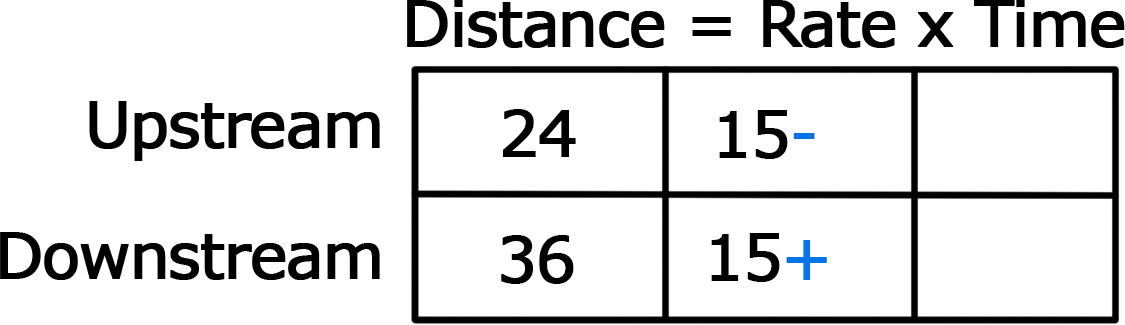
Now we need to figure out what gets added or subtracted. When going upstream, you're losing speed because you have to fight the current. So it would be a minus. When going downstream, you're gaining speed because you're moving with the current. So it would be a plus.

A 2x3 grid. First row labeled "Upstream," second row labeled "Downstream," first column labeled "Distance," second column labeled "rate," third column labeled "time." First row/first column contains the number 24, first row/second column contains the number 15-, second row/first column contains the number 36, second row second column contains the number 15+.

Image source: by Alex Federspiel

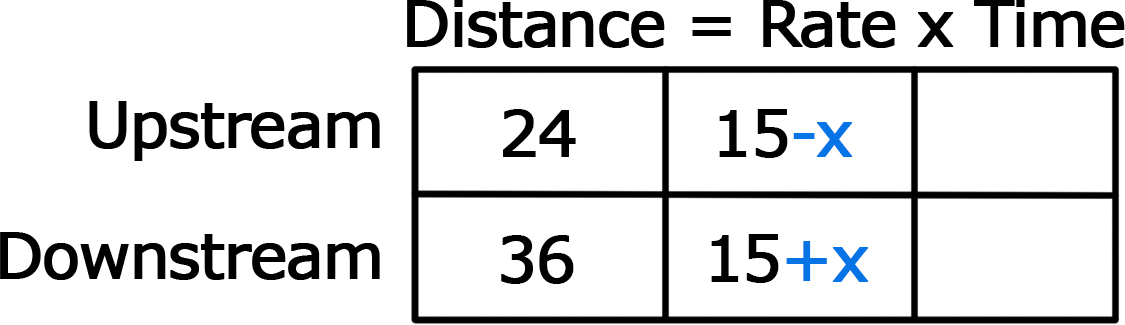
So, we're adding or subtracting the speed of the current. The problem is asking us to find the speed of the current. So, we can define our variable here: Let x=speed of current\text{Let }x=\text{speed of current}

A 2x3 grid. First row labeled "Upstream," second row labeled "Downstream," first column labeled "Distance," second column labeled "rate," third column labeled "time." First row/first column contains the number 24, first row/second column contains the number 15-x, second row/first column contains the number 36, second row second column contains the number 15+x.

Image source: by Alex Federspiel

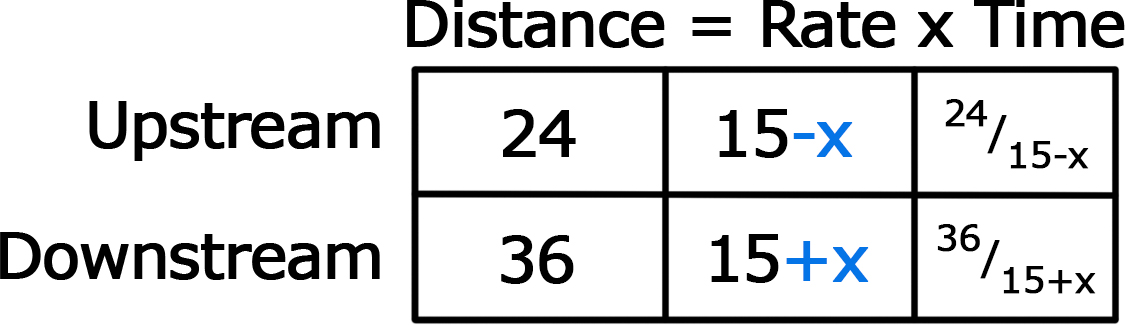
Next, we need to think about time. Well, we don't know the time. But we do know that our distance equals our rate times our time: d=r⋅td=r\cdot t We also have values for distance and rate. So we can solve this equation for time. d=r⋅tdr=r⋅trt=dr\begin{align} d&=r\cdot t\\ \frac{d}{\color{#8925AE}{r}}&=\frac{r\cdot t}{\color{#8925AE}{r}}\\ t&=\frac{d}r \end{align} So we can just put in the distance divided by the rate into our slot for time.

A 2x3 grid. First row labeled "Upstream," second row labeled "Downstream," first column labeled "Distance," second column labeled "rate," third column labeled "time." First row/first column contains the number 24, first row/second column contains the number 15-x, first row/third column contains the number 24/(15-x). Second row/first column contains the number 36, second row second column contains the number 15+x, second row/third column contains the number 36/(15+x).

Image source: by Alex Federspiel

Time can travel thirty-six miles downstream in the same amount of time that it can travel twenty-four miles upstream. The time it takes to travel upstream is equal to the time it takes to travel downstream. 2415−x=3615+x\frac{24}{15-x}=\frac{36}{15+x} And now we have a rational equation which we can solve with cross multiplication! 2415−x=3615+x24(15+x)=36(15−x)24(15+x)12=36(15−x)122(15+x)=3(15−x)30+2x=45−3x−30         =−302x=15−3x+3x=    +3x5x=155x5=155x=3\begin{align} \color{royalblue}{\frac{24}{15-x}}&=\color{magenta}{\frac{36}{15+x}}\\ \color{royalblue}{24}\color{magenta}{(15+x)}&=\color{magenta}{36}\color{royalblue}{(15-x)}\\ \frac{24(15+x)}{\color{#8925AE}{12}}&=\frac{36(15-x)}{\color{#8925AE}{12}}\\ 2(15+x)&=3(15-x)\\ 30+2x&=45-3x\\ \color{#8925AE}{-30}\ \ \ \ \ \ \ \ \ &=\color{#8925AE}{-30}\\ 2x&=15-3x\\ \color{#8925AE}{+3x}&=\ \ \ \ \color{#8925AE}{+3x}\\ 5x&=15\\ \frac{5x}{\color{#8925AE}{5}}&=\frac{15}{\color{#8925AE}{5}}\\ x&=3 \end{align}

Finally, we state our answer. The speed of the current is 3 miles per hour.\text{The speed of the current is }3\text{ miles per hour.}

Video · + 1 min read

(Video) Word Problems with Rational Equations

by larryschmidt

Here is a really good video by larryschmidt showing you how to work through some word problems involving rational expressions.

Summary\large{\text{Summary}}

One type of problem is when one person can work at a certain rate, and another person can work at a different rate, and you have to calculate how long it would take if these two people worked together.

The first problem he looks at is:

Sandra can paint a kitchen in 6 hours and Roger can paint the same kitchen in 7 hours. How long would it take for both working together to point the kitchen?

We start by setting up some rates per hour. It says that Sandra can paint 11 kitchen in 66 hours, or: 16 kitchen/hour\frac16\text{ kitchen/hour}

Roger can paint 11 kitchen in 77 hours, or: 17 kitchen/hour\frac17\text{ kitchen/hour}

Finally, let's let tt be the time it takes when they work together. So they can paint 11 kitchen in tt hours, or: 1t kitchen/hour\frac{1}{t}\text{ kitchen/hour}

If they work together, this is the same as their rates being added, so we get the equation: 16+17=1t\frac16+\frac17=\frac1t Let's solve for tt. 16+17=1t77⋅16+17⋅66=1t742+642=1t1342=1t4213=t3.23≈t\begin{align} \frac16+\frac17&=\frac1t\\ \color{#8925AE}{\frac77}\cdot\frac16+\frac17\cdot\color{#8925AE}{\frac66}&=\frac1t\\ \frac{7}{42}+\frac{6}{42}&=\frac1t\\ \frac{13}{42}&=\frac1t\\ \frac{42}{13}&=t\\ 3.23&\approx t \end{align}

So it takes approximately 3.233.23 hours for them to paint the kitchen together.

Test Yourself: Sam can beat a video game in 4 hours. Sara can beat the game in 3.5 hours. If they team up, how long will it take to beat the game.

Choose one answer

Type a concept, like “slope” or “photosynthesis”.

↑ ↓ to choose · Enter to openSearch explanations and problems