
Video

(Video) Graphing Exponential Functions
by PatrickJMT

Here's another video of patrickJMT showing you how to graph exponential functions.
Video
by PatrickJMT
Here's another video of patrickJMT showing you how to graph exponential functions.
Illustrated · 1 min
##Graphing Exponential Equations
Similar to how we graph rational functions, it is helpful to start by looking at certain features of the exponential function: asymptotes and intercepts.
Let's look at the standard form of an exponential function:
One of the key rules for exponential functions is that the exponential base () cannot be negative.
The horizontal asymptote equals the value of . There is no vertical asymptote.
To solve for the intercepts, we can use the same method we used when graphing rational functions. To find the intercept, we can set equal to and solve. To find the intercept, we can set equal to and solve.
However, keep in mind that if the horizontal asymptote is above or on the axis, there is no intercept. If the horizontal asymptote is below the axis, then there is an intercept.
Check out this example!
Since , we know there is a horizontal asymptote at .
Since the horizontal asymptote is above the axis, there is no intercept.
To find the intercept, we can solve...
Now we can graph:

Made using Desmos
We can see that this graph is an exponential growth, not an exponential decay.
Illustrated · 1 min
When you graph an exponential equation, the curve gets really close to a line without ever touching it. That invisible line is called an asymptote. An asymptote shows the value that the graph approaches but never reaches.
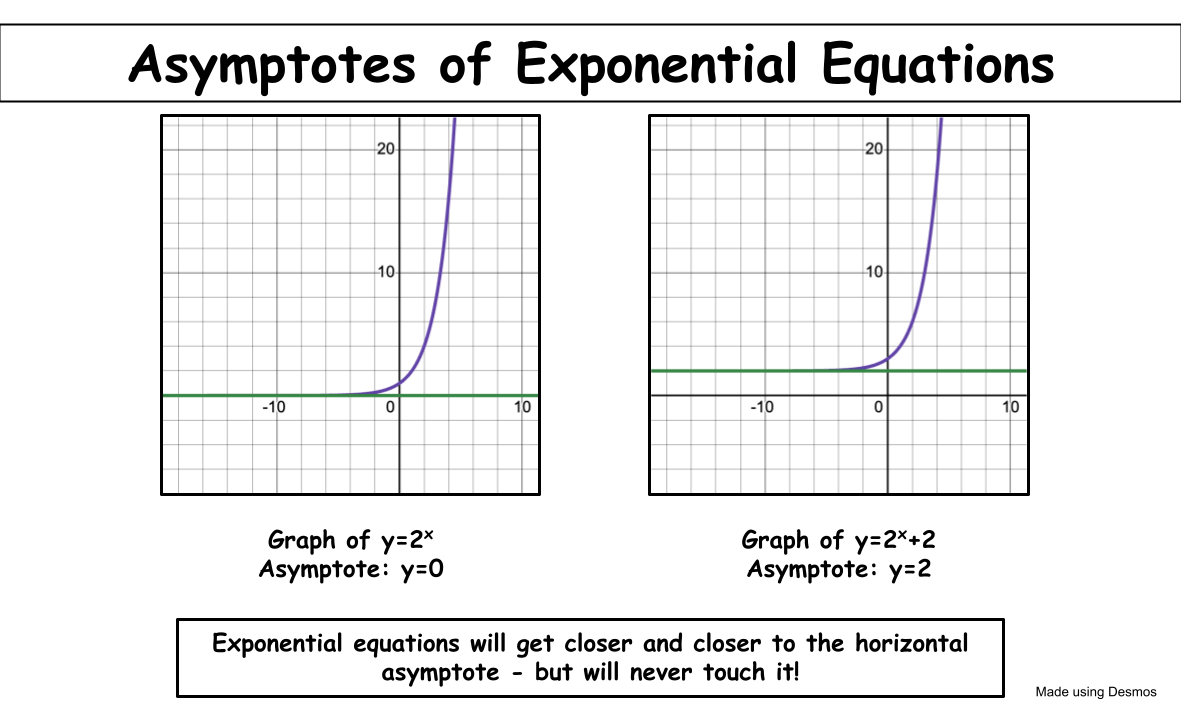
Made using Desmos
For basic exponential functions like: , the horizontal asymptote is the horizontal axis, or . This means that as gets smaller and smaller (goes to the left), the graph gets closer and closer to zero, but never actually touches it.
If the equation is changed, or translated, like:
, then the asymptote also moves up or down. The new asymptote is because the whole graph is shifted vertically.
For example, in the above image, the graph is shifted up by a factor of , so the graph gets closer to but never touches it. That line, is the horizontal asymptote.
Asymptotes help you to understand the behavior of exponential graphs, especially where they "flatten out". They're important for graphing and for understanding the limits of the function. Every exponential function has a horizontal asymptote, but never a vertical asymptote.

