Read · 1 min
We're exploring solutions! We started by studying the various ways we measure solution concentration. Then, we looked at the factors that affect solubility. Specifically, temperature and pressure. We've also examined how chemical reactions occur in solution. Sometimes, a compound will precipitate because it's insoluble.
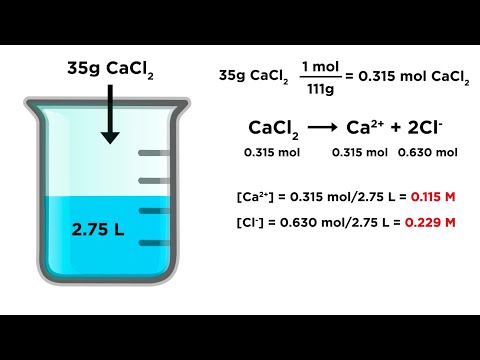
But, what if we want to do solution stoichiometry? We need to know ion concentrations. Today, we'll learn how to determine the concentration for each ion.
Calculating Dissolved Ion Concentration
Let's start by looking at an example. We'll place 1.0 mole of sodium chloride (NaCl) into 1.0 liters of water. That makes a 1.0 molar aqueous solution of NaCl. Remember, molar is equal to moles per liter. But, what happens to the NaCl when it's dissolved? We know that ionic bonds dissociate. So we have sodium and chloride ions. But, one sodium and one chlorine atom make up one NaCl compound. So, our solution has 1.0 moles of sodium ion and 1.0 moles of chloride ion. It's 1.0 molar for both ions.
So, we can create a formula for the dissolved ion concentration. Let's say we have some generic compound: .
So, ion concentration equals the compound's molarity multiplied by the mole ratios.
Why did we suddenly use mole ratios? The easiest way to think about solutions is to consider a decomposition reaction. So, . Now we can see that x and y are our mole ratios, in other words the ratio of the number of moles in x and y.
Another Example
Let's apply our formula to aluminum sulfate, .
Start by writing the decomposition reaction. .
Let's assume we start with a 0.74 molar solution of . How would we calculate the concentration of the aluminum and sulfate ions?