Video · + 1 min read

(Video) Converting Measurements

by tecmath

This video by tecmath goes over distance measurements in the metric system. Specifically, we learn how to convert between centimeters and meters.

Summary\large{\text{Summary}}

The main metric unit of length is the meter (m)(\text{m}). In other words, the meter is the base unit\textbf{base unit} of length. That means a meter is defined as the distance which a beam of light travels in a single second. There are also a few other major units of length we see all the time. The ones we'll talk about here are kilometers (km)(\text{km}), centimeters (cm)(\text{cm}), and millimeters (mm)(\text{mm}).

1,000 meters=1 kilometer1 meter=100 centimeter1 meter=1,000 millimeter\begin{array}{|c|} \hline 1{,}000\text{ meters}=1\text{ kilometer}\\ 1\text{ meter}=100\text{ centimeter}\\ 1\text{ meter}=1{,}000\text{ millimeter}\\ \hline \end{array}

Among other things, we can conclude:

-A kilometer is bigger than a meter.

-A meter is bigger than a centimeter.

-A meter is bigger than a millimeter.

An Example\large{\text{An Example}}

Suppose we want to convert 5 km5\text{ km} to m\text{m}. We can use these conversions by setting up a conversion chart. Start by writing down what we are given: 5 km5\text{ km}. 5 km\begin{array}{c|c} 5\text{ km}&\\ \hline & \end{array}

We now want to place a conversion to the right of it. We want a conversion factor where km\text{km}s are on the bottom. That way we can cancel the km\text{km} units out, and all that will remain are cm\text{cm}. We know 1 km1\text{ km} equals 1000 m1000\text{ m}. 5 km1,000 m1 km\begin{array}{c|c|c} 5\text{ km}&1{,}000\text{ m}&\\ \hline &1\text{ km}& \end{array}

Next, cancel units. 5 km1,000 m1 km\begin{array}{c|c|c} 5\cancel{\text{ km}}&1{,}000\text{ m}&\\ \hline &1\cancel{\text{ km}}& \end{array}

=5×1,0001 m=\frac{5\times1{,}000}{1}\text{ m} =5,000 m=\boxed{5{,}000\text{ m}}

If you're interested we can also convert between grams and kilograms, between kilometers and miles, or between feet and meters. The strategy of converting between units remains the same. However, the exact numbers we use will change.

Interactive · 2 questions

Converting Between Centimeters and Meters

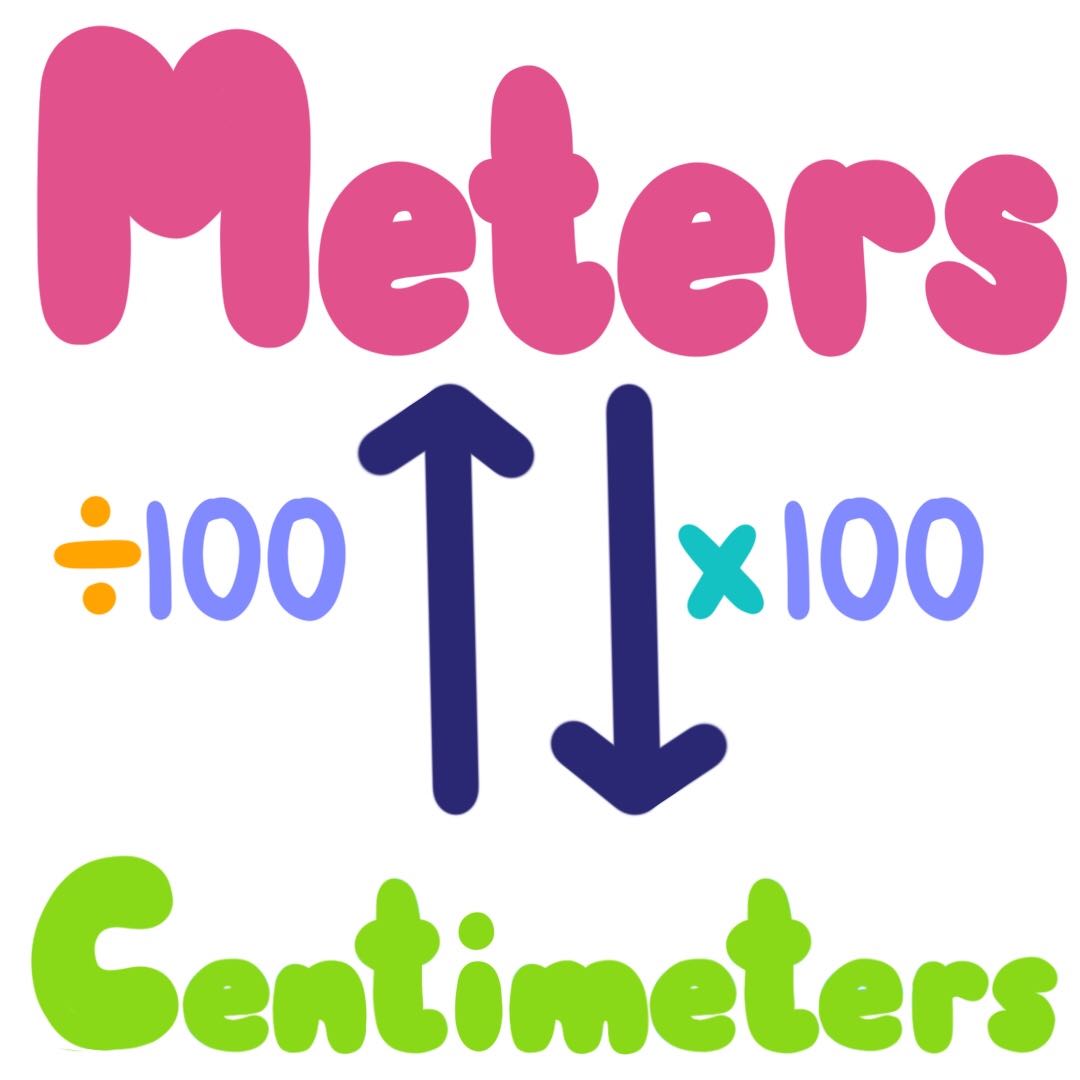
To convert from centimeters to meters, simply divide the number of centimeters by 100100 and change the units to m. The m is an abbreviation for meters.

To convert from meters to centimeters, simply multiply the number of meters by 100100 and change the units to cm. The cm is an abbreviation for centimeters.

As you might expect, these conversions are reversible. If we start with meters, convert to centimeters, and then convert back, we'll get the number we started with. As a result, converting back is a way of checking your work.

Here's another way to think about this. Converting from meters to centimeters means we multiply by 100100. To go back, we divide by 100100. But this is the same thing as multiplying by 1100\frac{1}{100}. Why is the fraction 1100\frac{1}{100} so remarkable? Well, it's the multiplicative inverse of 100100.

Meters to Centimeters: multiply by 100. Centimeters to Meters: divide by 100

Image by Caroline Kulczycky

Convert 560 cm560 \text{ cm} to meters.

Choose one answer

Interactive · 2 questions

Convert Meters to Kilometers

Meters and kilometers are units used to measure length. There are many other types of units, but these are two of the most common. The other one you'll see a lot is centimeters.

1 kilometer (km)=1,000 meters (m)1,000 meters (m)=1 kilometers (km)1\text{ kilometer (km)} = 1{,}000\text{ meters (m)}\\ 1{,}000\text{ meters (m)}=1\text{ kilometers (km)} 1,000 m×1km1,000m=1 km1{,}000 \text{ m}\times\frac{1 \text{km}}{1{,}000\text{m}}=1\text{ km}

Let’s take a look at an example.

Convert 2,000 meters2{,}000\text{ meters} to kilometers\text{kilometers}.

Since we know that 1,000 meters=1 kilometer1{,}000\text{ meters}=1\text{ kilometer}, we can use this information to set up a conversion chart. Start by writing down 2,000 meters2{,}000\text{ meters}. 2,000 m\begin{array}{c|c} 2{,}000\text{ m}&\\ \hline & \end{array} Now we want to convert meters\text{meters} to kilometers\text{kilometers}. 2,000 m1 km1,000 m\begin{array}{c|c|c} 2{,}000\text{ m}&1\text{ km}&\\ \hline &1{,}000\text{ m}& \end{array} Next, cancel out the common units. Kilometers appears in both the top row and the bottom row, so we can cancel them out. 2,000 m1 km1,000 m\begin{array}{c|c|c} 2{,}000\cancel{\text{ m}}&1\text{ km}\\ \hline &1{,}000\cancel{\text{ m}} \end{array} 2,0001 km1,000=2,000×11,000 km\begin{array}{c|c|c} 2{,}000&1\text{ km}\\ \hline &1{,}000 \end{array}= \frac{2{,}000\times1}{1{,}000}\text{ km} =2 km=2 \text{ km} We can also express this conversion chart in the following way: 2,000 m×1 km1,000 m=2,000 m×1 km1,000 m=2,0001,000 km=2 km\begin{align} 2{,}000 \text{ m} \times \frac{1 \text{ km}}{1{,}000 \text{ m}} &= 2{,}000 \cancel{\text{ m}} \times \frac{1 \text{ km}}{1{,}000 \cancel{\text{ m}}} \\ &= \frac{2{,}000}{1{,}000} \text{ km} \\ &= 2 \text{ km} \\ \end{align}

These two methods are nearly the same. There is only one major difference. The first method represents the calculation with a table. On the other hand, the second method uses a bunch of == signs to connect steps.

We are now going to take a look at some of the types of problems you might encounter about converting between meters and kilometers. A typical such problem will involve one or more of these conversions. At times there will be extra steps as well, especially for word problems.

Example 1

Convert 15 km15\text{ km} to meters\text{meters}.

Choose one answer

Interactive · 2 questions

Converting Between Meters and Kilometers

To convert from meters to kilometers, simply divide the number of meters by 1,0001{,}000 and change the units to km.

To convert from kilometers to meters, simply multiply the number of kilometers by 1,0001{,}000 and change the units to m.

From this we can get a few extra pieces of information. First of all, a meter is smaller than a kilometer. We can fit many meters into the same distance that a kilometer covers.

Next, we have a way of checking our work in these conversion problems. If we divide a quantity in meters by 10001000, we get the same distance in kilometers. Then if we multiply this number by 10001000, we should get the number we started with. If not, you made a mistake somewhere. In some cases it may also be easier to do this by rewriting your numbers in scientific notation.

Meters to Centimeters: multiply by 100. Centimeters to Meters: divide by 100

Image by Caroline Kulczycky

Convert 300 m300 \text{ m} to kilometers\text{kilometers}. Be careful with the decimal!

Choose one answer

Type a concept, like “slope” or “photosynthesis”.

↑ ↓ to choose · Enter to openSearch explanations and problems
