Формула заміни основи

Read · 1 min

The Change of Base Formula

Let's say you have a somewhat mediocre calculator; one that can only calculate logs in base 1010.

Now let's think about how we would approximate something like log⁡53\log_5{3}. Before we touch the calculator, let's try to manipulate it so that we can get something we can calculate.

Let's raise that to a base of 55:

5log⁡53=35^{\log_5{3}}=3

Now we introduce something we can calculate: a log base 1010.

(10log⁡105)log⁡53=3(10^{\log_{10}{5}})^{\log_5{3}}=3

We have something we can use! At this point, we attempt to isolate log⁡53\log_5{3}.

10(log⁡105)(log⁡53)=310^{(\log_{10}{5})(\log_5{3})}=3 (log⁡105)(log⁡53)=log⁡103(\log_{10}{5})(\log_5{3})=\log_{10}{3} log⁡53=log⁡103log⁡105\log_5{3}=\dfrac{\log_{10}{3}}{\log_{10}{5}}

And we've done it!

If we do the same for any log⁡ba\log_b{a}, we get log⁡ba=log⁡alog⁡b\log_b{a}=\dfrac{\log{a}}{\log{b}}

And you can even change it into whatever base you want, so this is valid: log⁡ba=log⁡427alog⁡427b=ln⁡aln⁡b\log_b{a}=\dfrac{\log_{427}{a}}{\log_{427}{b}}=\dfrac{\ln{a}}{\ln{b}}
Worth the struggle

Twenty minutes on one hard problem can teach more than ten easy exercises. These problems are worth staying with. These are real problems from the AMC 12 and AIME, the national math competitions for middle and high school students, each with a worked solution on LIVE by Po-Shen Loh.

Video · + 1 min read

(Video) Change of Base Formula

by mathman1024

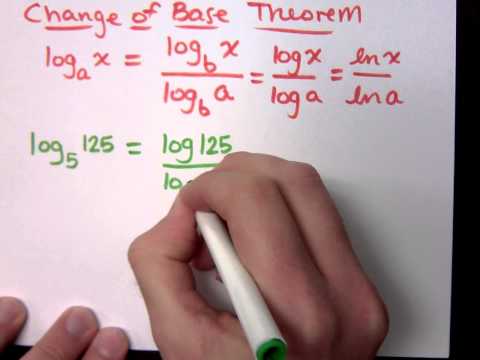
Here's a video by mathman1024 going over the Change of Base Theorem.

The common logarithm is in base 1010. When writing the common logarithm we leave out the ten but it's implied that it's there. Both sides of this equation are equal. log⁡x=log⁡10x\log x=\log_{10}x Just like how when we write just the radical symbol, it's implied that there's a two.

The natural logarithm has a base of ee. We denote this by writing ln⁡\ln instead of log⁡\log. ln⁡x=log⁡ex\ln x=\log_ex

The change of base formula is used to convert a logarithm to a different base. Pay close attention to the numerator and denominator. It says: log⁡ax=log⁡bxlog⁡ba\log_ax=\frac{\log_bx}{\log_ba}

The first example he looks at is: log⁡5125\log_5125. He converts it into base 10 so he can input it into his calculator. Apply the change of base formula. log⁡5125=log⁡125log⁡5=3\begin{align} \log_5125&=\frac{\log125}{\log5}\\ &=3 \end{align}

Next: log⁡328\log_{32}8. log⁡328=log⁡28log⁡232=32\begin{align} \log_{32}8&=\frac{\log_28}{\log_232}\\ &=\frac32 \end{align}

Illustrated · 1 min

Now that we've learned how to add and subtract logs, we can move onto more complicated math with logs.

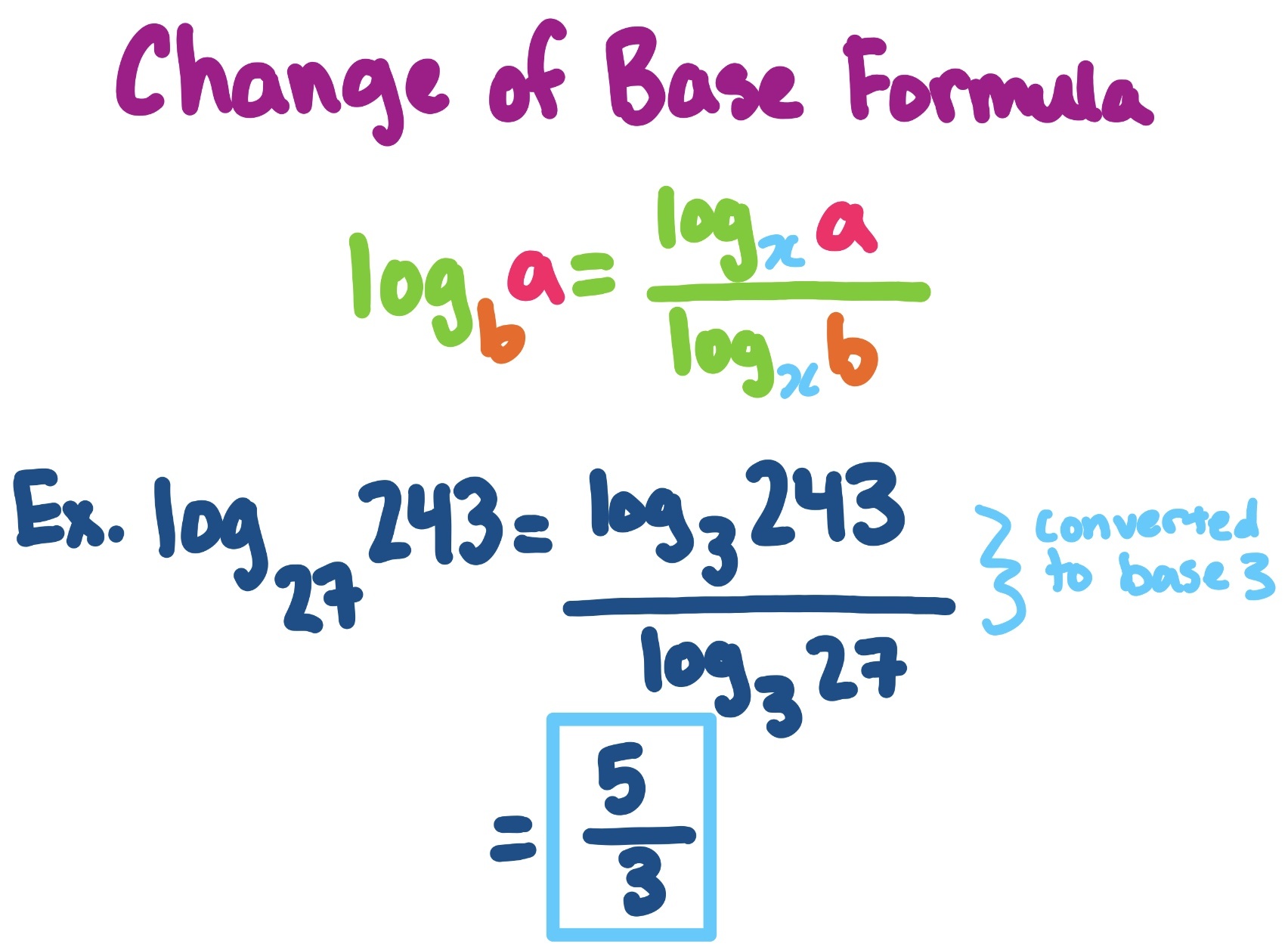
Change of Base Formula for Logs

We know that logarithms can have many different bases, such as 22, 10,oreven10, or evene.However,mostcalculatorsonlyhavebuttonsforcommonlogs(base. However, most calculators only have buttons for common logs (base10)andnaturallogs(base) and natural logs (basee$).

The change of base formula lets you rewrite a log with any base into an equivalent log using a base your calculator can evaluate.

Change of Base Formula

log(base b)a= fraction{log(base x)a}/{log(base x)b}
Ex.
log(base 27) 243 = fraction{log(base 3)243}/{log(base 3)27}
--> converted to base 3

= fraction{5}/{3}

Image source: by Trisha

If bb, aa, and xx are positive numbers with b≠1b\neq1 and a≠1a\neq1, then:

log⁡b(x)=log⁡a(x)log⁡a(b)\log_b(x) = \frac{\log_a(x)}{\log_a(b)}

We have two fairly common versions for both common logs and natural logs.

For common logs:

log⁡b(x)=log⁡(x)log⁡(b)\log_b(x) = \frac{\log(x)}{\log(b)}

For natural logs:

log⁡b(x)=ln⁡(x)ln⁡(b)\log_b(x) = \frac{\ln(x)}{\ln(b)}

Both formulas will give you the exact same answer.

####Example

Let's say you want to evaluate log⁡7(25\log_7(25.

Most calculators don't have a button for log⁡7\log_7. This is where the change of base formula comes in.

log⁡7(25)=log⁡(25)log⁡(7)\log_7(25) = \frac{\log(25)}{\log(7)}

We can enter that into the calculator to find that:

log⁡7(25)=1.654\log_7(25) = 1.654

Do note that it does not matter whether you use a common logarithm or a natural logarithm. For any logarithm,

log⁡(x)log⁡(b)=ln⁡(x)ln⁡(b)\frac{\log(x)}{\log(b)} = \frac{\ln(x)}{\ln(b)}

Both expressions produce the same value because they are equivalent forms of the change of base formula.

####Solve Exponential Equations

The change of base formula is especially useful when solving exponential equations.

Let's say that 2x=152^x = 15.

We can rewrite the equation using logarithms: x=log⁡2(15)x=\log_2(15).

We can now use the change of base formula!

x=log⁡(15)log⁡(2)x=\frac{\log(15)}{\log(2)}

We can solve, and we'll find that x=3.907x=3.907.

Type a concept, like “slope” or “photosynthesis”.

↑ ↓ to choose · Enter to openSearch explanations and problems