
Illustrated · 4 min
Before we dive into the five subgroups of redox reactions, let us briefly review the basics of this reaction consists of.
A redox reaction, or a Reduction-Oxidation reaction is a special kind of chemical reaction involving the electron transfer between species and changing of reactant oxidation states.
If you need a refresher on assigning oxidation states in a reaction, refer back to the page: Oxidation Number
The term redox comes from the two aspects involved in this reactions: reduction and oxidation.
- Reduction refers to either the gaining of electrons or the increase in oxidation state by a species.
- Oxidation refers to either the loss of electrons or or the decrease in oxidation state by a species.
The term species consists of molecules, ions, or atoms, for reference.
These reactions occur only simultaneously in matched sets: if one species is oxidized in a reaction, the other species must be reduced.
Think of the handy mnemonic "OIL RIG"--Oxidation is Losing (electrons), Reduction Is Gaining (electrons) to help you determine which process each species is experiencing in a reaction.

By Summer Black
In this picture, remember that substances that gain electrons (are reduced) will have a negative charge and those that lose electrons (are oxidized) will have a positive charge.
The species that is being reduced, or that is preforming the oxidation on the on the other species, is known as the Oxidizing Agent.
The species that is oxidized in the reaction, or that reduces its partner, is known as the Reducing Agent.
In other words, if a substance is reduced, it is an oxidizing agent, but if it is oxidized, it is a reducing agent.
Therefore, in the above image, substance A is the reducing agent and substance B is the oxidizing agent.
Now that we have reviewed the basics of redox reactions, let's discuss the five different types: combination, decomposition, displacement, combustion, and disproportion.
1. Combination Reactions
Combination reactions, also known as synthesis reactions, involve the combination of two different compounds to form a single chemical compound.
This occurs in the general form of A + B AB.
As an example, let's look at the formation of water molecules:
In this reaction, the reactants, and both have an oxidation state of 0, since they are in the molecular form of their respective elements. In the product, , the oxidation state for oxygen is -2 and that for hydrogen is +1. In the reaction, oxygen is gaining two electrons from the two hydrogen molecules, while each hydrogen is losing one electron to the oxygen.
Therefore, oxygen is being reduced (gains electrons) and hydrogen is being oxidized (loses electrons) in this example.
2. Decomposition Reactions
Decomposition reactions are simply the reverse of combination reactions-- meaning that a chemical compound is broken down into its component elements.
This occurs in the general form of AB A + B
Reversing the previous example, we have the breakdown of water molecules () into their constitute elements, and , both of which are neutral
As before, has a total oxidation state of 0, with the two hydrogens taking on a +1 state and the oxygen taking on a -2 state. When decomposition occurs, the oxygen is oxidized from -2 to 0 and the hydrogens are reduced from +1 to 0.
A common example is the decompositon of carbonic acid in soft drinks:
3. Displacement Reactions
Displacement reactions, also known as replacement reactions, involve a replacement of an atom or ion in a compound for another atom or ion in the compound.
These occur in the form of A + BC AB + C
Displacement reactions can be further categorized into Metal Displacement and Non-metal Displacement reactions.
- Metal Displacement Reactions consist of a metal in a compound being displaced by another metal
For example,
Copper is reduced from +2 oxidation state to 0, gaining two electrons, and zinc is oxidized from 0 to +2, losing two electrons.
- Non-metal Displacement Reactions usually consist of either a metal or a non-metal displacing a non-metal compound present in the reaction, usually hydrogen. In some rare cases, halogens or oxygen can undergo displacement
For example, good reducing agents (alkali metals) will displace hydrogen in cold water
Sodium is oxidized from a 0 oxidation state to a +1 and hydrogen is reduced from a +1 oxidation state to a 0.
Less active metals (magnesium and iron) can also react with steam to form hydrogen gas
Displacement reactions can occur as single-replacement reactions, which we have discussed, or as double-displacement reactions where two elements in the reactants are displaced by two in the products. Double-displacement reactions are NOT redox. The ions are simply recombined without the transfer of any electrons.
These take place in the general form of AB + CD AD + CB
4. Combustion Reactions
A combustion reaction will occur when a substance combines with to form an oxygen-containing compounds of other elements in the reaction. In combustion, the oxygen is reduced while the other elements are oxidized.
Combustion occurs in the general equation:
Combustion is an exothermic (heat releasing) process between an organic fuel and an oxidant. For example, the combustion of methane with oxygen to form carbon dioxide and two water molecules will release energy (heat).
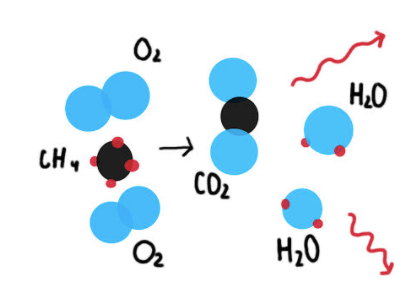
By Summer Black
5. Disproportionation Reactions
In this kind of redox reaction, substances can be both oxidized and reduced. This can occur because one compound of intermediate oxidation state converts to two compounds, one of higher and one of lower oxidation states
Disproportionation occurs in the general equation:
- where n represents the number of electrons transferred.
Molecular chlorine mixing with water is a good example of a disproptionation reaction:
Elemental chlorine () has an oxidation state of 0 before disproportionating into HCl with an oxidation state of -1 and HClO with +1. Therefore, chlorine is both reduced and oxidized in this reaction.

