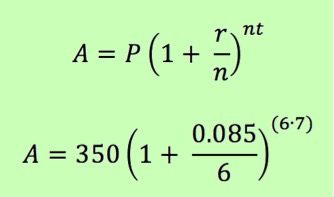
Формула складних відсотків

Before this, knowФормула простих відсотків

Video · + 1 min read

(Video) Finding Present and Future Values

by ThinkwellVids

This video by ThinkwellVids explains compound interest and how to solve problems with it. This equation is a little different than the simple interest equation.

Summary\large{\text{Summary}}

The equation for compound interest formula is: A=P(1+rm)mtA=P\left(1+\frac{r}{m}\right)^{mt} One way it differs from simple interest is the variable mm. This is the number of times you amount gets compounded. The more times money gets compounded, the more money accumulates.

Example

Suppose we stop buying avocado toast for a week and are able to put $9,000\$9{,}000 in our bank. The bank gives us an interest rate of 5%5\% and it gets compounded semiannually for 99 years. How much money will we have at the end of those 99 years?

There's a lot of information here, so let's start by defining our variables. We start with 9,0009{,}000 so: P=9,000P=9{,}000 The interest rate is 5%5\%. r=0.05r=0.05 The money is in the account for 99 years. t=9t=9 And, it gets compounded semiannually. This means it compounds twice every year. m=2m=2

Next, we plug these into our equation. A=P(1+rm)mtA=9,000(1+0.052)(2)(9)\begin{align} A&=P\left(1+\frac{r}{m}\right)^{mt}\\ A&={\color{#8925AE}{9{,}000}}\left(1+\frac{\color{#8925AE}{0.05}}{\color{#8925AE}{2}}\right)^{({\color{#8925AE}{2}})({\color{#8925AE}{9}})} \end{align}

Finally, solve. A=9,000(1+0.052)(2)(9)A=9,000(1+140)18A=9,000(4140)18A≈14,036.93\begin{align} A&=9{,}000\left(1+\frac{0.05}{2}\right)^{(2)(9)}\\ A&=9{,}000\left(1+\frac{1}{40}\right)^{18}\\ A&=9{,}000\left(\frac{41}{40}\right)^{18}\\ A&\approx14{,}036.93 \end{align}

Test Yourself

Simon puts $1,000\$1{,}000 into his bank account. He receives an interest of 4.8%4.8\% bi-annually for 66 years. How much money does he have at the end of the 66 years? \\ Bi-annually means once every other year.

Choose one answer

Illustrated · 2 min

Compound Interest

Compound interest is the concept of investing money, earning interest on it, and that money goes back into your savings account, so the next time you earn interest you get interest on the interest and the original value. This may seem like small gains, but over the span of 20 years, that could be a lot of money! A compounding period is the time between when the interest was last compounded and when the interest will be compounded again; typically, this takes the span of one month. The number of compounding periods is directly related to the amount of financial growth.

Now, you could use a compound interest calculator, but imagine how cool it would be if you could do it yourself! If you're given a principal amount, an annual interest rate, and the compounding frequency. You'll be able to determine the accumulated interest over time periods that occurs because of continuous compounding. This is how financial institutions calculate it!

The compound interest formula: A=P(1+rn)ntA=P\left(1+\frac{r}{n}\right)^{nt} Where:

  • A=A= the final amount
  • P=P= the principal (or starting) amount
  • r=r= the annual rate
  • n=n= number of time compounded per year
  • t=t= time (in years)

This formula is a literal equation, which means it has several variables!

A line break.

Example

You invest $12,000\$12{,}000 at an account that earns 8%8\% interest for five years. How much do you have after five years if

  1. compounded yearly
  2. compounded quarterly
  3. compounded monthly

Compounded Yearly

Let's first set up and solve the problem when it's compounded yearly.

Start by defining our variables. We're solving for AA so we can leave that one alone. We start with $12,000\$12{,}000 so P=12,000P=12{,}000, r=0.08r=0.08, t=5t=5, and it's compounded yearly which means once a year so n=1n=1. A=P(1+rn)ntA=12,000(1+0.081)1×5A=12,000(1.08)5A=17,631.94\begin{align} A&=P\left(1+\frac{r}{n}\right)^{nt}\\ A&={\color{#8925AE}{12{,}000}}\left(1+\frac{\color{#8925AE}{0.08}}{\color{#8925AE}{1}}\right)^{{\color{#8925AE}{1}}\times{\color{#8925AE}{5}}}\\ A&=12{,}000(1.08)^5\\ A&=17{,}631.94 \end{align}

Compounded Quarterly

Quarterly means it's compounded four times a year. So now n=4n=4. A=12,000(1+0.084)4×5A=12,000(1.02)20A=17,831.37\begin{align} A&=12{,}000\left(1+\frac{0.08}{\color{#8925AE}{4}}\right)^{{\color{#8925AE}{4}}\times5}\\ A&=12{,}000(1.02)^{20}\\ A&=17{,}831.37 \end{align} Notice you make more than when it's compounded yearly.

Compounded Monthly

Monthly means it's compounded twelve times a year! So now n=12n=12. A=12,000(1+0.0812)12×5A=12,000(151150)60A=17,878.15\begin{align} A&=12{,}000\left(1+\frac{0.08}{\color{#8925AE}{12}}\right)^{{\color{#8925AE}{12}}\times5}\\ A&=12{,}000\left(\frac{151}{150}\right)^{60}\\ A&=17{,}878.15 \end{align}

As you can see, the more frequently something is compounded, the more money you will make!

Interactive · 13 questions

Calculating Compound Interest

The best mindset to have when you're solving problems about interest is to think of yourself as a recent lottery-winner millionaire. Imagine piles of money around you, all needing to be invested and interest needing to be calculated. It's the practical thing to do...

Briefcase full of money.

Image by 472301 via Pixabay (CC0)

Recall that, when calculating simple interest, you are multiplying the interest rate by the principal amount (what you initially invested).

On the other hand, compound interest is basically interest on interest. Instead of just earning interest on the principal amount you invested, you earn interest on the principal and on interest you've already accumulated on it.

Here's the formula to follow:

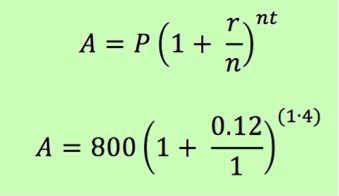
A = P(1 + r/n)^(nt)

Image source: by Hannah Bonville

A = final balance (amount)
P = principal (amount originally invested)
r = interest rate (as decimal)
n = number of times interest is compounded per year
t = time (years)

Image source: by Hannah Bonville

Let's try an example.

Let's start by matching up the information in our word problem with the variables in the formula.

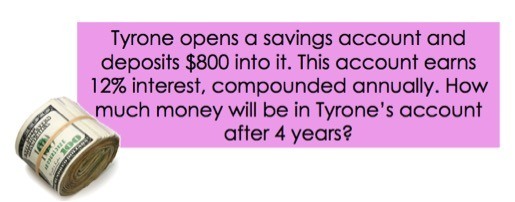
What is the principal invested (PP) in Tyrone's account?

Choose one answer

Type a concept, like “slope” or “photosynthesis”.

↑ ↓ to choose · Enter to openSearch explanations and problems