
Video
By Alex Federspiel

+1 contributors
Contributors

(Video) Inverse of a Matrix
by Math Meeting

Here's a video by Math Meeting showing you how to find the inverse of a matrix using the determinant. It's a lot more complicated than a matrix.
Video
by Math Meeting
Here's a video by Math Meeting showing you how to find the inverse of a matrix using the determinant. It's a lot more complicated than a matrix.
These problems have no steps to copy. You have to understand the idea well enough to bend it to a new purpose. These are real problems from the AMC 12, the national math competitions for middle and high school students, each with a worked solution on LIVE by Po-Shen Loh.
Illustrated · 1 min
I'm going to share with you a fun way to find the determinant of a matrix. My professor taught this to me and she called it the Butterfly Method but said she didn't know what it was actually called. A little digging into it shows that it is called Sarrus' rule or Sarrus' scheme. It's seems a little complicated to grasp at first but it's the method I prefer.
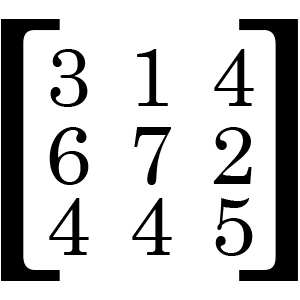
Here's our matrix we're going to find the determinant for.
It's going to be in the form:
Now let's find out how you find the parts.
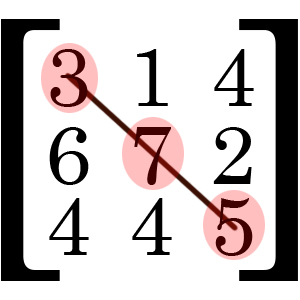
First we take the diagonal shown above and multiply the numbers together.
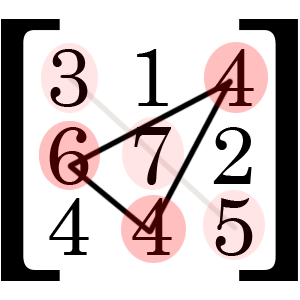
Next we multiply up the numbers in the first triangle who's vertices don't lie on the diagonal. You might notice that 1, 2, 4 also work. This is correct and will be part 3. It doesn't matter which triangle you take first. If you don't understand what I'm talking about you'll see in part 3.
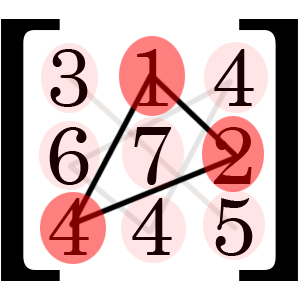
Now we selected the second triangle who's vertices don't touch the diagonal. There's always 2 of these triangles for each of the diagonals.
So now we have the first chunk completed.
Now we do the same process for the second diagonal.
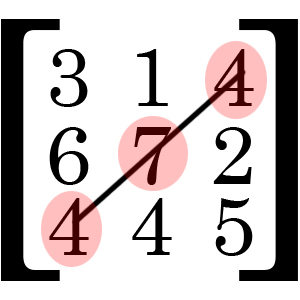
Multiply all the numbers together.

Next we find the triangles who's vertices don't touch the diagonal. Again it doesn't matter which one you choose first.
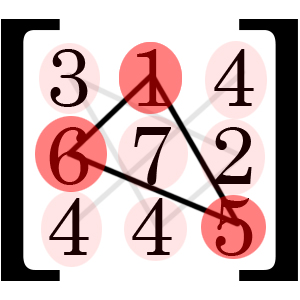
And finally, you multiply the numbers along the second triangle.
Now we just plug these back in and solve for our determinant.
And that's the Butterfly Method. It probably seems overly complicated, and hey maybe it is, but I always found this method to be easier for me so maybe someone else will.