Спряжені пари кислот та основ

Before this, knowBrønsted-Lowry Acids and Bases — Definition & Examples

Interactive · 1 question

Conjugate Acid-Base Pairs

What are Conjugate Acid-Base Pairs?

  • In a reaction, for every acid in the reactants, there is a conjugate base in the products

  • In a reaction, for every base in the reactants, there is a conjugate acid in the products

  • The reactant acid and conjugate base or the reactant base and the conjugate acid are referred to as: Conjugate Pairs

Image shows how in a reaction, there are conjugate pairs between the reactants and the products

Image source: By Caroline Monahan

Note: The acid pair always has one more hydrogen ion (H+^+) than its conjugate base!

Weak Acid and Bases

  • A strong acid will produce a weak base (and a weak base will form a strong acid)

Example: HCl is a strong acid which produces a conjugate base of Cl which is a weak base!

  • A weak acid will produce a strong base (and a strong base will produce a weak acid)

Example: HF is a weak acid which produces a conjugate base of F which is a strong base!

Try out a practice problem!

In the reaction below, what are the conjugate pairs?

HCHO2HCHO_{2} + H2OH_{2}O → CHO2CHO_{2} + H3OH_{3}O

Choose one answer

Illustrated · 1 min

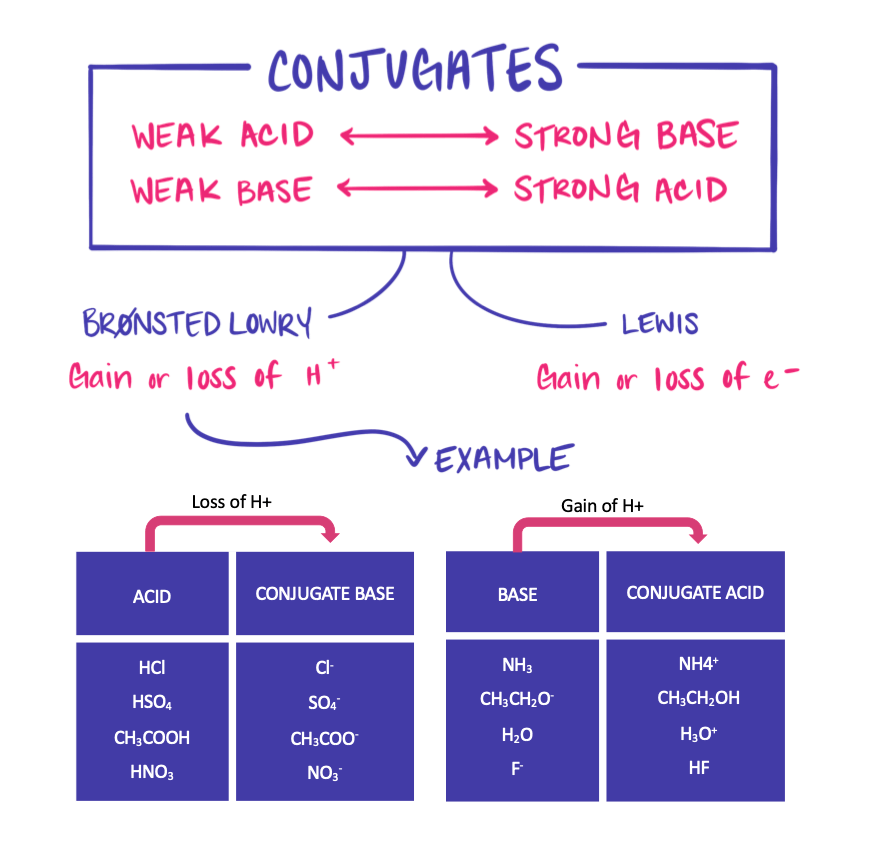
Conjugate Acid-Base Pairs

The image depicts what conjugates are in regards to acids and bases. A weak acid/base corresponds to a strong acid/base.

Image By: E. Burnham

Video

(Video) Conjugate Acid-Base Pairs

By: The Organic Chemistry Tutor

This video first goes over the differences between a Lewis acid and base, Bronsted-Lowry acid and base, and Arrhenius acid and base. A few examples are given that give the opportunity to check your understanding of acids/bases and identifying their appropriate conjugate molecule.

Type a concept, like “slope” or “photosynthesis”.

↑ ↓ to choose · Enter to openSearch explanations and problems