Станадартний вигляд квадратичної функції

Before this, knowВиділення повного квадрату: знаходження вершиниТеорема про розклад квадратного многочлена

Read · 2 min

A quadratic equation will be seen in several different forms. These forms are the standard form of a quadratic, vertex form, and slope-intercept form. They are useful for performing different operations on a quadratic equation.

Standard form is used for performing the quadratic formula on, or finding if the equation is a polynomial function. y=ax2+bx+cy = ax^2 + bx + c

Vertex form is used to find the vertex of the function to graph it. y=a(x−h)2+ky = a(x - h)^2 + k

Intercept form is used for completing the square or finding the intercepts or solutions of the graph. y=a(x−p)(x−q)y = a(x - p)(x - q)

Converting: Vertex Form →\rightarrow Standard Form

To convert from vertex form to standard form, we want to expand the equation in vertex form, combine like terms, and rearrange the terms.

y=a(x−h)2+k→y=ax2+bx+cy = a(x - h)^2 + k \rightarrow y = ax^2 + bx + c

Example

Let's convert y=2(x−3)2+5y=2(x-3)^2 +5 into standard form.

y=2(x−3)2+5y=2(x2−6x+9)+5y=2x2−12x+18+5y=2x2−12x+23\begin{align} y&=2(x-3)^2 +5 \\ y&=2(x^2 -6x +9) +5 \\ y&= 2x^2 -12x +18 + 5 \\ y&= 2x^2 -12x +23 \\ \end{align}

y=2x2−12x+23y= 2x^2 -12x +23 is in standard form!

Converting: Standard Form →\rightarrow Vertex Form

To convert from standard form to vertex form, we will use our steps for completing the square, which we learned about in the previous lesson.

There is one more way to convert from standard form to vertex form, and that is to use the formula for the vertex. For a vertex, (h,k)(h,k),

h=−b2ah=-\frac{b}{2a}

Once we find the vertex, we'll plug in the values for the x−x- and y−y-coordinates of the vertex into the vertex form of a quadratic.

Example

Let's convert y=2x2+4x+3y=2x^2 +4x +3 into vertex form.

h=−44=−1h = \frac{-4}{4} = -1

We've found our xx-coordinate (or the axis of symmetry), so now let's find the yy-coordinate for the vertex by plugging this solved xx-value back into the equation.

y=2(−1)2+4(−1)+3y=2−4+3y=−2+3y=1\begin{align} y &= 2(-1)^2 +4 (-1) +3 \\ y &= 2-4+3 \\ y &= -2 +3 \\ y &= 1 \\ \end{align}

So, the vertex of the equation is (−1,1)(-1,1). From our standard form, we know that a=2a=2, so we plug in these values into vertex form.

y=2(x+1)2+1y=2(x+1)^2 +1

Converting: Intercept Form →\rightarrow Standard Form

Similar to what we saw earlier when we were converting from vertex form to standard form, when we convert from intercept form to standard form, we want to expand the equation, combine like terms, and rearrange the terms.

y=a(x−p)(x−q)→y=ax2+bx+cy = a(x - p)(x - q) \rightarrow y=ax^2+bx+c

Example

Let's convert y=3(x−2)(x+4)y=3(x-2)(x+4) into standard form.

y=3(x−2)(x+4)y=3(x2+4x−2x−8)y=3(x2+2x−8)y=3x2+6x−24\begin{align} y&= 3(x-2)(x+4) \\ y&= 3(x^2 +4x -2x -8) \\ y&= 3(x^2 +2x -8) \\ y&= 3x^2 +6x -24 \\ \end{align}

We can see that y=3x2+6x−24y= 3x^2 +6x -24 is in standard form!

Converting: Standard Form →\rightarrow Intercept Form

At first, this may seem a little confusing. Think back to Algebra 1 when we learned how to factor quadratic equations. We looked for factors of acac that add to bb. The only difference here is that we want a=1a=1, so we will first factor out aa if a=1a=1.

y=ax2+bx+c→y=a(x−p)(x−q)y=ax^2 +bx +c \rightarrow y = a(x - p)(x - q)

Example

Let's convert y=2x2+8x+6y=2x^2 +8x +6 into intercept form.

We need a=1a=1, so let's first factor out a monomial, 22.

y=2x2+8x+6y=2(x2+4x+3)\begin{align} y &=2x^2 +8x +6 \\ y &=2(x^2 +4x +3) \\ \end{align}

Now, we'll find the factors for the quadratic within the parentheses. We are looking for factors of acac, 33, that add to bb, 44.

y=2(x2+4x+3)y=2(x+3)(x+1)\begin{align} y &=2(x^2 +4x +3) \\ y &=2(x+3)(x+1) \\ \end{align}

We can see that y=2(x+3)(x+1)y =2(x+3)(x+1) is in intercept form!

Interactive · 3 questions

Quadratics Functions

Quadratics are polynomials of degree two. They are in the form ax2+bx+cax^2+bx+c where a,b,ca,b,c are the coefficients of the quadratic.

Which of the following are quadratics?

Choose all correct answers

Video · + 1 min read

(Video) Changing Between Quadratic Forms

by Spiffy Math

This video by Spiffy Math discusses the pros and cons of each quadratic form, as well as how to convert between the forms.

Summary

There are three different forms of a quadratic that we can work with.

The first type is factored. The terms of the factored forms are the factors of the quadratic, or the solutions.

The second type is standard. This is the type of quadratic we are most used to seeing, where the equation looks like ax2+bx+cax^2 + bx + c.

The third type is vertex. You can tell where the vertex comes from when we use vertex form. This form is the most helpful when we are looking to sketch a graph without a lot of information.

Conversions

To go from factored form to standard form, we would use FOIL. To do the opposite (i.e., to go from standard form to factored form, we would look for factors of acac that added to bb.

To go from standard form to vertex form, we want to complete the square. To convert from vertex form to standard form, we use FOIL or expand the terms.

Example

Pause the video and try this example on your own!

x2+4x+3x^2 + 4x +3

Given this equation in standard form, convert the quadratic to factored form and to vertex form.

Illustrated · 1 min

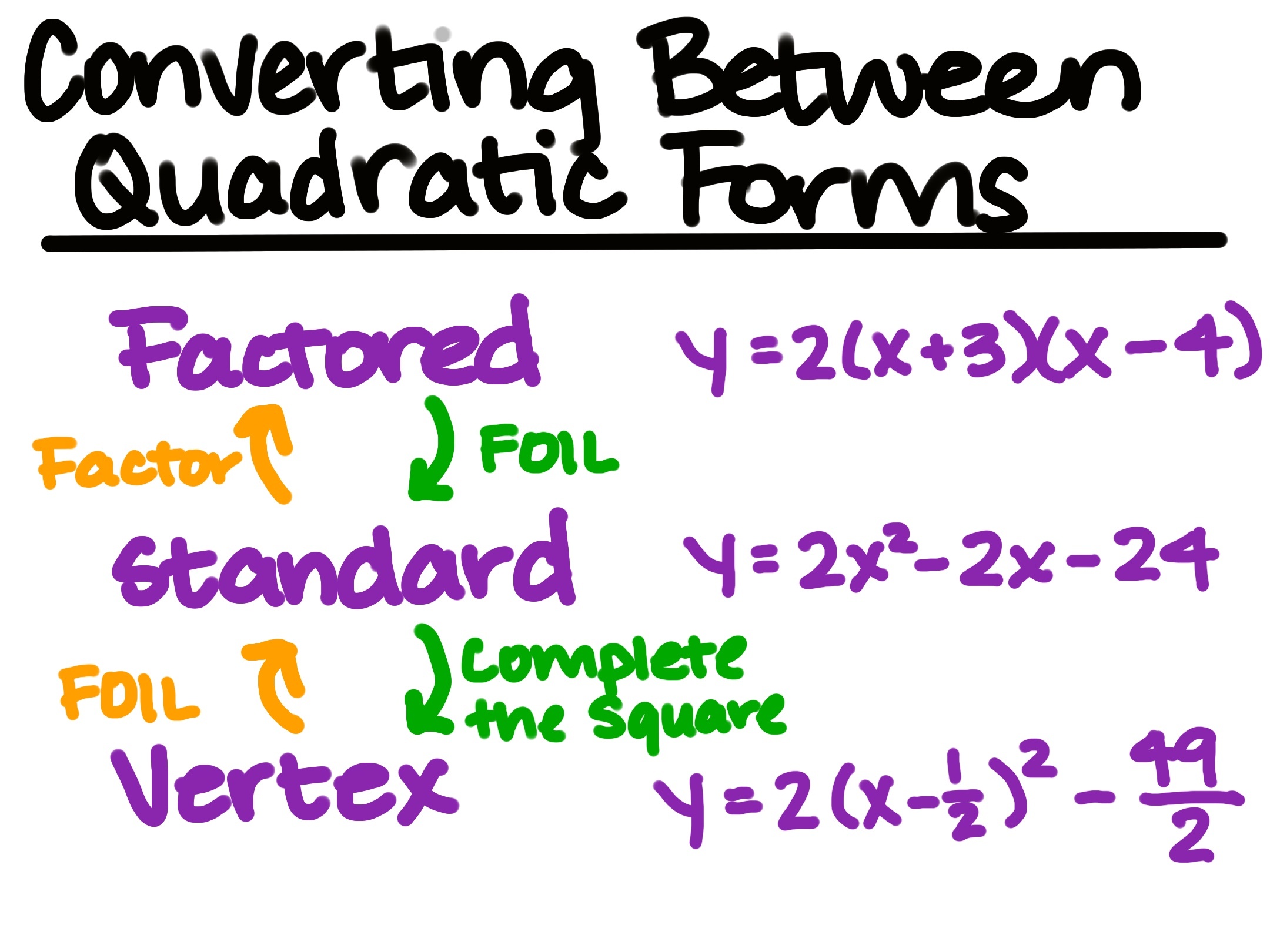
Converting Between Quadratic Forms

We can convert between quadratic forms, depending on what we'd need the quadratic for.

Converting Between Quadratic Forms

Image source: by Anusha Rahman

Given the quadratic equation in factored form: y=2(x+3)(x−4)y=2(x+3)(x-4) We can convert this equation into standard form and vertex form.

Factored Form →\rightarrow Standard Form

To convert the given factored form into the standard form y=ax2+bx+cy=ax^2+bx+c, we need to expand the expression.

y=2(x+3)(x−4)y=2(x+3)(x-4)

You can use the FOIL method to expand the binomials, then simplify. We find that the equation in standard form is:

y=2x2−2x−24y=2x^2-2x-24

Standard Form →\rightarrow Vertex Form

To convert from standard form to vertex form, we need to complete the square. If we do that, we find that the equation in vertex form is:

y=2(x−12)2−492y=2(x-\frac12)^2 - \frac{49}{2}

In Summary

  • Factored Form: y=2(x+3)(x−4)y=2(x+3)(x-4)

  • Standard Form: y=2x2−2x−24y=2x^2-2x-24

  • Vertex Form: y=2(x−12)2−492y=2(x-\frac12)^2 - \frac{49}{2}

You can use these steps to convert any quadratic equation between these forms.

Type a concept, like “slope” or “photosynthesis”.

↑ ↓ to choose · Enter to openSearch explanations and problems