Кути на координатній площині: кути, що різняться на повний оберт

Before this, knowКути на координатній площині: стандартне положенняЩо таке одиничне коло?

Illustrated · 2 min

In trigonometry, so far we have learned about the characteristics of periodic functions and various trig functions like sine, cosine, cosecant, etc. However, now we are going to learn about two new types of angles.

##Reference Angle

Let's take a look at an angle of 330∘330^{\circ} in [degrees] or 11π6\frac{11\pi}{6} in radians.

To find the reference angle for an angle of 330∘330^{\circ}, we have to first find what quadrant the terminal side is in. Luckily, there are some nifty rules regarding the quadrant we can use to help determine the amount to subtract from.

If the terminal side is in the first quadrant, you don't have to find a reference angle! Your angle is the reference angle:)

If the terminal side is in the second quadrant, the reference angle is 180∘180^{\circ} of π\pi minus the angle.

If the terminal side is in the third quadrant, the reference angle is the angle minus 180∘180^{\circ} or π\pi.

If the terminal side is in the fourth quadrant, the reference angle is 360∘360^{\circ} or 2π2\pi minus the angle.

In this example, the angle of 330∘330^{\circ} is in the fourth quadrant, so know that in order to find the reference angle, we must subtract the angle from 360∘360^{\circ} or 2π2\pi.

360∘−330∘=30∘360^{\circ} - 330^{\circ} = 30^{\circ}. In terms of radians, 2π−11π6=π62\pi - \frac{11\pi}{6} = \frac{\pi}{6}. Therefore the reference angle is 30∘30^{\circ} or π6\frac{\pi}{6}.

Angle of 330 or 11pi/6 degrees drawn on a coordinate plane. Reference angle of 30 degrees or pi/6 drawn.

Image source: by Trisha

Looking at this graph, we can see the terminal side and the angle of 330∘330^{\circ} labeled, along with the reference angle of 30∘30^{\circ}. We can see how together, they form a complete circle of a 360∘360^{\circ} angle.

Another way of thinking about the reference angle graphically is to find the angle distance between the terminal side and the xx-axis.

##Coterminal Angle

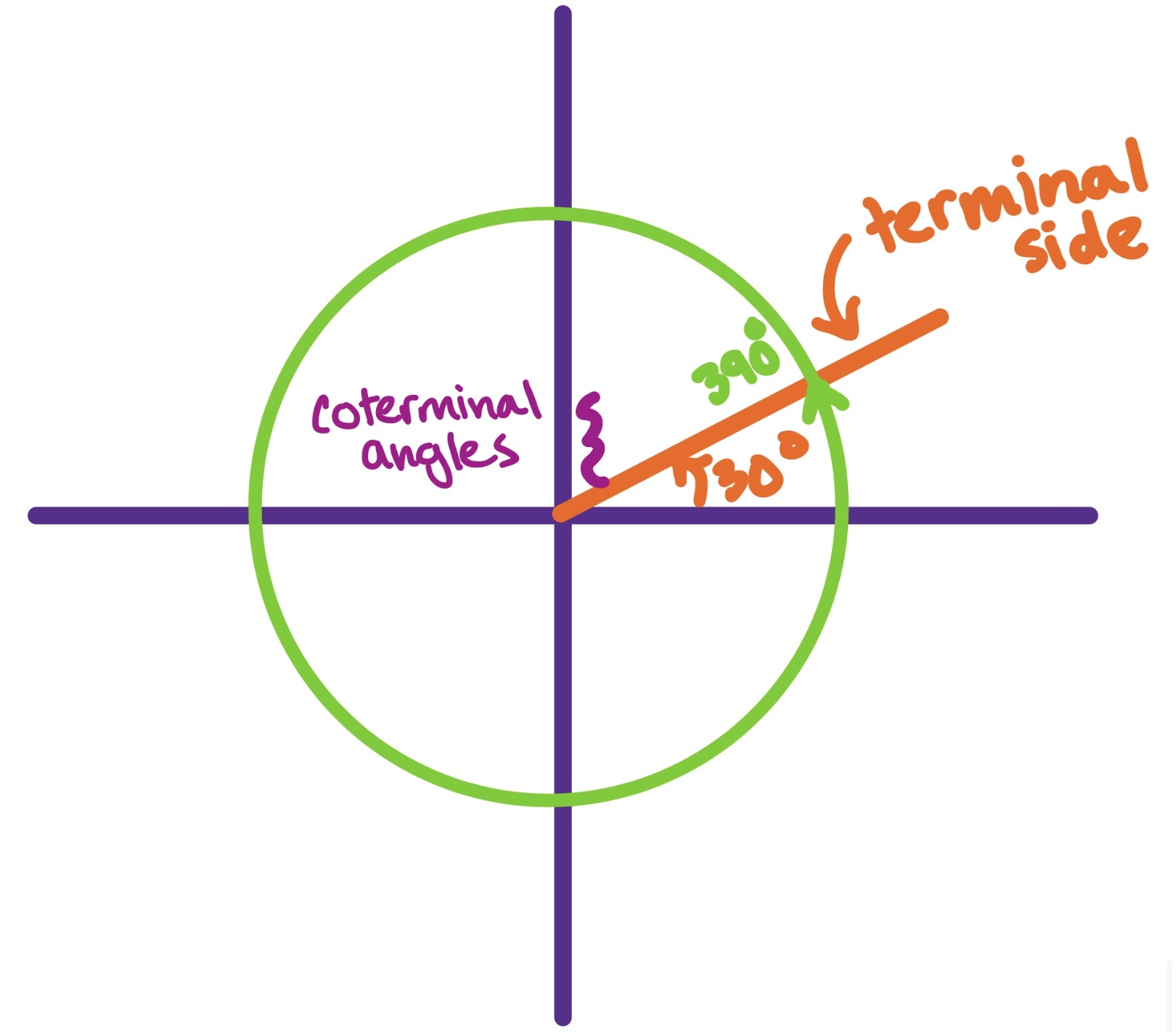
Coterminal angles are angles that have the same terminal side.

To find the coterminal angle, just add or subtract 360∘360^{\circ} or 2π2\pi from the angle.

Co-terminal angles of 30 degrees and 390 degrees labeled on a coordinate graph. The terminal side is also labeled.

Image source: by Trisha

In the example above, the angle is 30∘30^{\circ}. If we add 360∘360^{\circ}, we get 390∘390^{\circ}, which is a coterminal angle. We can subtract 360∘360^{\circ} or add another 360∘360^{\circ} as many times as we like and we would always receive a coterminal angle.

Video

(Video) Coterminal Angles

by The Organic Chemistry Tutor

This video by The Organic Chemistry Tutor provides a basic introduction of coterminal angles in degrees & radians.

Summary

Coterminal angles are angles that point to the same terminal angle.

Coterminal angles of 30 degrees and 390 degrees

Image source: by Anusha Rahman

The angle in red is 30∘30 ^{\circ}, but it is also 390∘390 ^{\circ}. We can go around the circle multiple times, so 360+30=390360 + 30 = 390. 30∘30 ^{\circ} is considered the reference angle.

So, anytime two angles differ by 360∘360 ^{\circ}, you can assume they are coterminal angles. If your angles differ by 2π2\pi, you can assume the two angles are coterminal angles.

Illustrated · 1 min

Coterminal and Reference Angles

A coterminal angle is an angle that shares a terminal side with another angle, but completes more or less rotations around the origin.

Coterminal Angles
60+360
Initial side on the x-axis, terminal side at 60 degrees

Image source: by Anusha Rahman

In the above image, we see the green angle at 60∘60^{\circ}. We also see three more coterminal angles drawn, in different colors. The first coterminal angle goes around the origin one additional time, so the coterminal angle is 60∘+360∘=420∘60^{\circ}+360^{\circ}=420^{\circ}.

The next coterminal angle wraps around the origin two additional times, compared to the original green angle at 60∘60^{\circ}. That means that the angle for this coterminal angle is 60∘+360∘+360∘=780∘60^{\circ}+360^{\circ}+360^{\circ}=780^{\circ}.

This pattern continues for the next coterminal angle. We can calculate the angle, which is 60∘+360∘+360∘+360∘=1140∘60^{\circ}+360^{\circ}+360^{\circ}+360^{\circ}=1140^{\circ}.

Now that we understand coterminal angles, we can learn reference angles! You can think of reference angles as the basic of the angle.

Reference Angles
Quadrant I: Ref angle - given angle
Quadrant II: 180 - given angle = ref angle
Quadrant III: Given angle - 180 = ref angle
Quadrant IV: 360 - given angle = ref angle

Image source: by Anusha Rahman

The reference angle is always going to be positive, and it will always be an angle between the terminal side and the xx-axis. It is a measure of the smallest acute angle that a given angle can be.

Type a concept, like “slope” or “photosynthesis”.

↑ ↓ to choose · Enter to openSearch explanations and problems