
Illustrated · 1 min
+2 contributors
Contributors

How does it occur?
-
When atoms get near each other, their nuclei attract each other's electrons. The attraction causes the two atoms to form a bond. When this happens, their electron densities shift towards each other. So, they share their electrons.
-
Different atoms, depending on what they are, will form longer or shorter bond lengths as well as have a higher or lower bond energy.
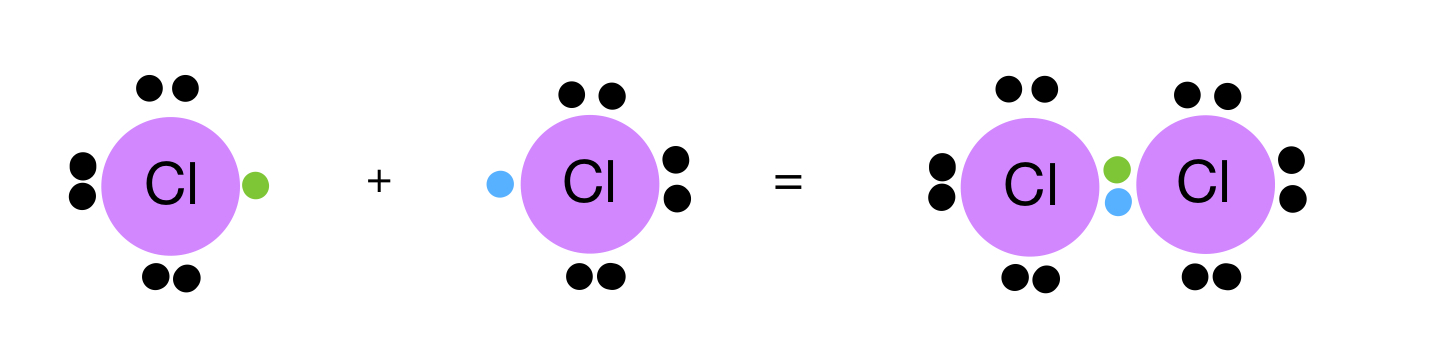
Image source: By Caroline Monahan
Types of Covalent Bonds
There are two different types of covalent bonds. The electronegativity difference between the elements determines how evenly the electrons are shared.
- In polar covalent bonds the electrons are unequally shared between the atoms.
- The unequal sharing creates a dipole. One side of the molecule has a partial positive charge. The other side has a partial negative charge.
- Polar molecules experience dipole-dipole interaction, ion-dipole interactions, and hydrogen bonding.
- In nonpolar covalent bonds the elections are equally shared between the atoms.
- The only intermolecular force they experience is London dispersion.




