Що значить "взяти границю" Риманової суми?

Before this, knowЛіві, праві, серединні Риманові суми

Read · 1 min

As we know, a Riemann sum is an approximation of the area of a curve, say f(x)f(x), on an interval, say [a,b][a,b]. The approximation comes from summing the area of many, say nn, rectangles on the interval which touch the function. If we have only 11 rectangle to approximate the curve's area, it will be a very rough approximation. If we have 55 rectangles to approximate the area, each now with smaller widths, it's a better approximation because the rectangles start to snug up against the curve. If we have 100100 or 10001000 rectangles, it becomes a much better approximation. Basically, as nn approaches ∞\infty, the approximation for the area continues to get better. For n=∞n=\infty, the approximation is exact, which is where the limit definition of a definite integral comes from.

Video · + 2 min read

(Video) Definition of the Definite Integral

by PatrickJMT

In this video by patrickJMT he explains the definition of the definite integral and how it comes about.

Let's begin with defining what an integral is. An integral is the area underneath a curve. While this seems simple, it can prove to be tricky.

The definition for a definite integral is given by: ∫abf(x)dx=lim⁡n→∞∑i=1nf(xi∗)Δx\boxed{\int_a^bf(x)dx=\lim_{n\rightarrow\infty}\sum_{i=1}^nf(x_i^*)\Delta x}

I don't know about you but this looks gross, and I'm pretty sure if you licked it it would taste gross. Luckily we can break down what the heck is going on here by looking at pictures!

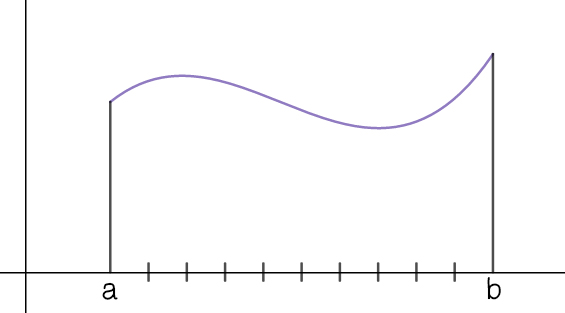
To begin suppose we have some curve y=f(x)y=f(x) on an interval [a,b][a,b].

To find the area below this curve and on the interval [a,b][a,b] we begin by approximating the area.

The first step is to chop up our interval of [a,b][a,b] into nn pieces of equal width.

Each of these pieces has a width of delta xx, Δx\Delta x.

We can calculate what Δx\Delta x is by taking the length of the interval and dividing it by how many pieces we have. Δx=b−an\Delta x=\frac{b-a}{n}

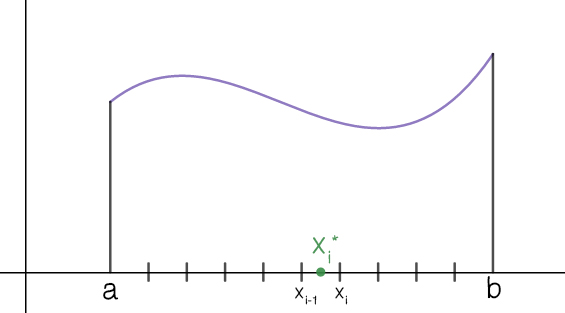
Let's take an arbitrary slice which we define as xi−1x_{i-1} and xix_i.

If we take any point inside this arbitrary interval [xi−1,xi][x_{i-1},x_i] we label it xi∗x_i^*. This just says that this point is within this ithi^{\text{th}} interval.

In order to approximate the area below this curve, we make rectangles. The way we make the rectangles is by taking a point within each slice and drawing a line straight up until it touches the curve.

Then you extend the rectangle to the edges of the piece, keeping the same height. It is okay if part of the rectangle is over or under the curve, this is just an approximation.

So for the approximation of the area under the curve, we add on the area of this rectangle.

The area of the rectangle will be the width, which we said was Δx\Delta x, times the height which will be the function evaluated at the point we used to make the line. Since we used the point xi∗x_i^\ast the height will be f(xi∗)f(x_i^*).

So the area of this ithi^{\text{th}} rectangle is: Ri=f(xi∗)ΔxR_i=f(x_i^*)\Delta x

What we do is apply this method to all the pieces within [a,b][a,b]. Each rectangle will have an area that can be found using the same technique as above.

After we find all the areas of the rectangles, the approximation of the area under the curve will be the sum of all the rectangles' areas.

So the area will be approximately: A≈R1+R2+R3+⋅⋅⋅+RnA≈f(x1∗)Δx+f(x2∗)Δx+f(x3∗)Δx+⋅⋅⋅+f(xn∗)ΔxA≈[f(x1∗)+f(x2∗)+f(x3∗)+⋅⋅⋅+f(xn∗)]ΔxA≈∑i=1nf(xi∗)Δx\begin{align} A&\approx \color{blue}{R_1}+\color{green}{R_2}+\color{orange}{R_3}+\cdot\cdot\cdot+\color{green}{R_n}\\ A&\approx \color{blue}{f(x_1^*)\Delta x}+\color{green}{f(x_2^*)\Delta x}+\color{orange}{f(x_3^*)\Delta x}+\cdot\cdot\cdot+\color{green}{f(x_n^*)\Delta x}\\ A&\approx [\color{blue}{f(x_1^*)}+\color{green}{f(x_2^*)}+\color{orange}{f(x_3^*)}+\cdot\cdot\cdot+\color{green}{f(x_n^*)}]\Delta x\\ A&\approx\sum_{i=1}^n f(x_i^*)\Delta x \end{align}

So here's the approximation of the area under the curve. In the example above we have n=10n=10 intervals. As you might conclude, the larger nn is the more accurate the area will be. If we take the limit as nn approaches infinity, we get the exact area under the curve.

Therefore, we can define the definite integral to be the limit of this summation. ∫abf(x)dx=lim⁡n→∞∑i=1nf(xi∗)Δx\boxed{\int_a^bf(x)dx=\lim_{n\rightarrow\infty}\sum_{i=1}^nf(x_i^*)\Delta x}

Video · + 2 min read

(Videos) Calculating a Definite Integral Using Riemann Sums

by PatrickJMT

Here's a video by patrickJMT where he shows you how to calculate a definite integral using Riemann Sums. He solves one problem across the two videos.

Before we begin there's a couple things to recall.

First is the definition of a definite integral. ∫abf(x)dx=lim⁡n→∞∑i=1nf(xi∗)Δx\int_a^b f(x)dx=\lim_{n\rightarrow\infty}\sum_{i=1}^nf(x_i^*)\Delta x

Second is the equation for Δx\Delta x. Δx=b−an\Delta x=\frac{b-a}{n}

Third is the equation for xi∗x_i^\ast. Note that this definition is for using the right endpoint method. Also, the ii's expressed here are NOT imaginary. xi∗=a+(Δx)ix_i^*=a+(\Delta x)i

Fourth is the summation of a constant. ∑i=1nk=kn\sum_{i=1}^nk=kn

Fifth is the summation of the first nn natural numbers. ∑i=1ni=n(n+1)2\sum_{i=1}^ni=\frac{n(n+1)}{2}

Sixth is the summation of the first nn natural numbers squared. ∑i=1ni2=n(n+1)(2n+1)6\sum_{i=1}^ni^2=\frac{n(n+1)(2n+1)}{6}

These last three equations are just given to you in order to save time. I will prove them at the very end if anyone wants to see why they are.

The integral we want to find a solution for is: ∫13(x2−x+1)dx\int_1^3(x^2-x+1)dx

To begin, we see it's on the interval [1,3][1,3]. Using this we can calculate what Δx\Delta x is. Δx=b−anΔx=3−1n=2n\begin{align} \Delta x&=\frac{b-a}{n}\\ \Delta x&=\frac{3-1}{n}\\ &=\frac2n \end{align}

Next, we calculate xi∗x_i^*. xi∗=a+(Δx)ixi∗=1+2n⋅i=1+2in\begin{align} x_i^*&=a+(\Delta x)i\\ x_i^*&=1+\frac2n\cdot i\\ &=1+\frac{2i}n \end{align}

Now, we can find f(xi∗)f(x_i^*). f(x)=x2−x+1f(xi∗)=(xi∗)2−(xi∗)+1f(xi∗)=(1+2in)2−(1+2in)+1f(xi∗)=1+4in+4i2n2−1−2in+1f(xi∗)=1+2in+4i2n2\begin{align} f(x)&=x^2-x+1\\ f(x_i^*)&=(x_i^*)^2-(x_i^*)+1\\ f(x_i^*)&=\bigg(1+\frac{2i}n\bigg)^2-\bigg(1+\frac{2i}n\bigg)+1\\ f(x_i^*)&=1+\frac{4i}n+\frac{4i^2}{n^2}-1-\frac{2i}n+1\\ f(x_i^*)&=1+\frac{2i}{n}+\frac{4i^2}{n^2} \end{align}

Next, we take the summation. ∑i=1n[1+2in+4i2n2]⋅2n\begin{align} \sum_{i=1}^n\bigg[1+\frac{2i}{n}+\frac{4i^2}{n^2}\bigg]\cdot\frac2n \end{align}

Because the 2n\frac2n term doesn't have an ii in it, we can write it outside the summation. 2n∑i=1n[1+2in+4i2n2]\frac2n\sum_{i=1}^n\bigg[1+\frac{2i}{n}+\frac{4i^2}{n^2}\bigg]

The summation can be distributed to each term inside the brackets. 2n[∑i=1n1+∑i=1n2in+∑i=1n4i2n2]\frac2n\bigg[\sum_{i=1}^n1+\sum_{i=1}^n\frac{2i}{n}+\sum_{i=1}^n\frac{4i^2}{n^2}\bigg]

This can be simplified. 2n[∑i=1n1+2n∑i=1ni+4n2∑i=1ni2]\frac2n\bigg[\sum_{i=1}^n1+\frac2n\sum_{i=1}^ni+\frac{4}{n^2}\sum_{i=1}^ni^2\bigg]

Now we can substitute in the summation formulas we defined above. 2n[n+2n(n(n+1)2)+4n2(n(n+1)(2n+1)6)]\frac2n\bigg[n+\frac2n\bigg(\frac{n(n+1)}{2}\bigg)+\frac{4}{n^2}\bigg(\frac{n(n+1)(2n+1)}{6}\bigg)\bigg]

The term outside can be distributed in. 2+4n2⋅n(n+1)2+8n3⋅n(n+1)(2n+1)62+\frac{4}{n^2}\cdot\frac{n(n+1)}{2}+\frac8{n^3}\cdot\frac{n(n+1)(2n+1)}{6}

Simplifying gives, 2+2⋅n+1n+43⋅2n2+3n+1n22+2\cdot\frac{n+1}{n}+\frac43\cdot\frac{2n^2+3n+1}{n^2}

Next, we take the limit. lim⁡n→∞[2+2⋅n+1n+43⋅2n2+3n+1n2]\lim_{n\rightarrow\infty}\bigg[2+2\cdot\frac{n+1}{n}+\frac43\cdot\frac{2n^2+3n+1}{n^2}\bigg]

We can distribute the limit across each term. lim⁡n→∞2+lim⁡n→∞2⋅n+1n+lim⁡n→∞43⋅2n2+3n+1n2\lim_{n\rightarrow\infty}2+\lim_{n\rightarrow\infty}2\cdot\frac{n+1}{n}+\lim_{n\rightarrow\infty}\frac43\cdot\frac{2n^2+3n+1}{n^2}

This can be simplified. lim⁡n→∞2+2lim⁡n→∞n+1n+43lim⁡n→∞2n2+3n+1n2\lim_{n\rightarrow\infty}2+2\lim_{n\rightarrow\infty}\frac{n+1}{n}+\frac43\lim_{n\rightarrow\infty}\frac{2n^2+3n+1}{n^2}

Now, take the limit. 2+2(1)+43(2)2+2(1)+\frac43(2)

Finally, we get: ∫13(x2−x+1)dx=203\int_1^3(x^2-x+1)dx=\frac{20}3

Proofs

∑i=1nk=kn\sum_{i=1}^nk=kn

The first term will be kk. The second term will be kk. The third term will be kk. This continues all the way to the nthn^{\text{th}} term. S=k+k+k+⋅⋅⋅+kS=k(1+1+1+⋅⋅⋅+1)S=k(n)\begin{align} &S=k+k+k+\cdot\cdot\cdot+k\\ &S=k(1+1+1+\cdot\cdot\cdot+1)\\ &S=k(n) \end{align}

∑i=1ni=n(n+1)2\sum_{i=1}^ni=\frac{n(n+1)}{2}

The first term will be 1. The second term will be 2. The third term will be 3. This continues all the way to the nthn^{\text{th}} term which is nn. S=1+2+3+⋅⋅⋅+n\begin{align} S&=1+2+3+\cdot\cdot\cdot+n \end{align}

Now let's write it in reverse. S=n+(n−1)+(n−2)+⋅⋅⋅+1S=n+(n-1)+(n-2)+\cdot\cdot\cdot+1

Now let's write them above each other. S=1+2+3+⋅⋅⋅+nS=n+(n−1)+(n−2)+⋅⋅⋅+1\begin{array}{rrrrrr} S=&1+&2+&3+&\cdot\cdot\cdot+&n\\ S=&n+&(n-1)+&(n-2)+&\cdot\cdot\cdot+&1 \end{array}

We can now add these two expressions together. 2S=[n+1]+[(n−1)+2]+[(n−2)+3]+⋅⋅⋅[1+n]2S=[n+1]+[n+1]+[n+1]+⋅⋅⋅[n+1]2S=(n+1)(1+1+1+⋅⋅⋅+1)2S=(n+1)(n)S=n(n+1)2\begin{align} 2S&=[n+1]+[(n-1)+2]+[(n-2)+3]+\cdot\cdot\cdot[1+n]\\ 2S&=[n+1]+[n+1]+[n+1]+\cdot\cdot\cdot[n+1]\\ 2S&=(n+1)(1+1+1+\cdot\cdot\cdot+1)\\ 2S&=(n+1)(n)\\ S&=\frac{n(n+1)}{2} \end{align}

∑i=1ni2=n(n+1)(2n+1)6\sum_{i=1}^ni^2=\frac{n(n+1)(2n+1)}{6}

This one's annoying so I'm just going to leave a link to a video which explains it.

Type a concept, like “slope” or “photosynthesis”.

↑ ↓ to choose · Enter to openSearch explanations and problems