Диференціали та лінійні наближення

Before this, knowДотична пряма та (локальне) лінійне наближення у точці

Interactive · 2 questions

In the previous section, we learned about linear approximations for a function f(x)f(x) around x=ax=a: f(x)≈f(a)+f′(a)(x−a).f(x)\approx f(a)+f'(a)(x-a). This idea is sometimes stated in the perspective and terminology of differentials:

For the function y=f(x)y=f(x) above, differentiable at x=ax=a, the differentials dxdx and dydy denote changes in xx and yy of the tangent line to the graph of f(x)f(x) at x=ax=a. Since the tangent line has slope f′(a)f'(a), we then have f′(a)=riserun=dxdy,f'(a)=\frac{\text{rise}}{\text{run}}=\frac{dx}{dy}, where the expression on the right is an actual fraction, and not the notation for differentiation. Now, we can find a formula for the dependent differential dydy: dy=f′(a) dx.dy=f'(a)\, dx. Of course, dxdx is the independent variable in this equation.

Now, let's return to our earlier notion of linear approximation: f(x)≈f(a)+f′(a)(x−a).f(x)\approx f(a)+f'(a)(x-a). Can you find a way to rewrite this equation in terms of the differentials dxdx and dydy?

Let's say dx=x−adx=x-a. Then this implies x=a+dxx=a+dx, and so f(a+dx)=f(x)≈f(a)+f′(a)(x−a)=f(a)+f′(a) dx=f(a)+dy.f(a+dx)=f(x)\approx f(a)+f'(a)(x-a)\\=f(a)+f'(a)\, dx=f(a)+dy.

Great! Now, not only have we learned what differentials are, we also related it to our notions of linear approximation! This calls for some practice problems:

If f(x)=x2+2f(x)=x^2+2, find dydy in terms of dxdx at x=3x=3.

Choose one answer

Video · + 1 min read

(Video) Using Differentials

by PatrickJMT

Here's a video by patrickJMT showing you how to do a linear approximation using differentials.

The differential formula dydy is: if,  y=f(x)then,  dy=f′(x)dx\begin{align} \text{if, }\ y&=f(x)\\ \text{then, }\ dy&=f'(x)dx \end{align}

Th key idea to remember when facing these problems is that dy≈Δydy\approx\Delta y where Δy\Delta y is the true change in value and dydy serves as an approximation. So we can approximate the true change by using the differential formula above.

The problem that he solve is using differentials to approximate the value (18)14(18)^{\frac14} or 184\sqrt[4]{18}.

To begin, we're trying to find the value of 181418^{\frac14}. In a more general case, we're trying to find the the value of some number to the 14\frac14 power. So the function we would use is: f(x)=x14f(x)=x^{\frac14}

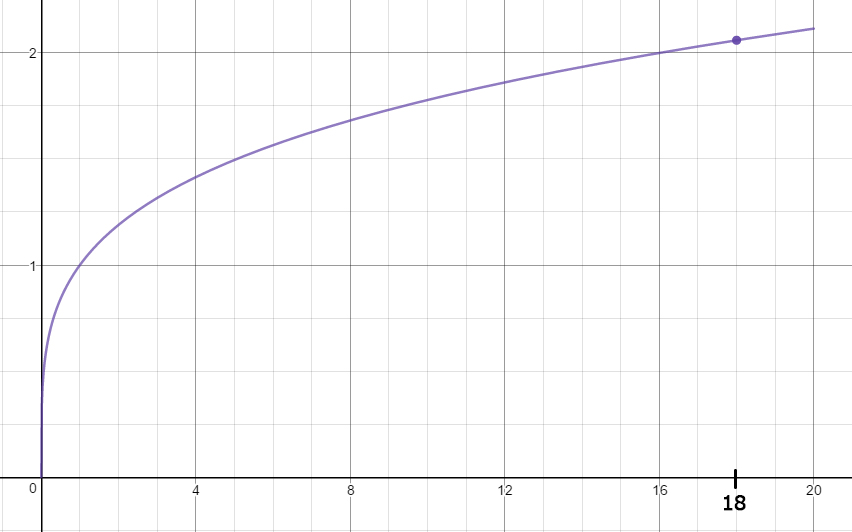
Conceptually, we have our graph of x14x^{\frac14} and we we have our point (18,1814)(18,18^{\frac14}).

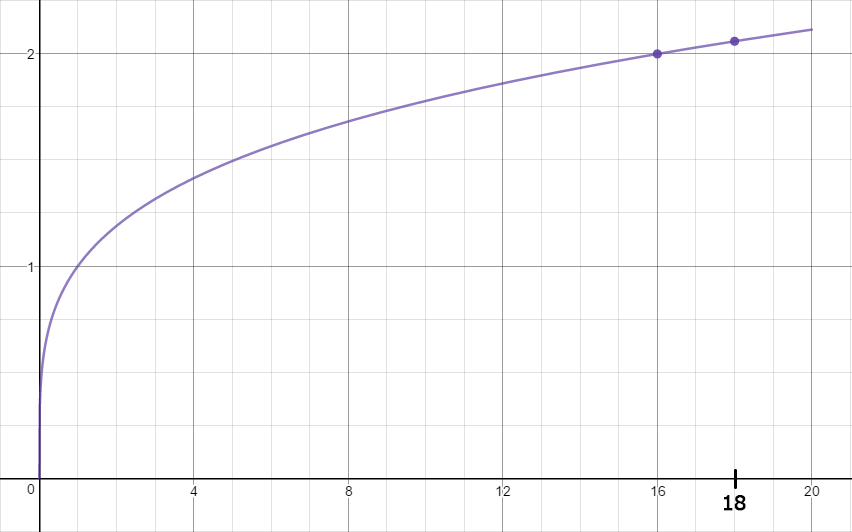
What we want to do is pick a number close to 18 that we can easily take the fourth root of. In this case, 1616 is that number. If we take the fourth root of 1616 we get 22; 164=2\sqrt[4]{16}=2.

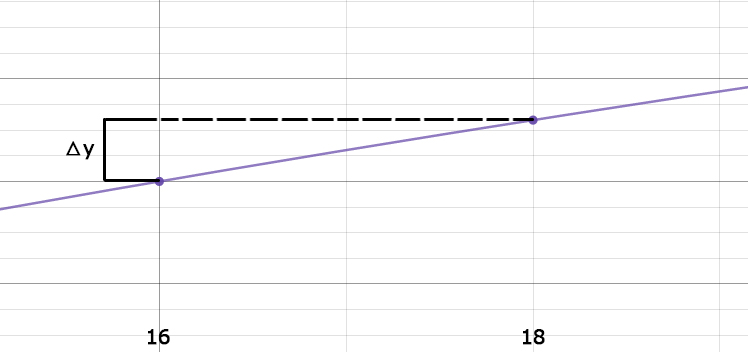
This change in height, going from 22 to 181418^{\frac14}, is what we call Δy\Delta y or the true change in yy.

So we can write that 181418^{\frac14} is equal to the prior yy value plus whatever Δy\Delta y is. 1814=y+Δy18^{\frac14}=y+\Delta y But we don't know exactly what Δy\Delta y is so we can approximate the value using dydy. 1814≈y+dy18^{\frac14}\approx y+dy

We need to take the differential of the function f(x)=x14f(x)=x^{\frac14} now. dy=14x−34dxdy=\frac14x^{-\frac34}dx This gives us a formula for our dydy value. So, we need to find an xx and dxdx to plug in.

Our xx will be the "easy to evaluate number" that we used, x=16x=16, and the dxdx will be the change between the two xx's, dx=18−16=2dx=18-16=2.

Plug these values into differential of the function. dy=14x34dx=14(16)34(2)=12(23)=12(8)=116\begin{align} dy&=\frac{1}{4\sqrt[4]{x^3}}dx\\ &=\frac{1}{4\sqrt[4]{(16)^3}}(2)\\ &=\frac{1}{2(2^3)}\\ &=\frac{1}{2(8)}\\ &=\frac{1}{16} \end{align}

Now that we have a value for dydy we can plug that into the approximation equation. 1814≈2+116≈3216+116≈3316\begin{align} 18^{\frac14}&\approx2+\frac{1}{16}\\ &\approx\frac{32}{16}+\frac{1}{16}\\ &\boxed{\approx\frac{33}{16}} \end{align}

Let's see how accurate this was. 3316=2.0625184=2.0598\frac{33}{16}=2.0625\\ \sqrt[4]{18}=2.0598 That's pretty accurate!

Type a concept, like “slope” or “photosynthesis”.

↑ ↓ to choose · Enter to openSearch explanations and problems