Video · + 2 min read

+1 contributors

(Video) Fundamental Theorem of Calculus - Part 1
by PatrickJMT
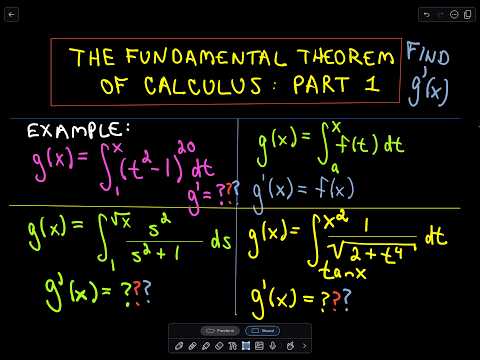
Here's a video by patrickJMT where he explains the Fundamental Theorem of Calculus Part 1 and how you can solve problems with it.

The Fundamental Theorem of Calculus Part 1
If is continuous on , then is continuous on , differentiable on , and
Essentially, we're just taking the derivative of an integral. In other words, the derivative of an integral of a function is just the function. Basically, the two cancel each other out like addition and subtraction. Furthermore, we're just taking the variable in the top limit of the integral, , and substituting it into the function being integrated, .

Problem 1 - Standard
Find the derivative of
All we need to do in this problem is replace the variable with .

Problem 2 - Variable in Lower Limit
Find the derivative of
In this problem the variable is in the lower limit. To apply the Fundamental Theorem of Calculus, the variable needs to be in the upper limit. Luckily, we can flip the limits of integration as long as we put a negative sign out front.
Now that the variable is in the upper limit we can find the derivative.

Problem 3 - Expression in Upper Limit
Find the derivative of
In this problem, we have our variable in the top limit but it's an expression. To solve these problems we need to apply the chain rule. You can substitute in the expression but then you also need to multiply it by the derivative of the expression.

Problem 4 - Expressions in Both Limits
Find the derivative of
In this problem we have a variable in both the upper and lower limit. What we can do is split the integral into two integrals at some point between the limits.
Since, it doesn't matter where we break it up at, let's just choose zero.
We need to flip the first integral because the variable is on the bottom.
Now we substitute the upper limit in and make sure to multiply by the derivative.