I recently started raising chickens. I own six baby chicks. They're seriously adorable. We got them when they were only two days old! So, for about a month, they'll live inside our house. We have them in a massive tub. They spend most of their day eating, sleeping, and running around. Right after they've woken up, they're hyper! It's chaos! You can't keep track of where they're going. One second they're on one side of the tub. The next, they're running around their waterer, jumping on their feeder, and flapping their wings. It's hilarious to watch! But when they get tired, it's so cute. When they sleep, they all gather on one side of the tub. They love to snuggle.
I've talked enough about my chickens. Let's study some chemistry.
London Dispersion Forces
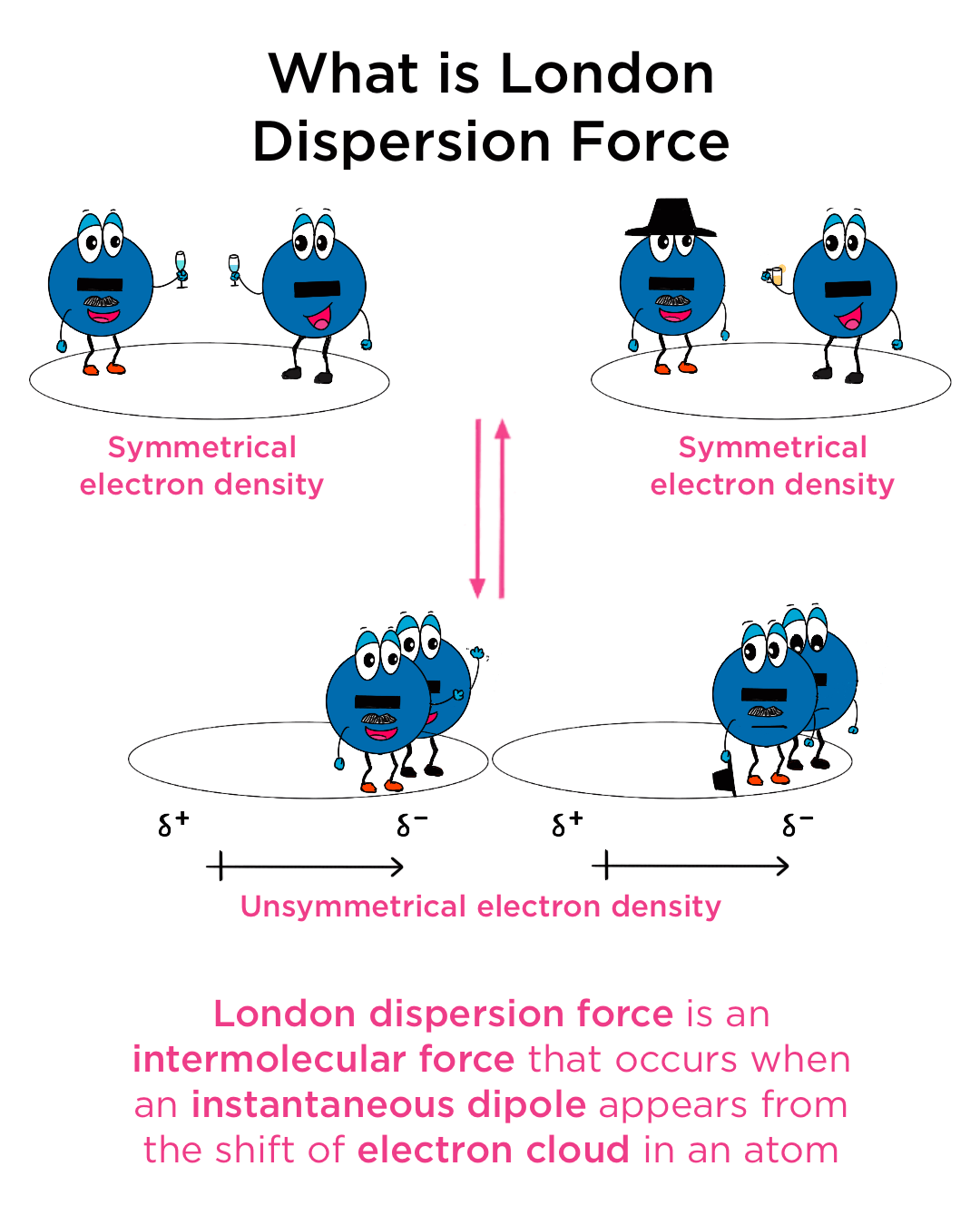
What do my chickens have to do with chemistry? They're a surprising metaphor for the electrons in atoms and molecules. Sometimes, electrons evenly space themselves. So, they balance the charge from the nucleus' protons. But sometimes, electrons will congregate. They may all be on one side of the atom. So, some protons are further from the electrons than others. The atom remains neutral. There is still an equal number of protons and electrons. But, it's unbalanced. We've created two charged sides. What's the word for that? A dipole!
When two dipoles interact, they exert a force. The forces caused by the random movement of electrons are London Dispersion Forces. We named them after Fritz London. He was a physical chemist who worked on [applied](https://www.expii.com/t/pure-vs-applied-chemistry-overview-comparison-110250 quantum mechanics in the 1930s. In the 1870s, Diderik Van der Waal argued for intermolecular forces. He thought they explained the transitions between the phases of matter. He was right! But, we didn't have a model for what caused intermolecular forces.
What causes London Dispersion Forces? Remember, we can't know an electron's exact location. That's the uncertainty principle. So, we define atomic orbitals based on probability. So, we're confident we can find an electron in a region most of the time. What's the likelihood of finding the electrons spaced evenly around an atom? Very low! So, for a split second, the atom is unbalanced. The positive side will attract the electrons of neighboring particles. The negative side attracts other nuclei.
Strength of London Dispersion Forces
Dispersion forces depend on the movement of electrons. So, what elements would you expect to experience the most dispersion? The ones with the most electrons! So, on the periodic table, dispersion forces increase across a period and down a group. That explains some of the physical properties. For example, let's consider the halogens. At room temperature, fluorine and chlorine are gases. At bromine, we transition to a liquid. Finally, Iodine is solid. The halogens are all diatomic nonpolar covalent molecules. So, the only intermolecular force they experience is dispersion forces. Iodine's atomic number is 53. Its 53 electrons are more likely to be unbalanced than fluorine's nine. Moreso, it might have many extra electrons on one side.
What else increases dispersion? The size of the molecule. Consider methane (CH4), pentane (C5H12) and octadecane (C18H38). They each only have carbon-hydrogen bonds. But, at room temperature, they are respectively gas, liquid, and solid. Why? Octadecane is a huge molecule! Its molar mass is 255 grams per mole! It has a lot of electrons. In a molecule, it's easier to think of the electron cloud. It spans the whole molecule. That's an application of molecular orbital theory. The movement of electrons causes the cloud to become distorted. Neighboring molecules get influenced by the distortion. A big molecule will have more distortions and more powerful distortions.
Percentage of Intermolecular Attraction from Dispersion
All atoms and molecules have electrons. So, they all undergo dispersion forces. But, what percentage of intermolecular interactions come from dispersion? The larger the molecule, the greater the dispersion percentage. It's considerable even for polar molecules. For example, consider hydrogen bromide. The electronegativity difference is 0.76. It's a moderate polar bond! But, the percentage of intermolecular forces attributed to dispersion is 96 percent.
Do any molecules have a low percentage? Yes. But, the molecule needs to be very small and very polar. A great example is water. It only has three atoms. The biggest is oxygen, which isn't very large. Plus, the hydrogen-oxygen bond is super polar. Water's hydrogen bonding is the stereotypical example. So, only 24 percent of its intermolecular interactions are from dispersion.