Ділення комплексних чисел

Before this, knowКорені з комплексного числа. Спряжені числа

Interactive · 1 question

When we have an fraction with ii in both the numerator and the denominator, we want to transform the fraction back to standard form: xi+yxi + y, where xx and yy are real constants. This is an example of a fraction complex number: (5)/(9+2i)(5)/(9 + 2i)

The denominator, (9+2i)(9 + 2i), has a conjugate, (9−2i)(9 - 2i). It can be multiplied to its conjugate to form a difference of squares, consisting of only numeral terms and i2i^2 terms. The i2i^2 term can then be symplified to a −1-1 term, making all the terms constant numerals. Let's do this on the example fraction complex number:
(5)/(9+2i)(5)/(9 + 2i) = (5)∗(9−2i)/(9+2i)∗(9−2i)(5) * (9 - 2i)/(9 + 2i) * (9 - 2i) = (45−10i)/(81−4i)(45 - 10i)/(81 - 4i)

Your answer is: (45−10i)/(81−4i)(45 - 10i)/(81 - 4i).

What is a conjugate?

Choose one answer

Video

(Video) Dividing Complex Numbers

by mathman1024

In this video by mathman1024 he shows you how to divide complex numbers. The trick to solve these is to multiply both top and bottom by the complex conjugate.

The first problem he solves is 72+3i\dfrac{7}{2+3i}. 72+3i⋅2−3i2−3i7(2−3i)(2+3i)(2−3i)14−21i4+914−21i131413−21i13\frac{7}{2+3i}\color{#8925AE}{\cdot\frac{2-3i}{2-3i}}\\ \frac{7(2-3i)}{(2+3i)(2-3i)}\\ \frac{14-21i}{4+9}\\ \frac{14-21i}{13}\\ \frac{14}{13}-\frac{21i}{13}

Try the following examples by yourself and then see if you get the same answers as him.

  1. 105−i\dfrac{10}{5-i}
  2. 5−2i1+4i\dfrac{5-2i}{1+4i}

Test Yourself: 3+i1+i\dfrac{3+i}{1+i}

Choose one answer

Illustrated · 1 min

Now that we've covered multiplying complex numbers, let's move on to dividing!

Dividing Complex Numbers

When dividing two complex numbers, there is a general pattern that you can follow!

Before diving in, it might be helpful to review the concept of complex conjugates.

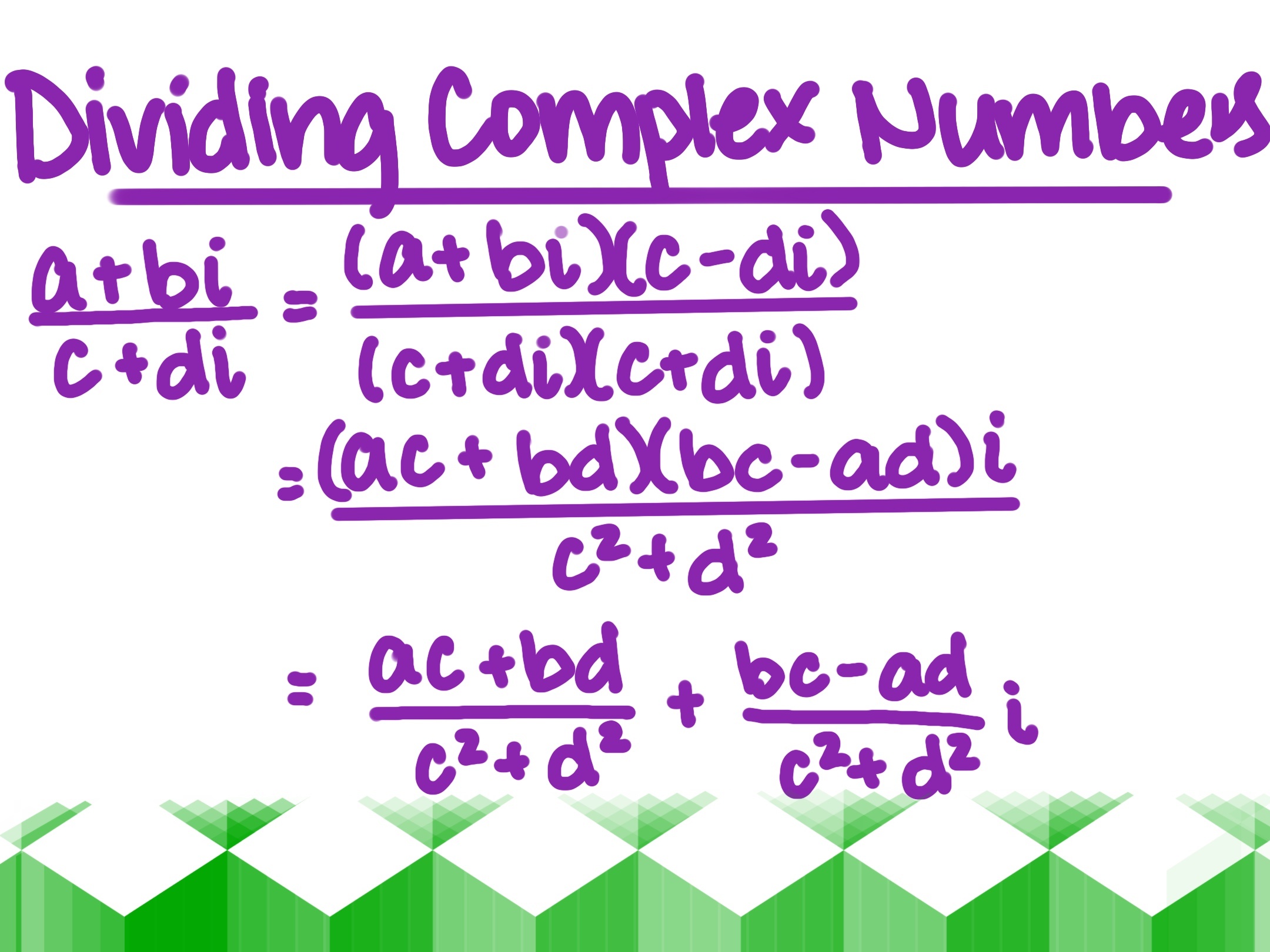
Dividing complex numbers

Image source: by Anusha Rahman

When we divide complex numbers, we use multiply the fraction by the complex conjugate of the denominator, since our goal is to get rid of the imaginary number in the denominator. We use FOIL to get rid of the imaginary part.

Even if you don't see division of complex numbers presented as a fraction, you can still convert it to this form! Writing the problem as a fraction will help you to solve the problem.

You can also extend this topic to dividing complex numbers in polar form!

Type a concept, like “slope” or “photosynthesis”.

↑ ↓ to choose · Enter to openSearch explanations and problems